13 min read
Encounter route pick
Pick one encounter or route already written on this topic and reopen it next time.
Classroom literacy — not a lab result, diagnosis or outbreak alert.
Route on this page
Quick facts
J. William Costerton and colleagues popularized biofilm for sessile communities glued in their own matrix.Costerton 1978
Plaque is the everyday biofilm: mixed oral species on teeth, fed by sugars and time.Dental plaque
Catheters, joints and valves can host films that shrug off doses that kill planktonic cells.Device persistence
Extracellular polymeric substance — sugars, proteins, DNA — holds water and slows some drugs.EPS matrix
Many species use chemical signals to coordinate group behavior once density rises — a concept, not a home experiment.Quorum talk
Reviews often estimate that a majority of chronic device-related infections involve biofilm; the exact share is debated.Chronic-infection share
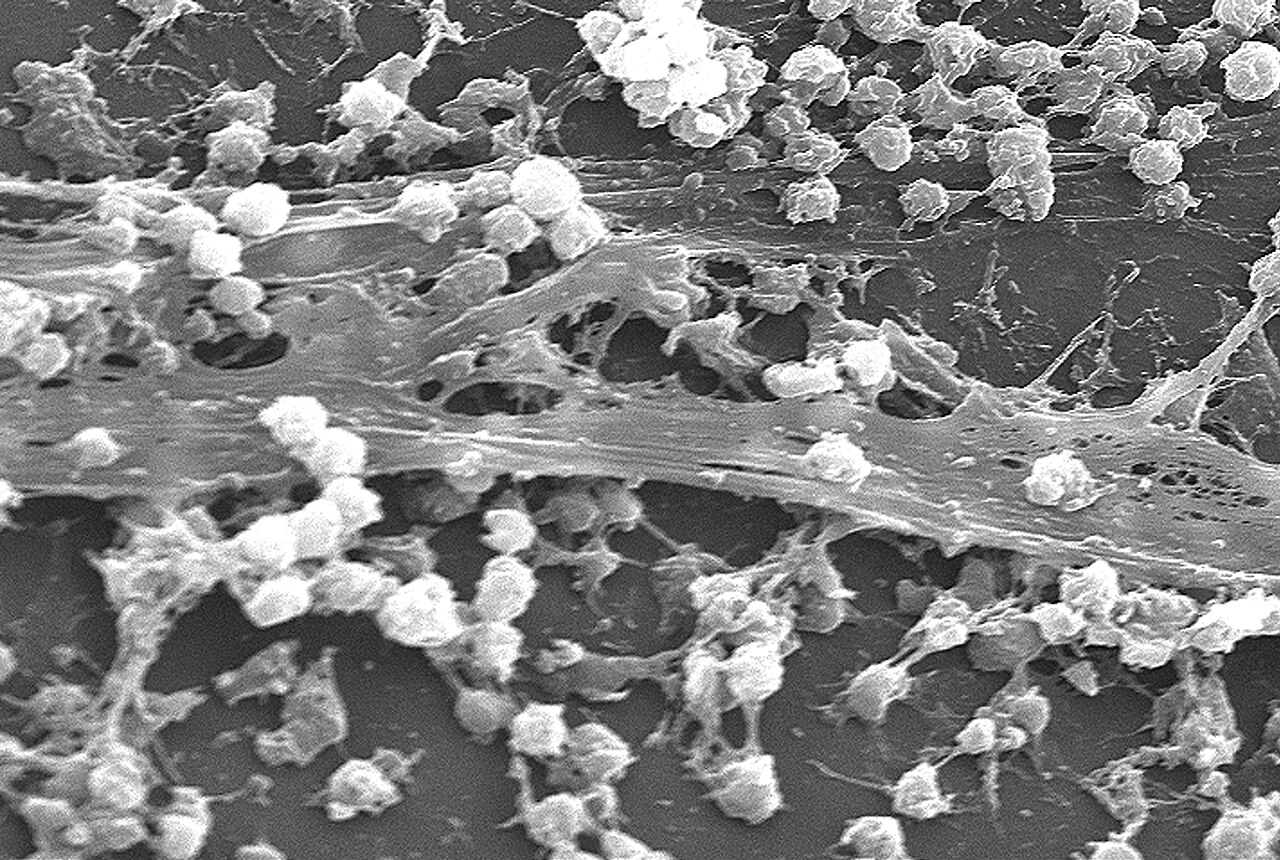
A biofilm is a community stuck to a surface and wrapped in a homemade matrix, not a lonely floating cell.
Plaque and catheter films show why a drug that works in a flask can fail on a surface.
This page explains persistence as ecology. It is not a protocol for growing films.
38FamiliarityEditorial 0–100 browsing aid within this atlas.
70Medical weightEditorial 0–100 browsing aid within this atlas.
30BenefitEditorial 0–100 browsing aid within this atlas.
65RiskEditorial 0–100 browsing aid within this atlas.
Biofilms — concrete atlas depth on Tool-Lifes.
Best-of microbe rankings
Biofilms — concrete atlas depth on Tool-Lifes.
Local lensCities of cells
English dentistry already taught biofilm as plaque. Hospital English adds catheter and implant. Kitchen English says slime on a vase.
Plaque
The English most people already have for a biofilm.
Hospital devices
Public infection-control stories, not a nursing manual.
Public-health desks
Plumbing slime is ecology. Do not weaponise household cleaners from this page.
Read the local lens — English-speaking public health
The profile
- Familiarity38
- Medical weight70
- Benefit30
- Risk65
- Research75
- Live debate25
Risk
Surface cities of microbes — plaque and catheters explain persistence, without a grow-your-own kit.
Seven ways into this topic
Related on the scale
Slide across the log scale — teaching sizes, not lab measurements.
See size scale →
Frequently asked questions
Where should I start with Biofilms?
Read Identity → How they live → Body & health, then use compare rails.
Is this page advice for Biofilms?
Public-health education — not a care plan, prescription, or outbreak briefing.
What does the local lens add?
It names everyday desks for Change & defence before English norms look universal.
Are the scores a ranking of Biofilms?
No — editorial 0–100 browsing aids inside this atlas only.
How do I compare Biofilms to neighbours?
Use related cards and best-of / quiz rails after the first three chapters.
Which chapter is densest?
How they live and Body & health carry mechanisms; skim Identity first.
Can I cite these scores externally?
Treat them as atlas orientation, not certificates or forecasts.
What should I check before acting?
Primary desks for Change & defence: public-health desks and lab teaching frames.
More in Change & defence
MMutation and variants
Populations of genomes, not cartoon villains — RNA viruses copy sloppily, and public-health names track clusters that spread.
AAntibiotic resistance
A shared drug budget under selection in hospitals, farms and wastewater — stewardship, not a lab manual.
VVaccines and immunity
Antibodies, memory cells and community arithmetic — conceptual, not a prescription and not an anti-vaccine tract.
HHygiene and balance
Clean water saves lives; missing old microbial partners is a separate, still-debated immune story.
HHorizontal gene transfer
Sideways DNA traffic — conjugation, transduction, transformation as names and history, not protocols.