13 min read
Encounter route pick
Pick one encounter or route already written on this topic and reopen it next time.
Classroom literacy — not a lab result, diagnosis or outbreak alert.
Route on this page
Quick facts
About 78% of the atmosphere is inert dinitrogenAir is mostly N2
Only some bacteria and archaea fix N2 into ammoniaNitrogenase
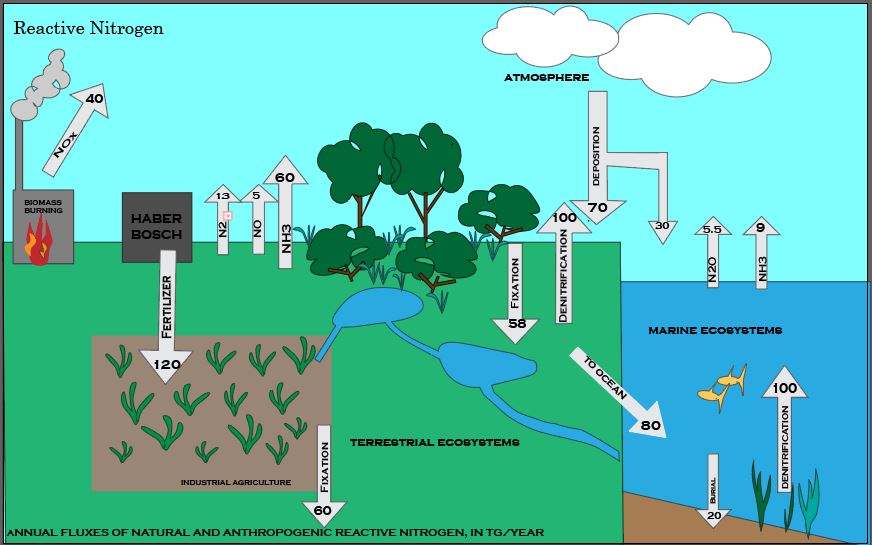
1909–1913 industrial ammonia — a human parallel to microbesHaber-Bosch
Ammonia oxidisers then nitrite oxidisers (classic Nitrosomonas / Nitrobacter teaching)Nitrification pair
Anaerobes return N2 (and some N2O) to airDenitrification
1990s — anaerobic ammonium oxidation, now used in some wastewater plantsAnammox
The nitrogen cycle is how life borrows an inert atmospheric gas. Microbes fix N2, oxidise ammonia, and return N2 — a relay no animal invented.
Haber-Bosch (1909–1913) added an industrial shortcut that now feeds billions and also leaks surplus nitrate and N2O.
This atlas is ecology and history, not a fertilizer recipe or a culture protocol.
40FamiliarityEditorial 0–100 browsing aid within this atlas.
10Medical weightEditorial 0–100 browsing aid within this atlas.
90BenefitEditorial 0–100 browsing aid within this atlas.
8RiskEditorial 0–100 browsing aid within this atlas.
Nitrogen cycle — concrete atlas depth on Tool-Lifes.
Best-of microbe rankings
Nitrogen cycle — concrete atlas depth on Tool-Lifes.
Local lensAir into life
English school posters show N2 to nitrate. Adult English meets the same cycle as fertilizer runoff and coastal dead zones.
Fertilizer English
NPK on a bag is the industrial nitrogen cycle in three letters.
Dead zone news
Gulf hypoxia stories are nitrogen plus microbes plus politics.
Public-health desks
English-speaking diets already eat the cycle when they eat beans and peas.
Read the local lens — English-speaking public health
The profile
- Familiarity40
- Medical weight10
- Benefit90
- Risk8
- Research60
- Live debate15
Risk
How microbes move nitrogen between air, soil, water and food — plus the industrial shortcut that feeds billions.
Seven ways into this topic
01
Identity
A microbial relay that moves nitrogen between air, water, soil and living tissue.
Read
02
How they live
Fixation, assimilation, nitrification, denitrification and anammox.
Read
03
Body & health
Bread from Haber-Bosch, river dead zones, and wastewater as a microbial factory.
Read
04
History
From Hellriegel's nodules to Haber-Bosch, Winogradsky and anammox.
Read
05
Everyday life
Beans on the plate, lawn fertilizer, river news and the air you do not notice.
Read
06
Frontiers
How to feed people with less leak, and who the newest oxidisers really are.
Read
07
Myths
Air nitrogen is not plant food until microbes or factories act; more fertilizer is not always better.
Read
Related on the scale
Slide across the log scale — teaching sizes, not lab measurements.
See size scale →
Frequently asked questions
Where should I start with Nitrogen cycle?
Read Identity → How they live → Body & health, then use compare rails.
Is this page advice for Nitrogen cycle?
Public-health education — not a care plan, prescription, or outbreak briefing.
What does the local lens add?
It names everyday desks for Beneficial allies before English norms look universal.
Are the scores a ranking of Nitrogen cycle?
No — editorial 0–100 browsing aids inside this atlas only.
How do I compare Nitrogen cycle to neighbours?
Use related cards and best-of / quiz rails after the first three chapters.
Which chapter is densest?
How they live and Body & health carry mechanisms; skim Identity first.
Can I cite these scores externally?
Treat them as atlas orientation, not certificates or forecasts.
What should I check before acting?
Primary desks for Beneficial allies: public-health desks and lab teaching frames.
More in Beneficial allies