Darker cells mean a higher score for this topic on that metric.
LessMore
Last reviewed Sources & creditsMedia creditsMethodology
Quick answers
How many wild tigers are left?
Global estimates in the 2020s sit near 4,000-5,500 depending on the year and method. India holds the majority. The number is a camera-trap product, not a Victorian hunter tale.
Did Project Tiger work?
India wild counts rose from a 1970s crisis to the largest national population. Methods changed (pugmarks to cameras), so the graph is not a single instrument. Southeast Asia did not copy the rebound.
What was Tx2?
A 2010 pledge by tiger-range states in St Petersburg to double wild numbers by 2022. Some countries gained; others lost. The slogan outlived the deadline.
Why not score tigers and lions the same?
Lions are Vulnerable with a wider African footprint and a tiny Gir relic. Tigers are Endangered, more forest-bound, and culturally heavier in South and East Asia. Scores stay relative across all 24 types.
Who was Jim Corbett in this story?
A hunter of man-eaters who wrote Man-Eaters of Kumaon (1944) and later lent his name to India first national park -- a colonial-to-reserve arc.
Are Siberian tigers a separate conservation?
Panthera tigris tigris now lumps many mainland tigers in some taxonomies; Amur animals still have a Russian-Chinese border programme and a different prey winter.
IUCN: Endangered
Anatomy overlay
Numbered teaching hotspots on the species still — not a clinical diagnosis.
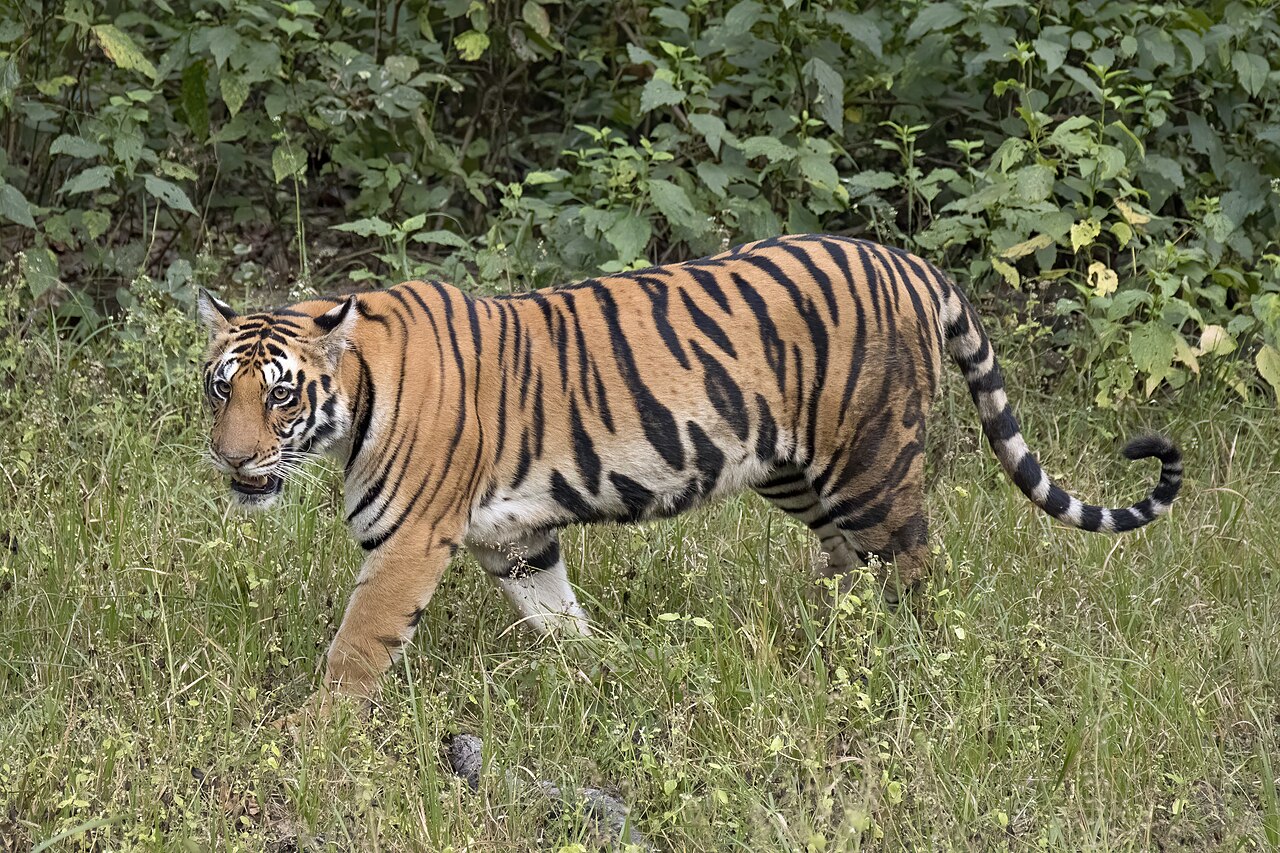
- 1 Primary weapon or tool — The bill, teeth, trunk, pouch or talon that field guides name first -- and that trade or c
- 2 Energy store — Fat, cache, crop or bamboo hours that decide whether a season closes.
- 3 Natal or breeding site — A redd, eyrie, den, anemone or ice lair -- often a single-point risk (Izumi, Natron, Gir).
- 4 Sensory organ — Night vision and hearing in closed forest. Stripes break outline more than they advertise.
- 5 Human interface — Hunt, tourism, film or quota -- the surface where tiger biology meets English-language law
Anatomy overlay
Four teaching regions on Tiger. A schematic, not a dissection guide.
Every tiger is a stack of tissues that must agree under season, prey and human pressure.
Meters below repeat the six atlas scores as gauges; they are relative marks, not laboratory certificates.
Systems
Support and integument
A solitary pantherine with a long body, striped disruptive coat and forelimbs built to wrestle large ungulates. Canines and a killing bite to the neck or throat finish what the ambush starts.
Feeding apparatus
Sit-and-ambush on chital, sambar, wild pig and, in the Amur, deer and boar. A large kill funds days; livestock is the conflict calorie. The feeding kit sets the ecological-role score relative to the other 23 types.
Respiration and circulation
Gas exchange and blood flow are tuned to the tiger energy budget -- dive, hover, sprint or bulk browse -- not to a generic vertebrate template.
Senses and neural control
Night vision and hearing in closed forest. Stripes break outline more than they advertise.
Reproduction and ontogeny
Replacement rate is the hidden resilience number. A few thousand animals, shrinking SE Asian forest, and a prey base that snares erase. High cultural impact does not raise resilience.
Thermoregulation and salt/water
Climate and osmoregulation bound where a tiger can close its daily budget. Field sites in the English-speaking world still measure that envelope first.
Relative meters
Hotspots
Primary weapon or tool
The bill, teeth, trunk, pouch or talon that field guides name first -- and that trade or conflict usually targets.
Energy store
Fat, cache, crop or bamboo hours that decide whether a season closes.
Natal or breeding site
A redd, eyrie, den, anemone or ice lair -- often a single-point risk (Izumi, Natron, Gir).
Sensory organ
Night vision and hearing in closed forest. Stripes break outline more than they advertise.
Human interface
Hunt, tourism, film or quota -- the surface where tiger biology meets English-language law.
Tissues & materials
Keratin and integument
Feathers, fur, baleen or skin plates -- tissues, not metals. Moult and wear are the maintenance cycle.
Bone and cartilage
Load paths for stoop, lunge, knuckle-walk or hover. Marrow and pneumatic bone differ by family.
Muscle and tendon
The expensive tissue that speed and intelligence scores only hint at.
Fat, oil and glycogen
Stores that migration, fast and lactation spend. A market for those stores (oil, ivory, fin) is a historical threat.
Keep exploring
More in Wildlife
Lion
A social pantherine whose prides, Gir relic and 2015 Cecil killing still structure African conservation politics.
Overall 66 🐘African bush elephant
The atlas type is the bush elephant -- an ecosystem engineer whose ivory ban (1989) and split from forest elephants still structure African conservation.
Overall 61 🐺Gray wolf
A Holarctic pack hunter whose 1995 Yellowstone return and older Leopold ethics still structure predator politics.
Overall 78 🐼Giant panda
A bamboo specialist whose WWF logo, Wolong quake and 2016 IUCN downlist from EN to VU made a recovery into a brand.
Overall 41 🐻Polar bear
A marine bear whose seal-and-ice budget made Churchill, Knut and climate models into one public animal.
Overall 56 🦍Gorilla
The atlas type is the western gorilla -- a knuckle-walking ape whose Fossey-era mountain cousins and Koko lab fame split one public name.
Overall 45 🐋Blue whale
The largest animal whose 1966 IWC protection, 1982 moratorium and still-thin Antarctic recovery define a hunted giant.
Overall 65