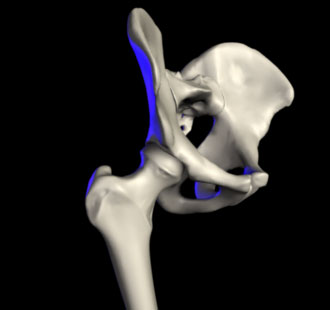
The hip is a deep, stable ball-and-socket joint that bears several times body weight during walking and running, making it a common site of both overuse pain and degenerative change.
Osteoarthritis, tendinopathy, muscle strainCommon cause
8–12 weeks for tendinopathyTypical recovery
Gluteus medius, iliopsoas, hamstringsKey muscles
Inability to bear weight after traumaRed-flag signs
The hip is a deep ball-and-socket joint where the femoral head sits within the pelvis's cup-shaped socket, giving it far greater inherent bony stability than the shoulder while still allowing a substantial range of motion for walking, running, and squatting.
As a major weight-bearing joint, the hip is subject to forces several times body weight during activities such as running or climbing stairs, which contributes to its vulnerability to both overuse injuries in active individuals and degenerative osteoarthritis with advancing age.
Hip pain can also originate from surrounding soft tissue, including the gluteal tendons at the outer hip or the iliopsoas tendon at the front, rather than the joint itself, which is why a careful examination is often needed to localize the true source. This page reviews the hip's anatomy, common conditions, assessment approaches, and general exercise and recovery patterns.
The profile
Pain frequency55
Recovery length60
Exercise load55
Clinician need65
Self-care fit45
Recurrence risk55
Clinician need
The hip is a deep, stable ball-and-socket joint that bears several times body weight during walking and running, making it a common site of both overuse pain and degenerative change.
The hip is a deep ball-and-socket joint where the femoral head sits within the pelvis's cup-shaped socket, giving it far greater inherent bony stability than the shoulder while still allowing a substantial range of motion for walking, running, and squatting.
When should I stop and seek care for Hip?
Inability to bear weight after trauma — A sudden inability to bear weight on the leg following a fall, particularly in older adults, raises concern for hip fracture and warrants urgent evaluation.
What is a starter exercise for Hip?
Hip flexor stretch — 2 × 3 each side, held 20–30s — In a kneeling lunge position, gently shift the hips forward while keeping the trunk upright to stretch the front of the hip.
How does Hip load progression usually start?
Pain and load management — 0–2 weeks — Activity modification and gentle range-of-motion work aim to reduce irritation while maintaining as much normal movement as tolerated.
What should I avoid with Hip?
Prolonged sitting with legs crossed — Sustained hip adduction and internal rotation positions, such as crossing the legs for long periods, are commonly discouraged in gluteal tendon conditions because they compress the irritated tendons.
What causes hip pain in older adults?
Osteoarthritis is among the most common causes of hip pain after middle age, involving gradual breakdown of the joint's cartilage and associated changes in the surrounding bone and soft tissue.
What is greater trochanteric pain syndrome?
Greater trochanteric pain syndrome describes pain at the outer hip related to irritation of the gluteal tendons or the nearby bursa, often mistaken in the past for bursitis alone.
What is femoroacetabular impingement?
Femoroacetabular impingement describes abnormal contact between the femoral head and the hip socket during certain movements, related to subtle variations in bone shape, which can contribute to groin pain and reduced range of motion in some individuals.
Neighbouring regions
Neighbouring topics share region literacy — not a severity ranking.