- 1 Start
- 2 Mid
- 3 End
Hip flexor stretch
●○○○○2 × 3 each side, held 20–30s
In a kneeling lunge position, gently shift the hips forward while keeping the trunk upright to stretch the front of the hip.
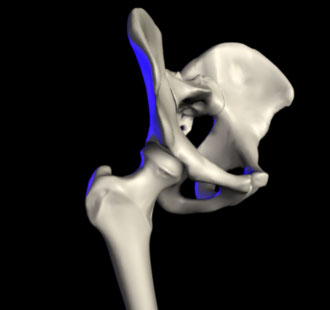
Hip · The hip is a deep, stable ball-and-socket joint that bears several times body weight during walking and running, making it a common site of both overuse pain and degenerative change.
Darker cells mean a higher score for this topic on that metric.
LessMore
Last reviewed Sources & creditsMedia creditsMethodology
Osteoarthritis is among the most common causes of hip pain after middle age, involving gradual breakdown of the joint's cartilage and associated changes in the surrounding bone and soft tissue.
Greater trochanteric pain syndrome describes pain at the outer hip related to irritation of the gluteal tendons or the nearby bursa, often mistaken in the past for bursitis alone.
Femoroacetabular impingement describes abnormal contact between the femoral head and the hip socket during certain movements, related to subtle variations in bone shape, which can contribute to groin pain and reduced range of motion in some individuals.
Many cases of hip osteoarthritis are managed for years with exercise, weight management, and activity modification; joint replacement is typically considered when conservative measures no longer provide adequate relief.
Reduced strength or endurance in the gluteal muscles is commonly associated with several hip and even knee conditions, since these muscles are central to controlling pelvis and leg alignment during walking and running.
A hip labral tear is damage to the ring of cartilage that deepens the hip socket, which can occur from trauma, repetitive impingement, or gradual wear, and may contribute to pain, clicking, or a sense of instability.
Hip exercise programs typically combine mobility work to maintain joint range with strengthening focused on the gluteal muscles, which play a central role in controlling pelvic and leg alignment.
For conditions like osteoarthritis, guidelines from bodies such as the American Academy of Orthopaedic Surgeons consistently recommend exercise as a first-line management strategy alongside weight management where relevant.
Simple picture of a move already published on this page — not a prescription or medical advice.
2 × 3 each side, held 20–30s
In a kneeling lunge position, gently shift the hips forward while keeping the trunk upright to stretch the front of the hip.
3 × 12 each side
Lying on the side with knees bent, lift the top knee while keeping the feet together and the pelvis still.
3 × 12
Lying on the back with knees bent, lift the hips by squeezing the glutes without overarching the low back.
3 × 12 each side
Standing tall, lift one leg out to the side with control, keeping the trunk stable and avoiding hip hiking.
3 × 12 each side
Lying on the side with a light band above the knees, lift the top leg against resistance while keeping the hips stacked.
3 × 12
Lower the hips back and down while keeping the knees tracking over the feet, then return to standing.
3 × 10 each side
Step up onto a stable platform leading with one leg, controlling the movement on both the way up and down.
3 × 8 each side
Balancing on one leg, hinge forward at the hip while extending the other leg behind for counterbalance, then return to standing.
Progression generally moves from isolated gluteal activation toward more functional, weight-bearing movements that mirror the demands of walking, stair climbing, and sport.
Neighbouring topics share region literacy — not a severity ranking.
The knee is the body's largest joint and one of its most frequently injured, relying on ligaments and surrounding muscles rather than bony shape for stability.
Pain frequency 65 Same body regionThe anterior cruciate ligament stabilizes the knee against pivoting and forward-sliding forces, and its rupture is one of the most studied and rehabilitation-intensive sports injuries.
Pain frequency 50 Same body regionThe ankle and foot absorb and redirect the full force of body weight with every step, making sprains and overuse injuries among the most common in sport and daily life.
Pain frequency 70 Same body region