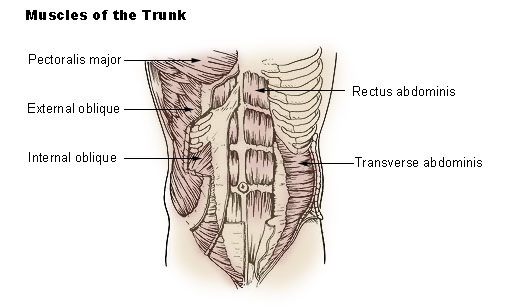
The core is the coordinated group of trunk muscles that stabilizes the spine and pelvis, transferring force between the upper and lower body during nearly every movement.
Spinal stabilization and force transferPrimary role
Deconditioning rather than injuryCommon issue
4–8 weeks to build baseline enduranceTypical timeline
Linked to low back pain preventionClinical relevance
Endurance and control over raw strengthTraining focus
The core is not a single muscle but a coordinated system spanning the abdominal wall, deep spinal muscles, pelvic floor, and diaphragm. Together, these structures stabilize the trunk and pelvis, allowing force generated by the legs to transfer efficiently to the arms and back again during walking, lifting, and sport.
Unlike most regions covered on this site, the core is rarely the site of an acute traumatic injury; instead, it is more often discussed in the context of deconditioning, muscular imbalance, or its supporting role in preventing and managing low back pain. Research on core stability exercise has grown substantially since the 1990s, though its precise role relative to general strength and conditioning remains an active area of study.
This page reviews the core's anatomy, common issues related to weakness or dysfunction, how clinicians assess trunk control, and general exercise progressions used in both rehabilitation and general fitness settings.
The profile
Pain frequency35
Recovery length20
Exercise load55
Clinician need25
Self-care fit80
Recurrence risk40
Clinician need
The core is the coordinated group of trunk muscles that stabilizes the spine and pelvis, transferring force between the upper and lower body during nearly every movement.
The core is not a single muscle but a coordinated system spanning the abdominal wall, deep spinal muscles, pelvic floor, and diaphragm. Together, these structures stabilize the trunk and pelvis, allowing force generated by the legs to transfer efficiently to the arms and back again during walking, lifting, and sport.
When should I stop and seek care for Core?
Visible or palpable abdominal bulge — A new bulge in the abdominal wall, especially one that changes with coughing or straining, may indicate a hernia and should be evaluated by a physician.
What is a starter exercise for Core?
Abdominal drawing-in — 3 × 10, held 5–10s — Gently draw the lower abdomen inward without holding the breath or tilting the pelvis.
How does Core load progression usually start?
Activation and awareness — 0–2 weeks — Learning to isolate and activate the deep stabilizing muscles without substituting larger, more superficial muscles.
What should I avoid with Core?
High-repetition sit-ups as the main strategy — Relying heavily on repeated spinal flexion exercises is generally discouraged in modern rehabilitation guidance, since it loads the lumbar discs without necessarily building functional stability.
What muscles make up the core?
The core includes the deep transversus abdominis, the rectus and oblique abdominal muscles, the multifidus and erector spinae along the spine, the diaphragm above, and the pelvic floor below.
Is core strength the same as having visible abdominal muscles?
No — core strength refers to the ability of trunk muscles to stabilize the spine under load, which is a functional quality distinct from muscle visibility, which depends more on body composition.
Does a strong core prevent back pain?
Core strengthening is commonly included in back pain prevention programs and is associated with reduced recurrence in some studies, though it is one of several contributing factors alongside general activity and load management.
Neighbouring regions
Neighbouring topics share region literacy — not a severity ranking.