Transversus abdominis
The deepest abdominal muscle wraps horizontally around the trunk like a corset and typically activates just before limb movement to stabilize the spine.
Core · The core is the coordinated group of trunk muscles that stabilizes the spine and pelvis, transferring force between the upper and lower body during nearly every movement.
Darker cells mean a higher score for this topic on that metric.
LessMore
Last reviewed Sources & creditsMedia creditsMethodology
The core includes the deep transversus abdominis, the rectus and oblique abdominal muscles, the multifidus and erector spinae along the spine, the diaphragm above, and the pelvic floor below.
No — core strength refers to the ability of trunk muscles to stabilize the spine under load, which is a functional quality distinct from muscle visibility, which depends more on body composition.
Core strengthening is commonly included in back pain prevention programs and is associated with reduced recurrence in some studies, though it is one of several contributing factors alongside general activity and load management.
Modern core training generally emphasizes anti-movement exercises like planks and dead bugs over high-repetition spinal flexion, since repeated sit-ups load the lumbar discs without necessarily improving functional stability.
Diastasis recti is a widening of the connective tissue between the two sides of the rectus abdominis, common during and after pregnancy, that can affect trunk support and is often addressed with targeted rehabilitation exercise.
Because core muscles are largely endurance-oriented postural muscles, many programs include some form of core activation several days a week, though adequate recovery still applies to higher-intensity strengthening work.
The core can be described as a cylinder: the diaphragm forms the top, the pelvic floor forms the bottom, the deep abdominal and spinal muscles form the walls, and coordinated activity among all of them regulates pressure and stability within the trunk.
Rather than producing large joint movements, many core muscles act primarily as stabilizers, contracting to resist unwanted motion of the spine while the limbs move — a role sometimes described as anticipatory or anti-movement function.
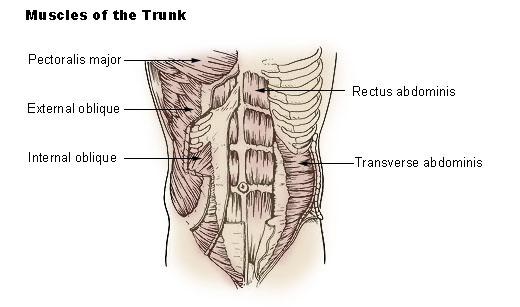
The deepest abdominal muscle wraps horizontally around the trunk like a corset and typically activates just before limb movement to stabilize the spine.
This long, superficial muscle running down the front of the abdomen flexes the trunk and is most visible when body fat is low, though it plays a smaller stabilizing role than the deeper muscles.
These layered muscles at the sides of the trunk control rotation and side-bending and contribute significantly to force transfer between the upper and lower body during twisting movements.
Small, deep muscles running along the spine provide fine-tuned control at each vertebral level and are frequently found to be underactive in people with a history of low back pain.
Beyond its role in breathing, the diaphragm works with the deep abdominal wall to manage intra-abdominal pressure, contributing to spinal support during lifting and exertion.
This muscular sling at the base of the pelvis supports pelvic organs and works in coordination with the diaphragm and deep abdominals to regulate trunk pressure.
While the core is discussed more in terms of stability than pure range of motion, thoracolumbar rotation is the primary movement most core muscles help control, particularly during twisting or asymmetric lifting tasks.
This layered, cylinder-like arrangement explains why core training programs typically target endurance and coordinated activation across multiple muscles rather than isolated strength in any single one.
Neighbouring topics share region literacy — not a severity ranking.
The seven cervical vertebrae and the soft tissues that carry the head — posture load, disc and facet pain, and graded mobility work.
Pain frequency 82 Same body regionThe lumbar spine bears more compressive load than any other spinal region, making low back pain the single most common musculoskeletal complaint worldwide.
Pain frequency 80 Same body region