- 1 Start
- 2 Mid
- 3 End
Abdominal drawing-in
●○○○○3 × 10, held 5–10s
Gently draw the lower abdomen inward without holding the breath or tilting the pelvis.
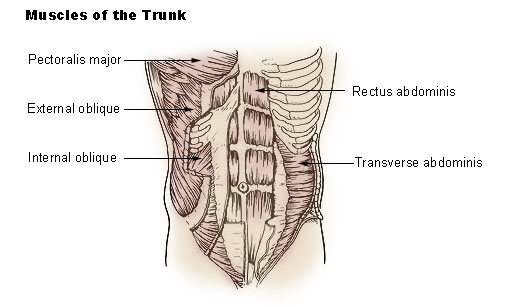
Core · The core is the coordinated group of trunk muscles that stabilizes the spine and pelvis, transferring force between the upper and lower body during nearly every movement.
Darker cells mean a higher score for this topic on that metric.
LessMore
Last reviewed Sources & creditsMedia creditsMethodology
The core includes the deep transversus abdominis, the rectus and oblique abdominal muscles, the multifidus and erector spinae along the spine, the diaphragm above, and the pelvic floor below.
No — core strength refers to the ability of trunk muscles to stabilize the spine under load, which is a functional quality distinct from muscle visibility, which depends more on body composition.
Core strengthening is commonly included in back pain prevention programs and is associated with reduced recurrence in some studies, though it is one of several contributing factors alongside general activity and load management.
Modern core training generally emphasizes anti-movement exercises like planks and dead bugs over high-repetition spinal flexion, since repeated sit-ups load the lumbar discs without necessarily improving functional stability.
Diastasis recti is a widening of the connective tissue between the two sides of the rectus abdominis, common during and after pregnancy, that can affect trunk support and is often addressed with targeted rehabilitation exercise.
Because core muscles are largely endurance-oriented postural muscles, many programs include some form of core activation several days a week, though adequate recovery still applies to higher-intensity strengthening work.
Core exercise programs generally begin with learning to activate the deep stabilizing muscles in isolation, then progress toward exercises that challenge the trunk to resist motion while the limbs move.
This anti-movement approach — resisting unwanted flexion, extension, or rotation — is widely used in both rehabilitation and general strength training because it reflects how the core actually functions during daily and athletic activity.
Simple picture of a move already published on this page — not a prescription or medical advice.
3 × 10, held 5–10s
Gently draw the lower abdomen inward without holding the breath or tilting the pelvis.
3 × 10 each side
Lying on the back with arms and knees raised, lower one arm and the opposite leg slowly while keeping the low back stable.
3 × 8 each side
From hands and knees, extend one arm and the opposite leg while keeping the trunk level and still.
3 × 20–40s
Hold a straight line from head to heels on forearms and toes, keeping the hips level throughout.
3 × 15–30s each side
Support the body on one forearm and the side of one foot, keeping the hips lifted in a straight line.
3 × 10 each side
Holding a resistance band anchored to one side, press the hands straight out while resisting the pull toward that side.
3 × 30–40m
Carry a weight at the side or overhead while walking with an upright, stable trunk.
3 × 8–10
From a kneeling position with hands on a stable roller or bar, extend the arms forward while keeping the spine neutral, then return.
As control improves, exercises typically progress from isolated activation on a stable surface toward dynamic, loaded, or unstable conditions that better reflect the demands of daily activity and sport.
Neighbouring topics share region literacy — not a severity ranking.
The seven cervical vertebrae and the soft tissues that carry the head — posture load, disc and facet pain, and graded mobility work.
Pain frequency 82 Same body regionThe lumbar spine bears more compressive load than any other spinal region, making low back pain the single most common musculoskeletal complaint worldwide.
Pain frequency 80 Same body region