Census mother tongue undercounts multilinguals
One box per person erases daily code-switching — survey design shapes the map.
Which languages children learn first — speaker giants, endangered isolates and the politics of schooling.
Side-by-side cultures and maps — never race ranks.
Read the map layers
Last reviewed Sources & creditsMedia creditsMethodology
Five research punchlines — scan before you dive.
Mother tongues is a reference layer for the Peoples atlas: patterns you can check, not a podium for continents.
Each layer explains what the measure is, where it misleads, and how it connects to culture pages without racial ranking.
Demography and linguistics change; treat figures as era-bound.
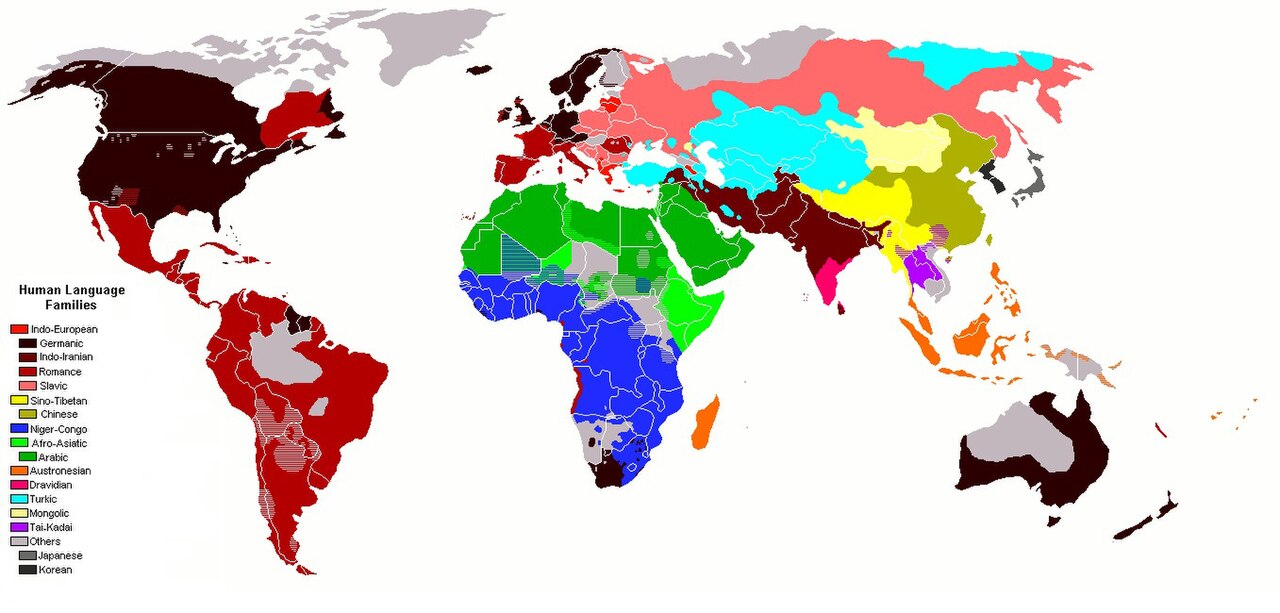
What Mother tongues measures and why it matters.
This layer exists to answer “where?” and “how connected?” without sliding into “who is better?”
Read it beside culture pages: tongues, cities and migrations are how peoples actually meet.
English can dominate workplaces while remaining a second language for billions.
States undercount or overcount tongues to fit national stories.
Most named languages have small speaker bases.
One school generation can end home transmission.
Saturday schools and streaming keep L1 alive abroad.
Signals a careful reader looks for — and the traps that turn maps into myths.
One box per person erases daily code-switching — survey design shapes the map.
English and Spanish polygons hide hundreds of indigenous tongues — zoom or toggle layers.
Revival and shift move numbers within a generation — check dataset year.
Red zones need rescue funding, not pity ranking — vitality is political will.
Scholarly themes rewritten for curious readers — not paywalled jargon, and never a race ranking.
Language catalogs disagree on counts because “language vs dialect” is partly political.
Takeaway Totals are judgments.
Census mother-tongue questions fail for multilinguals; numbers are soft.
Takeaway Trust ranges, not fake precision.
Fishman’s graded disruption scales help diagnose when a tongue stops being learned at home.
Takeaway Kids are the metric.
Endangerment atlases guide funding but can freeze communities as “dying.”
Takeaway Urgency without fatalism.
Metros host dozens of mother tongues in one subway car — atlas challenge.
Takeaway Zoom in to see plurality.
Books, reviews and museum trails — starting points, not a syllabus.
How languages live and die — kids are the metric.
Language vs dialect is political — totals are judgments.
Endangerment maps guide funding — urgency without fatalism.
Wampanoag revival — immersion can bend curves.
Speaker estimates with uncertainty — trust ranges, not fake precision.
No. Atlas pages refuse superior/inferior framing.
When masters revise; UN and linguistic datasets move — check dates in prose.
Yes, with attribution to Tool-Lifes and underlying public datasets named in text.
Reusable licences and stable Wikipedia titles feed our media pipeline.
No. They show languages, density, migration or methods — never race league tables.
Cultural pages note conflict when relevant; atlas layers prefer demographic basins over propaganda maps.
The metric is not; using it to rank human worth is.
Pair this page with Race is not biology in the diversity pillar.