Ivory centuries
Arab and Atlantic trades
Tusks left Africa before any park existed.
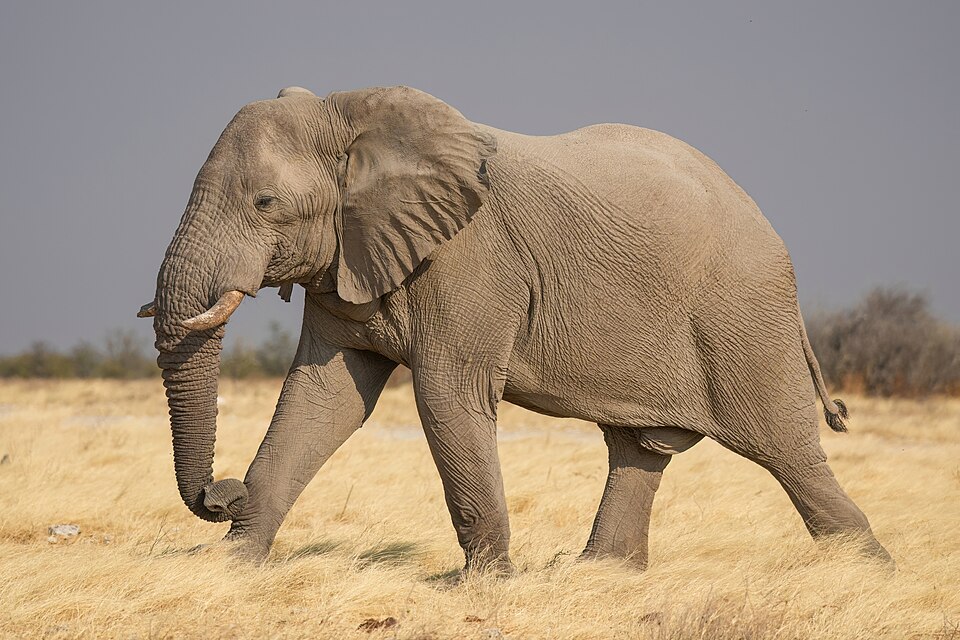
African bush elephant · The atlas type is the bush elephant -- an ecosystem engineer whose ivory ban (1989) and split from forest elephants still structure African conservation.
Milestones in order. This is history, not a weekly activity grid.
Darker cells mean a higher score for this topic on that metric.
LessMore
Last reviewed Sources & creditsMedia creditsMethodology
The taxonomy wiki is African bush elephant. Forest elephants (L. cyclotis) were widely recognised as a separate EN/CR story in the 2021 IUCN assessments.
It collapsed legal international commercial trade. Domestic markets, stockpiles and later one-off sales (2008) kept the argument alive. Poaching did not end in 1989.
Amboseli Elephant Research Project since 1972 -- matrilines with names and decades of calves, the opposite of an anonymous ivory graph.
They open woodland, dig water, disperse seeds and rewrite fire. In this 24-type atlas that engineer role outranks even wolves and whales.
A periodic male state with urine dribble, temporal secretion and aggression. It is physiology, not a mood.
Large-scale culling paused in the 1990s. Contraception, range expansion and later density debates replaced it without a final peace.
IUCN: Endangered (2021)
The african bush elephant did not enter English as a finished emblem. Hunts, films, listings and field stations rewrote the animal on a dated clock.
This chapter keeps ten timeline points, five eras and three milestones so a later translation can hold the same years.
Cynthia Moss begins the named-matriarch series that still runs.
An early aerial synthesis that made decline a number, not a rumour.
Commercial international trade shut; stockpiles became the next fight.
South Africa halted routine culling as contraception and ethics arguments rose.
CITES allowed limited southern African stockpile sales -- a still-cited fracture.
Selous and Niassa losses reset the post-ban optimism.
Major market closures followed the poaching decade.
Savanna EN, forest CR -- the two-species Red List.
Domestic market closure after 2017 still being measured in seizures.
Crop-raid killings outrank ivory in some East African local news.
Tusks left Africa before any park existed.
Amboseli science met a CITES gavel.
Kruger density ethics replaced routine shooting in policy talk.
One-off legal ivory and a poaching spike shared a decade.
EN/CR split and conflict, not only ivory, lead the file.
A population became a genealogy.
The year ivory lost its main legal ocean.
Bush and forest elephants stopped sharing one card.
Reading african bush elephant history beside the resilience score keeps a recovered stock from standing in for a threatened cousin.
Asia largest cat — subspecies maps, 1973 Project Tiger, and roughly 4,000 remaining wild animals still frame a century of recovery arithmetic.
Overall 62 🦁A social pantherine whose prides, Gir relic and 2015 Cecil killing still structure African conservation politics.
Overall 66 🐺A Holarctic pack hunter whose 1995 Yellowstone return and older Leopold ethics still structure predator politics.
Overall 78 🐼A bamboo specialist whose WWF logo, Wolong quake and 2016 IUCN downlist from EN to VU made a recovery into a brand.
Overall 41 🐻A marine bear whose seal-and-ice budget made Churchill, Knut and climate models into one public animal.
Overall 56 🦍The atlas type is the western gorilla -- a knuckle-walking ape whose Fossey-era mountain cousins and Koko lab fame split one public name.
Overall 45 🐋The largest animal whose 1966 IWC protection, 1982 moratorium and still-thin Antarctic recovery define a hunted giant.
Overall 65