Darker cells mean a higher score for this topic on that metric.
LessMore
Last reviewed Sources & creditsMedia creditsMethodology
Quick answers
Why bush elephant, not African elephant in general?
The taxonomy wiki is African bush elephant. Forest elephants (L. cyclotis) were widely recognised as a separate EN/CR story in the 2021 IUCN assessments.
What did the 1989 ivory ban do?
It collapsed legal international commercial trade. Domestic markets, stockpiles and later one-off sales (2008) kept the argument alive. Poaching did not end in 1989.
Who is Cynthia Moss in this file?
Amboseli Elephant Research Project since 1972 -- matrilines with names and decades of calves, the opposite of an anonymous ivory graph.
Are elephants the highest ecological-role score for a reason?
They open woodland, dig water, disperse seeds and rewrite fire. In this 24-type atlas that engineer role outranks even wolves and whales.
What is musth?
A periodic male state with urine dribble, temporal secretion and aggression. It is physiology, not a mood.
Did Kruger culling end?
Large-scale culling paused in the 1990s. Contraception, range expansion and later density debates replaced it without a final peace.
IUCN: Endangered (2021)
Anatomy overlay
Numbered teaching hotspots on the species still — not a clinical diagnosis.
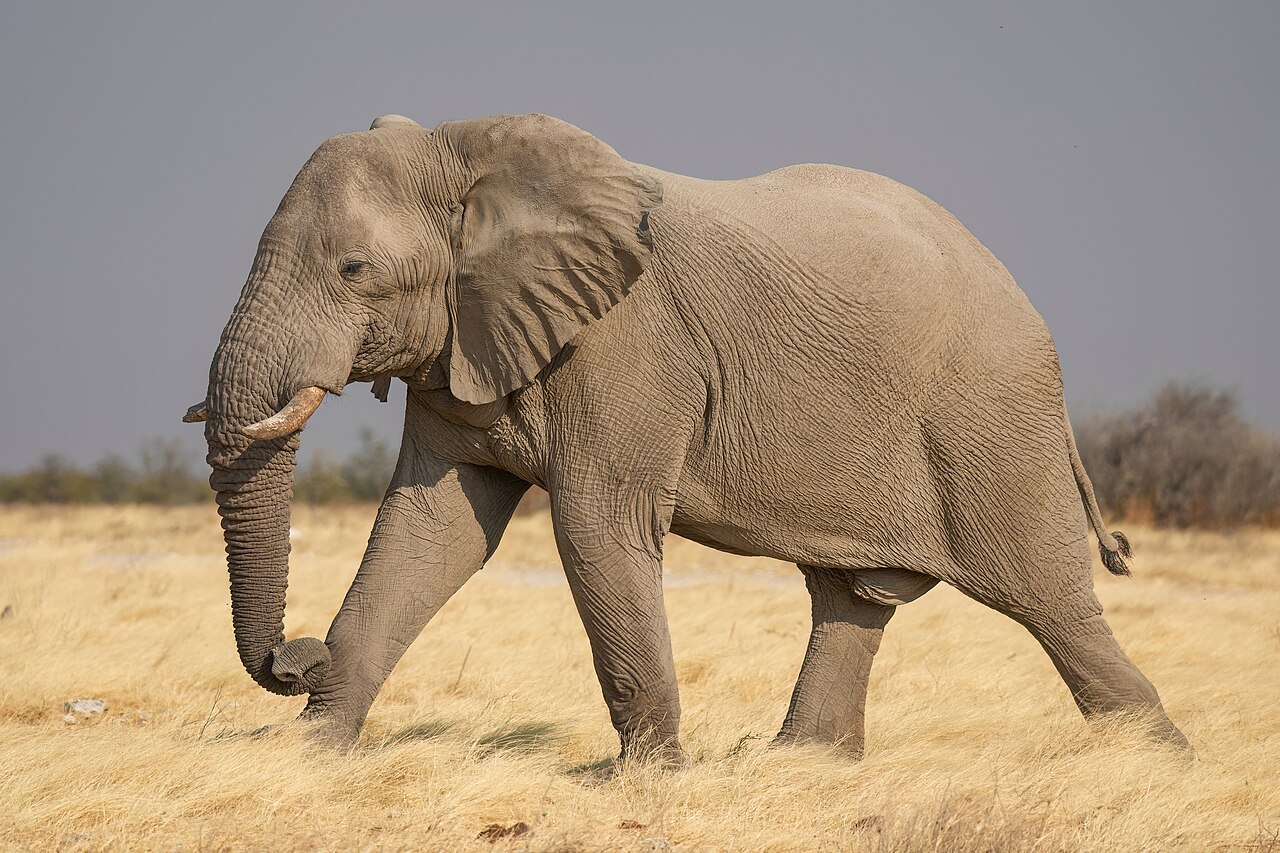
- 1 Primary weapon or tool — The bill, teeth, trunk, pouch or talon that field guides name first -- and that trade or c
- 2 Energy store — Fat, cache, crop or bamboo hours that decide whether a season closes.
- 3 Natal or breeding site — A redd, eyrie, den, anemone or ice lair -- often a single-point risk (Izumi, Natron, Gir).
- 4 Sensory organ — Infrasound rumbles, smell, and a trunk that is a hand. Musth rewrites male social smell.
- 5 Human interface — Hunt, tourism, film or quota -- the surface where african bush elephant biology meets Engl
Anatomy overlay
Four teaching regions on African bush elephant. A schematic, not a dissection guide.
Every african bush elephant is a stack of tissues that must agree under season, prey and human pressure.
Meters below repeat the six atlas scores as gauges; they are relative marks, not laboratory certificates.
Systems
Support and integument
Pillar legs, a trunk of tens of thousands of muscle units, and tusks that are incisors. Heat dumps through ears; the brain is large and long-memoried.
Feeding apparatus
A daily mass of grass, browse and bark. Engineers open woodland and dig wells that other species drink -- the ecological-role reason. The feeding kit sets the ecological-role score relative to the other 23 types.
Respiration and circulation
Gas exchange and blood flow are tuned to the african bush elephant energy budget -- dive, hover, sprint or bulk browse -- not to a generic vertebrate template.
Senses and neural control
Infrasound rumbles, smell, and a trunk that is a hand. Musth rewrites male social smell.
Reproduction and ontogeny
Replacement rate is the hidden resilience number. Ivory price, fences, and maize. A full park does not cancel an EN assessment.
Thermoregulation and salt/water
Climate and osmoregulation bound where a african bush elephant can close its daily budget. Field sites in the English-speaking world still measure that envelope first.
Relative meters
Hotspots
Primary weapon or tool
The bill, teeth, trunk, pouch or talon that field guides name first -- and that trade or conflict usually targets.
Energy store
Fat, cache, crop or bamboo hours that decide whether a season closes.
Natal or breeding site
A redd, eyrie, den, anemone or ice lair -- often a single-point risk (Izumi, Natron, Gir).
Sensory organ
Infrasound rumbles, smell, and a trunk that is a hand. Musth rewrites male social smell.
Human interface
Hunt, tourism, film or quota -- the surface where african bush elephant biology meets English-language law.
Tissues & materials
Keratin and integument
Feathers, fur, baleen or skin plates -- tissues, not metals. Moult and wear are the maintenance cycle.
Bone and cartilage
Load paths for stoop, lunge, knuckle-walk or hover. Marrow and pneumatic bone differ by family.
Muscle and tendon
The expensive tissue that speed and intelligence scores only hint at.
Fat, oil and glycogen
Stores that migration, fast and lactation spend. A market for those stores (oil, ivory, fin) is a historical threat.
Keep exploring
More in Wildlife
Tiger
Asia largest cat — subspecies maps, 1973 Project Tiger, and roughly 4,000 remaining wild animals still frame a century of recovery arithmetic.
Overall 62 🦁Lion
A social pantherine whose prides, Gir relic and 2015 Cecil killing still structure African conservation politics.
Overall 66 🐺Gray wolf
A Holarctic pack hunter whose 1995 Yellowstone return and older Leopold ethics still structure predator politics.
Overall 78 🐼Giant panda
A bamboo specialist whose WWF logo, Wolong quake and 2016 IUCN downlist from EN to VU made a recovery into a brand.
Overall 41 🐻Polar bear
A marine bear whose seal-and-ice budget made Churchill, Knut and climate models into one public animal.
Overall 56 🦍Gorilla
The atlas type is the western gorilla -- a knuckle-walking ape whose Fossey-era mountain cousins and Koko lab fame split one public name.
Overall 45 🐋Blue whale
The largest animal whose 1966 IWC protection, 1982 moratorium and still-thin Antarctic recovery define a hunted giant.
Overall 65