Milestones in order. This is history, not a weekly activity grid.
- The Stanford Spacewar contest
- Atari Space Invaders Championship
- Red Annihilation and the CPL
- StarCraft ignites Korea
- KeSPA and the World Cyber Games
- Counter-Strike goes retail
- MLG and EVO formalize
- EVO Moment 37
- League of Legends launches
- The International and Twitch
- Worlds at the Staples Center
- The first CS:GO Major
- Overwatch and the league model
- Franchising and battle royale
Last reviewed Sources & creditsMedia creditsMethodology
Quick answers
Is esports a real sport?
It depends on your definition, but esports meets many of the criteria: organized competition, professional athletes on salaries, governing rules, world championships and enormous audiences. Elite players train for hours daily, and the physical demands of reaction speed, precision and endurance under pressure are genuine, even if they differ from traditional athletics. Institutional recognition has grown, esports was a medal sport at the 2022 Asian Games, and the International Olympic Committee has backed Olympic esports competition. Critics point out that the games are privately owned and change constantly, unlike static traditional sports. Whether or not one calls it a sport, esports functions as a professional competitive discipline with a global industry around it, and the debate matters less than that reality.
How do esports players make money?
Professional players earn from several streams. Team salaries provide a base, and tournament prize money can be enormous in games with large pools, Dota 2's The International has paid over $40M across a single event. Beyond competition, many players earn substantial income from live streaming on Twitch and YouTube, from sponsorships and personal brand deals, and from content creation, which for some exceeds their competitive earnings. Top players in major titles can earn millions annually across these sources, though the majority of pros make far more modest sums, and careers are often short. The financial gap between the elite handful and the wider professional field is wide, and income beyond prize money is frequently the larger and more stable part.
What are the most popular esports games?
The leading titles by audience and prestige are League of Legends, whose World Championship draws the largest viewership in esports, and Counter-Strike, whose Majors anchor the tactical-shooter scene. Dota 2 commands attention for its record prize pools, and Valorant has grown rapidly into a major franchised circuit since 2020. In Asia and the global South, mobile titles including Mobile Legends: Bang Bang, PUBG Mobile, Free Fire and Honor of Kings command some of the biggest live audiences of all. Fighting games centered on EVO and real-time strategy like StarCraft II retain devoted followings. The mix shifts constantly as games rise and fade, but MOBAs and tactical shooters have been the most durable pillars of competitive PC esports.
Who is the highest-earning esports player?
By tracked tournament prize money, the top earners are overwhelmingly Dota 2 players, because that game's Internationals feature by far the largest prize pools in esports. Johan 'N0tail' Sundstein, the OG captain who won back-to-back Internationals in 2018 and 2019, long held the record with career earnings above $7M. Several of his OG teammates and other Dota professionals also rank near the top. It is important to note these figures track prize money only, not salaries, streaming income or sponsorships, so they understate total earnings and skew heavily toward Dota. A League of Legends star like Faker, whose prize money is far lower, likely earns more overall once salary and endorsements are counted.
Why is South Korea so important to esports?
South Korea effectively invented modern professional esports. The late-1990s combination of the game StarCraft, a national broadband rollout and PC bang internet-cafe culture created the world's first true esports ecosystem, complete with televised leagues, salaried players and genuine celebrities like BoxeR. The Korea e-Sports Association, founded in 2000, gave the scene formal governance years before anywhere else. That head start built a deep infrastructure and competitive culture that carried into later games, especially League of Legends, where Korea's LCK became the strongest league in the world and produced Faker and a long line of world champions. Korea's disciplined, systematic approach set the competitive standard the rest of the world spent years trying to match, and its influence remains foundational.
What was the biggest esports prize pool ever?
The largest prize pool for a single esports event is Dota 2's The International 2021, which reached $40,018,195. Dota's Internationals are crowdfunded: Valve funnels a share of in-game cosmetic purchases into the pool, which is how the game's championships have repeatedly set records unmatched by any other title. The 2021 winners, Team Spirit, took home roughly $18.2M, the biggest payout a single team has claimed from one event. For multi-title events, Saudi Arabia's Esports World Cup, launched in 2024, offers an even larger total prize pool exceeding $60M, but that is spread across many games rather than one competition. The International's single-tournament figure remains the benchmark for a lone event.
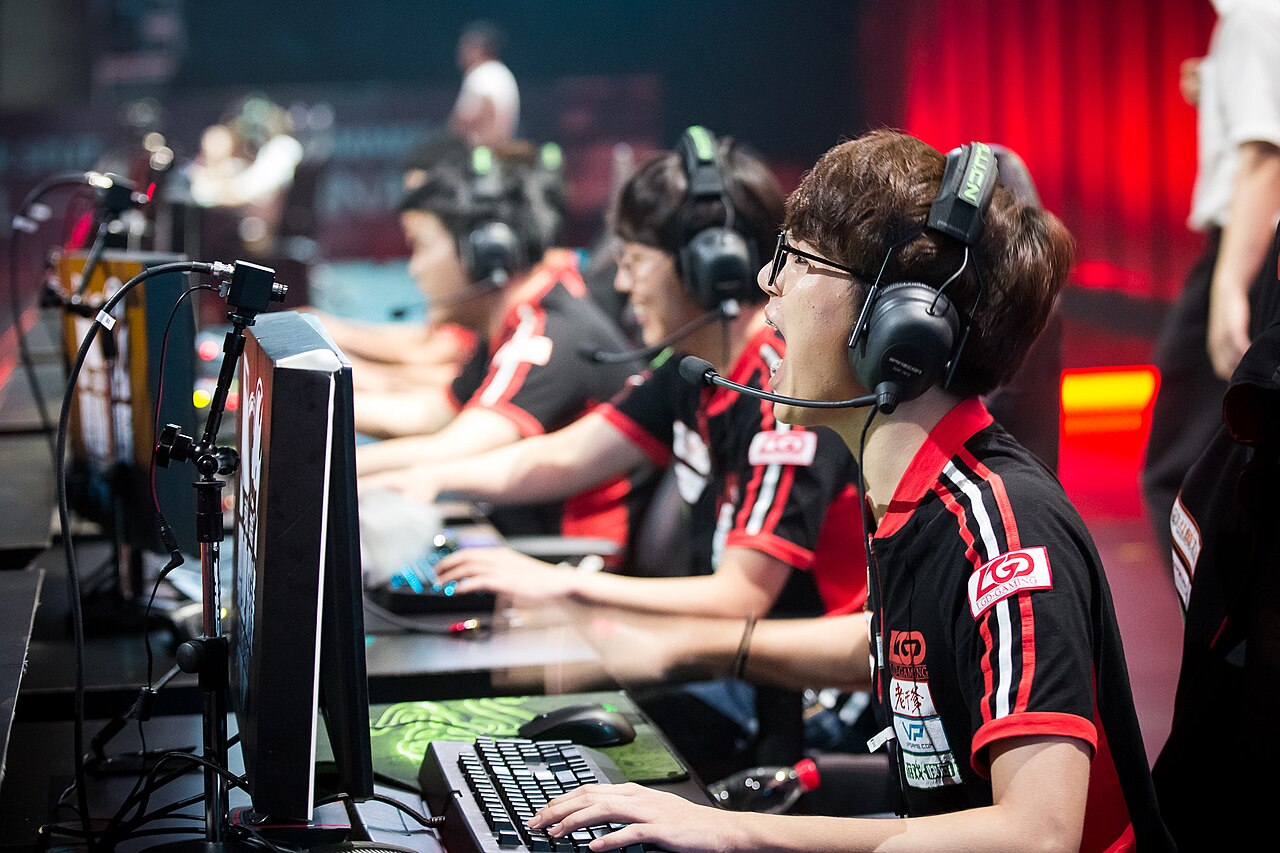
Esports is younger than most sports yet older than many assume. The first known video game competition took place at Stanford University in 1972, and the arcade boom produced mass tournaments before home consoles even matured. But the modern professional form was forged in South Korea in the late 1990s, when StarCraft, cheap broadband and dedicated television turned pro gaming into a genuine spectator culture with salaried stars and household-name champions.
From those roots the phenomenon globalized in waves, each driven by a defining game and a new way to watch. Counter-Strike built an international LAN culture, the launch of Twitch in 2011 removed the broadcast bottleneck, and the arrival of League of Legends and Dota 2 created billion-view spectacles funded by crowdsourced prize pools. The story since is one of explosive growth, speculative investment and, most recently, consolidation and a shift toward mobile audiences and Gulf-state money.
Timeline
Students hold the Intergalactic Spacewar Olympics at Stanford, the first known organized video game competition; the prize is a year's subscription to Rolling Stone.
Atari runs a Space Invaders tournament drawing an estimated 10,000 participants across the United States, the first large-scale competitive gaming event.
Dennis 'Thresh' Fong wins a national Quake tournament and reportedly John Carmack's Ferrari; the Cyberathlete Professional League is founded, formalizing prize-money gaming.
Blizzard's StarCraft launches and, paired with a national broadband rollout and PC bang culture, makes South Korea the world's first true esports nation.
South Korea establishes the Korea e-Sports Association to govern pro gaming, and the World Cyber Games launches as an international, Olympic-style tournament.
Counter-Strike releases as a full retail game, becoming the defining team shooter of LAN esports for over a decade and seeding a global competitive scene.
Major League Gaming is founded in the United States, and the fighting-game Evolution Championship Series adopts the EVO name, professionalizing two enduring scenes.
Daigo Umehara's full-parry comeback against Justin Wong in Street Fighter III becomes the most famous moment in fighting-game history and a viral esports landmark.
Riot Games releases League of Legends as a free-to-play MOBA, building the game that would become the biggest in esports by audience.
Valve debuts The International for Dota 2 with a landmark $1.6M prize pool won by Na'Vi; the launch of Twitch removes the barrier to live streaming.
SK Telecom T1, led by a teenage Faker, wins the League of Legends World Championship at Los Angeles's Staples Center, announcing the sport's mainstream ambitions.
DreamHack Winter hosts the first Valve-sponsored Counter-Strike: Global Offensive Major, won by Fnatic, launching the Major system that anchors CS esports.
Blizzard releases Overwatch and soon announces the city-based, franchised Overwatch League, importing a traditional-sports business model into esports.
Riot begins franchising its North American league, ending promotion and relegation, while PUBG popularizes the battle-royale genre that Fortnite would take global.
Sixteen-year-old Kyle 'Bugha' Giersdorf wins the Fortnite World Cup solo final for a $3M prize, one of the largest individual payouts in esports history.
The crowdfunded prize pool for Dota 2's The International 2021 reaches $40,018,195, the largest for a single esports event; Team Spirit win about $18.2M.
Riot's tactical shooter Valorant, released in 2020, holds its first Champions title event, rapidly building a global franchised circuit to rival Counter-Strike.
Esports is contested as a full medal sport at the Hangzhou Asian Games, with seven medal events, a major step toward institutional recognition.
Saudi Arabia launches the Esports World Cup in Riyadh, a multi-title mega-event with a prize pool exceeding $60M, as the Overwatch League is dissolved.
Faker leads T1 to a fifth League of Legends World Championship, extending his record and cementing his status as the sport's defining athlete.
The eras
Arcade and LAN Origins
The prehistory of esports lies in university labs and arcades. The 1972 Spacewar contest at Stanford was a curiosity, but the arcade boom of the late 1970s and 1980s turned high scores into public competition, with Atari's 1980 Space Invaders Championship drawing thousands and score-keeping outfits like Twin Galaxies crowning record holders. The pivotal shift came with networked personal computers in the mid-1990s. Id Software's Doom and then Quake enabled real-time, head-to-head play over LAN and early internet, and a competitive community formed around them. The 1997 Red Annihilation Quake tournament, whose winner Dennis 'Thresh' Fong reportedly drove away John Carmack's Ferrari, is often cited as the first true esports event with a professional stake, and the founding of the Cyberathlete Professional League the same year gave prize-money gaming its first organized circuit. This era had no leagues, salaries or television; it was built by enthusiasts on dial-up connections and in cramped LAN halls. Yet it established the essential ingredients, direct player-versus-player competition, spectators, and the idea that a video game could be played for money and glory, that the coming Korean revolution would industrialize into a genuine profession.
The Korean Foundation
Modern professional esports was effectively invented in South Korea. The 1998 release of StarCraft coincided with a government-driven national broadband rollout and the explosion of PC bangs, internet cafes where the game became a social phenomenon. Uniquely, Korea built dedicated television around it: channels like OGN broadcast StarCraft leagues to mass audiences, and players became genuine celebrities. Lim 'BoxeR' Yo-hwan, 'The Emperor,' was the first superstar, his fan club numbering in the hundreds of thousands, and his mastery of Terran micro drew crowds to stadiums for a computer game. In 2000 the Korea e-Sports Association was founded to govern the scene, salaries and sponsored teams appeared, and the World Cyber Games launched as an international, quasi-Olympic tournament headquartered in Korea. Elsewhere the picture was more fragmented but growing: Counter-Strike's retail launch in 2000 created a global LAN culture, and Western circuits like the CPL offered prize money. But it was Korea that proved a video game could sustain a full professional ecosystem, teams, salaries, television, governance and stars, and that template would be exported around the world over the following two decades.
Global Broadcast and the MLG Era
The mid-2000s saw esports spread and diversify beyond Korea, even as it remained a niche. In the United States, Major League Gaming professionalized console and PC competition, ran arena events and secured early television deals, while the fighting-game community coalesced around the annual EVO championship, immortalized by Daigo Umehara's 2004 full-parry comeback. Counter-Strike 1.6 entered a golden age of European and international LAN rivalry, producing dynasties and a devoted following. This was still the pre-streaming era: fans followed matches through recorded demos, IRC and forums, and viewership was constrained by the lack of an accessible live platform. Prize pools were modest by later standards, careers were precarious, and many players held day jobs. Yet the period matured the culture, established durable competitions across multiple genres, and produced the personalities and rivalries that would anchor the coming boom. Crucially, it set the stage technologically and commercially, and when a free live-streaming platform finally arrived alongside a new generation of games designed for spectators, esports was ready to detonate from a subculture into a global entertainment industry almost overnight.
The MOBA Explosion and Twitch
Two developments in the early 2010s transformed esports from niche to mainstream: the multiplayer online battle arena genre and live streaming. League of Legends, released in 2009, and Dota 2, which launched The International in 2011 with a then-astonishing $1.6M prize pool, gave the world team-based, endlessly deep, spectator-friendly games that tens of millions also played. The launch of Twitch in 2011 removed the final barrier, letting anyone watch top play live and free, and viewership figures exploded. Riot built the League of Legends World Championship into an arena-filling annual spectacle, with SK Telecom T1 and the teenage prodigy Faker becoming global icons after the 2013 final at the Staples Center. Valve pioneered crowdfunded prize pools that pushed The International past ten million dollars, redefining what an esports event could pay. Counter-Strike: Global Offensive's 2013 Major system revitalized the shooter scene. Investment, sponsorship and media attention poured in as audiences reached traditional-sport scale. By 2015 esports had a coherent global structure of publisher-run world championships, and its status as a legitimate spectator entertainment, not a fringe hobby, was no longer seriously in question.
Franchising and the Investment Bubble
Flush with proof of concept, esports entered a phase of aggressive commercialization and speculative money. Blizzard's Overwatch League, launched with city-based franchises sold for tens of millions of dollars, imported the closed-league model of American pro sports, and Riot franchised its League of Legends leagues, replacing promotion and relegation with permanent, investor-owned slots. Venture capital, celebrity owners and traditional sports franchises bought in, valuations soared, and organizations built expensive facilities and rosters. The battle-royale wave, PUBG and then the cultural juggernaut Fortnite, briefly reoriented the industry, culminating in the 2019 Fortnite World Cup and its $3M solo prize for a sixteen-year-old. Faker became a genuinely global celebrity, and mainstream sponsors, non-endemic brands and broadcasters arrived in force. Yet the economics strained: many organizations spent far more than they earned, betting on future audience monetization that lagged expectations. The COVID-19 pandemic in 2020 forced events online, testing the model and accelerating a reckoning. The era proved esports could attract serious capital and institutional structures, but also exposed how fragile those structures were when built on speculative valuations rather than sustainable revenue.
Consolidation, Mobile and Gulf Money
The current era is defined by correction and realignment after the bubble. Overheated franchising retrenched sharply, culminating in the dissolution of the Overwatch League in 2024 and a pivot to a publisher-run circuit, while many organizations cut costs. At the same time the ceiling kept rising: Dota 2's The International 2021 set an all-time prize-pool record above $40M, and Valorant matured into a franchised global circuit challenging Counter-Strike, which itself transitioned to CS2. The audience's center of gravity shifted toward mobile titles, Mobile Legends, PUBG Mobile, Free Fire and Honor of Kings, which command the largest live viewerships in Asia and the global South. Most consequentially, Gulf-state investment arrived at scale: Saudi Arabia's Savvy Games Group and the 2024 launch of the Esports World Cup, with a prize pool exceeding $60M, reshaped the calendar and the sport's finances almost overnight. Institutional recognition advanced too, with esports contested for medals at the 2023 Asian Games and the announcement of Olympic-sanctioned esports competition. The result is a more consolidated, more heavily capitalized, more geographically balanced esports than ever, still wrestling with the question of long-term sustainability.
In half a century esports has gone from a Spacewar match played for a magazine subscription to a global industry with forty-million-dollar prize pools, arena-filling finals and Asian Games medals. Its future is being rewritten again by Gulf-state investment, a mobile-first Asian audience and the long-running question of whether a publisher-owned competition can ever be as durable as a traditional sport. What is certain is that the pace of reinvention, faster than any conventional game because the arena itself is patched every few weeks, shows no sign of slowing.
Keep exploring
More sports
Soccer
The simplest game on Earth, played by hundreds of millions and argued over by half the planet.
🏀Basketball
Five players, 24 seconds, and geometry at full sprint — the city game that conquered the world.
⚾Baseball
The clockless chess match where a round bat meets a round ball and the best hitters on earth still fail seven times out of ten.
🎾Tennis
The loneliest duel in sport: no clock, no teammates, no place to hide until the last point is won.
🏎️F1
Twenty drivers, a thousand horsepower, and the most expensive engineering arms race in sport.
⛳Golf
A six-century test of nerve where the only opponent is the ground, the wind, and yourself.
🏈Football
Four downs, ten yards, one end zone: the ultimate game of territory, collision, and coaching.
🏏Cricket
The bat-and-ball contest where a single match can last five days and still turn on one ball.