Neanderthal DNA in non-African genomes
Admixture introgression shows "pure" continents never existed — archaic snippets are normal.
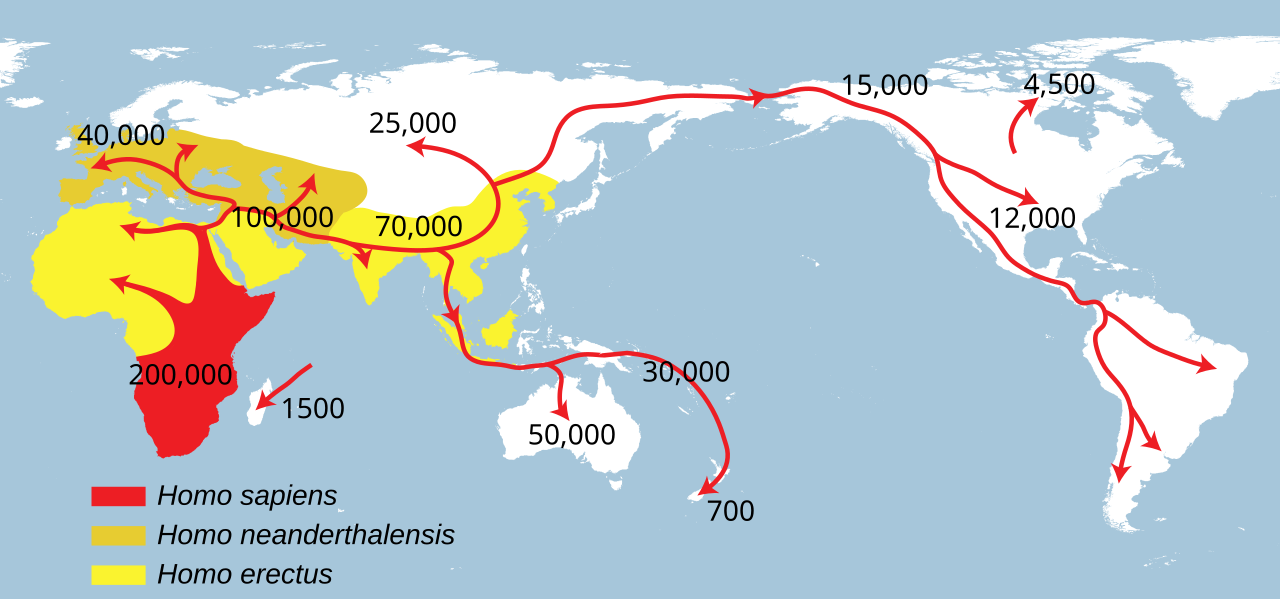
Modern humans arose in Africa and dispersed worldwide; deeper African diversity undercuts race-as-branch folklore.
Last reviewed Sources & creditsMedia creditsMethodology
Five research punchlines — scan before you dive.
Out of Africa is explained here as measurable human variation — geography, pathogens, diet and migration — not as a scoreboard of peoples.
Readers get the mechanism, the map-like pattern (clines and patches), and the misconceptions that turn traits into racial folklore.
Nothing on this page ranks intelligence, worth or civilization by group.
Biological mechanism behind Out of Africa.
The trait responds to concrete pressures: light, air, pathogens, diet or demographic history.
Multiple genes and environments usually interact; single-gene bedtime stories are rare.
Where and why Out of Africa varies.
Maps of this trait look like weather: gradients, patches and corridors — not painted race continents.
Colonial census categories rarely match those biological gradients.
Concrete histories of adaptation and contact — never a league table of peoples.
Admixture introgression shows "pure" continents never existed — archaic snippets are normal.
Within-Africa structure holds more variation than between-continent averages — origin ≠ uniformity.
Long local tenure plus later contact — multiregional myths misread both science and indigenous claims.
White-nationalist forums twist migration science; educators stress shared ancestry and within-Africa diversity.
Scholarly themes rewritten for curious readers — not paywalled jargon, and never a race ranking.
Genetic and fossil evidence support modern humans expanding from Africa with later admixture — a shared origin story, not a ranking of continents.
Takeaway We are a young African-origin species.
Diversity tends to decline with distance along expansion routes — a statistical pattern, not “degeneration.”
Takeaway Bottlenecks explain variety gradients.
Non-African genomes often carry archaic snippets; Africans have complex deep structure too — admixture is normal.
Takeaway Purity was never the plot.
Older multiregional models lost ground; teaching the debate shows science self-correcting.
Takeaway Consensus can move.
Extremists twist migration science; educators stress shared ancestry and within-Africa diversity.
Takeaway Refuse weaponized prehistory.
Books, reviews and museum trails — starting points, not a syllabus.
Accessible genetic anthropology — shared African origin, not continental ranking.
Fossil and DNA alignment — admixture normal, purity myth dead.
Hominin fossil casts with migration maps — read past "replacement" clickbait.
Genographic project film — use critically, good for classroom starter.
Primary reference era for modern genomics — context for structure debates.
Tap a card — the fact stays hidden until you flip.
Leaving Africa created superior races.
Dispersal founder effects explain some diversity patterns, not hierarchies of worth.
Non-Africans are a different species.
Living humans interbreed fully; we are one species.
Out of Africa denies regional fossils.
The model absorbs limited archaic admixture without polygenic “race species.”
African diversity means Africa is “primitive.”
Higher diversity means deeper population history — not lower culture.
Everyone outside Africa shares one ancestor pair recently.
Bottlenecks happened, but genealogies are tangled forests, not a single couple.
No. Traits can vary by place without slicing humanity into ranked subspecies.
Because curiosity about bodies is valid — and unanswered curiosity is where race myths recruit.
Only to explain mechanisms or public health. Averages never become league tables of worth.
No. Clinical decisions need clinicians, not atlas pages.
By preferring review-level consensus and labeling open debates.
A gradual change in trait frequency across geography, rather than a sharp racial border.
Yes — dairying and malaria are classic feedback loops.
See related diversity topics and the atlas page on genetic-distance myths.