Sickle cell belt across tropical Africa
HbS carrier advantage against severe malaria left a frequency cline — allele with benefit and disease cost.
Sickle cell and related alleles show how disease pressure shapes genomes — and why “racial disease” talk misleads.
Last reviewed Sources & creditsMedia creditsMethodology
Five research punchlines — scan before you dive.
Malaria adaptations is explained here as measurable human variation — geography, pathogens, diet and migration — not as a scoreboard of peoples.
Readers get the mechanism, the map-like pattern (clines and patches), and the misconceptions that turn traits into racial folklore.
Nothing on this page ranks intelligence, worth or civilization by group.
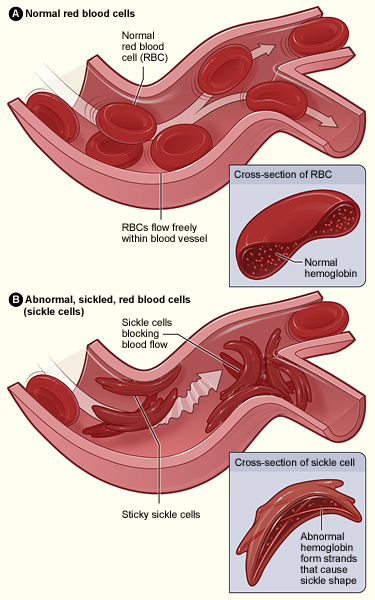
Biological mechanism behind Malaria adaptations.
The trait responds to concrete pressures: light, air, pathogens, diet or demographic history.
Multiple genes and environments usually interact; single-gene bedtime stories are rare.
Where and why Malaria adaptations varies.
Maps of this trait look like weather: gradients, patches and corridors — not painted race continents.
Colonial census categories rarely match those biological gradients.
Concrete histories of adaptation and contact — never a league table of peoples.
HbS carrier advantage against severe malaria left a frequency cline — allele with benefit and disease cost.
Hemoglobinopathies in malarious coasts from Greece to Sardinia — history lives in blood clinics.
Absence of receptor blocks some Plasmodium vivax strains — variant geography, not racial immunity.
European administrators invented racial susceptibilities to explain illness — failed under scrutiny, bred distrust.
Scholarly themes rewritten for curious readers — not paywalled jargon, and never a race ranking.
HbS carrier advantage against severe malaria is a canonical selection story — and a reminder that alleles have costs.
Takeaway Protection can hurt in other contexts.
X-linked enzyme variants track malaria history and complicate drug safety — clinical genetics, not folk race.
Takeaway Maps guide dosing, not destiny.
Hemoglobinopathies in Mediterranean, South Asian and other zones are studied as malaria-related adaptations with disease burdens.
Takeaway History lives in blood clinics.
Vector control research treats malaria as a three-way ecology of human, Anopheles and Plasmodium.
Takeaway Wipeouts need ecosystems thinking.
Archives show colonial medicine inventing racial susceptibilities that failed under scrutiny.
Takeaway Distrust that history.
Books, reviews and museum trails — starting points, not a syllabus.
Heterozygote advantage explained with costs — classic selection, not superiority.
X-linked variant geography guides dosing — clinical genetics, not folk race.
Parasite life cycle displays — three-way ecology of human, mosquito and Plasmodium.
Book/film on Plasmodium history — colonial medicine's racist susceptibility myths dismantled.
Epidemiology maps — medical geography, not destiny.
Tap a card — the fact stays hidden until you flip.
Sickle cell is an “African race disease.”
It tracks historic malaria, including in parts of the Mediterranean, Middle East and India.
Carrying HbS means someone is unhealthy.
Heterozygotes are often healthy and malaria-resistant in endemic zones.
Ending malaria ends the allele instantly.
Allele frequencies change over generations, not news cycles.
Only one malaria defense exists.
G6PD deficiency, thalassemias and other traits also respond to the same pressure.
Genetic defense proves separate human species.
Balancing selection inside one species is normal.
No. Traits can vary by place without slicing humanity into ranked subspecies.
Because curiosity about bodies is valid — and unanswered curiosity is where race myths recruit.
Only to explain mechanisms or public health. Averages never become league tables of worth.
No. Clinical decisions need clinicians, not atlas pages.
By preferring review-level consensus and labeling open debates.
A gradual change in trait frequency across geography, rather than a sharp racial border.
Yes — dairying and malaria are classic feedback loops.
See related diversity topics and the atlas page on genetic-distance myths.