Hunt treaty
1973 agreement
Range states managed harvest before ice became the lead file.
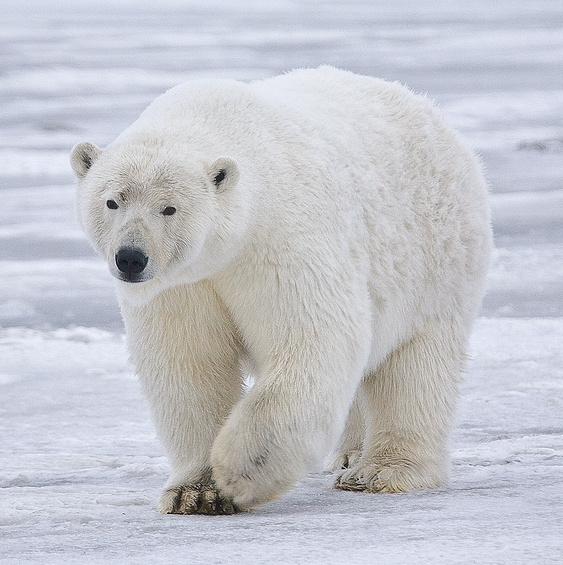
Polar bear · A marine bear whose seal-and-ice budget made Churchill, Knut and climate models into one public animal.
Milestones in order. This is history, not a weekly activity grid.
Darker cells mean a higher score for this topic on that metric.
LessMore
Last reviewed Sources & creditsMedia creditsMethodology
IUCN VU and the 2008 ESA listing rest on ice-season length. A few stable stocks do not cancel a circumpolar ice forecast. High resilience in this atlas means secure (koi, many owls), not famous.
It treated greenhouse gases as a listed-species threat. Courts later limited how far that could reach power plants; the biological finding stayed.
Western Hudson Bay is an early-ice-loss stock and a tourist town. It is a visible subpopulation, not the whole Arctic.
A hand-reared Berlin cub (2006-2011) whose fame and death made zoo ethics a tabloid. He is culture, not a sea-ice time series.
Seals (especially ringed) are the fat that pays. Bird eggs, carrion and land food appear more in long ice-free summers -- a budget problem, not a new niche that replaces ice.
The 1922 film staged Inuit life for a southern camera. It is a portrayal, not an ethnography of nanuq knowledge.
IUCN: Vulnerable
The polar bear did not enter English as a finished emblem. Hunts, films, listings and field stations rewrote the animal on a dated clock.
This chapter keeps ten timeline points, five eras and three milestones so a later translation can hold the same years.
Flaherty film that staged Arctic life for southern audiences.
Range-state hunt treaty -- the pre-climate legal layer.
Tundra buggies made a migration a ticket.
Berlin Zoo cub that became a global name.
Sea ice named as the primary threat.
A zoo death as a media event.
Bear-as-climate-icon sat beside a treaty the listing had previewed.
Subpopulation-by-subpopulation honesty against a single cartoon decline.
Onshore waiting lengthened; conflict and tourism both rose.
Model papers still used as the ESA biological backbone.
Range states managed harvest before ice became the lead file.
A town sold a migration.
A zoo cub out-shouted subpopulation tables.
ESA made ice a legal habitat.
Longer ice-free seasons rewrote conflict and diet notes.
A hunt treaty among Arctic states -- rare for a single species.
Climate as a listed threat.
Zoo fame as a cultural-impact spike.
Reading polar bear history beside the resilience score keeps a recovered stock from standing in for a threatened cousin.
Asia largest cat — subspecies maps, 1973 Project Tiger, and roughly 4,000 remaining wild animals still frame a century of recovery arithmetic.
Overall 62 🦁A social pantherine whose prides, Gir relic and 2015 Cecil killing still structure African conservation politics.
Overall 66 🐘The atlas type is the bush elephant -- an ecosystem engineer whose ivory ban (1989) and split from forest elephants still structure African conservation.
Overall 61 🐺A Holarctic pack hunter whose 1995 Yellowstone return and older Leopold ethics still structure predator politics.
Overall 78 🐼A bamboo specialist whose WWF logo, Wolong quake and 2016 IUCN downlist from EN to VU made a recovery into a brand.
Overall 41 🦍The atlas type is the western gorilla -- a knuckle-walking ape whose Fossey-era mountain cousins and Koko lab fame split one public name.
Overall 45 🐋The largest animal whose 1966 IWC protection, 1982 moratorium and still-thin Antarctic recovery define a hunted giant.
Overall 65