Miocene-Holocene
Lamnid apex
A warm-muscle fish eater that later specialised on pinnipeds where seals bloomed.
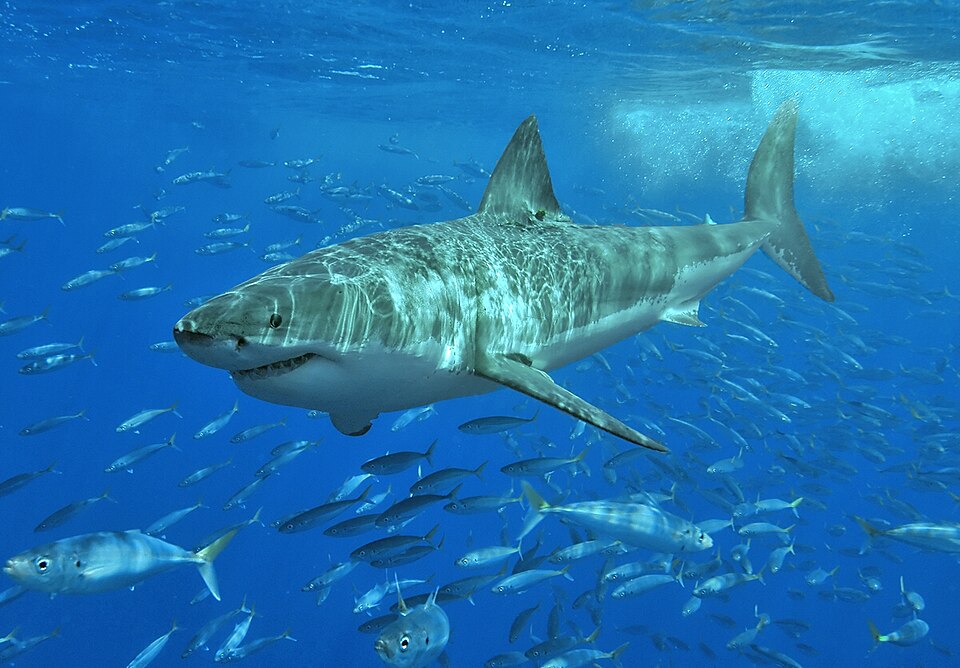
Great white shark · Apex lamnid whose warm muscle, broad diet and 1975 cinema still outrun the tagging papers.
Milestones in order. This is history, not a weekly activity grid.
Darker cells mean a higher score for this topic on that metric.
LessMore
Last reviewed Sources & creditsMedia creditsMethodology
The 1975 film increased trophy interest and beach fear. Later decline drivers are fins, bycatch and slow life history. Benchley later argued the fiction had been taken as a brief.
A mid-Pacific patch where California-tagged whites linger. Foraging on midwater squid and fish is the working hypothesis, not a seal colony.
They are regional endotherms. Countercurrent heat exchangers keep muscle and stomach above ambient -- not mammalian homeothermy.
Cape fur seals and elephant seals create predictable prey. Cage tourism and research boats stacked on those same reefs.
A very large female photographed at Guadalupe and later Hawaii -- a media name, not a stock assessment.
Appendix II in 2004. Papers still move; the listing forces permits and data, not a zero quota.
IUCN: Vulnerable
The great white shark did not enter English as a finished emblem. Hunts, films, listings and field stations rewrote the animal on a dated clock.
This chapter keeps ten timeline points, five eras and three milestones so a later translation can hold the same years.
Fossils separate living whites from the larger Otodus megalodon line in public confusion.
Early scientific descriptions from South African material entered European lists.
The book preceded the film that would freeze the public image.
Spielberg shark became the default white -- bigger and shallower than the papers.
An early national ban on killing whites, later copied in pieces elsewhere.
International trade in whites required permits.
Stanford/Hopkins tags named the offshore Pacific hangout.
Named sharks (Mary Lee and others) became a browser sport.
Grey-seal recovery brought whites back to a tourist coast that had forgotten them.
Cage-dive operators reported fewer regulars -- a local debate, not a global delisting.
A warm-muscle fish eater that later specialised on pinnipeds where seals bloomed.
Fiction scaled faster than protection; South Africa moved first among range states.
CITES and satellite names made a Vulnerable shark trackable by phone.
Cape Cod and California sightings followed pinniped recoveries.
Tourism sites argue about empty cages while the Red List stays cautious.
A film set the fear baseline that field programmes still spend money undoing.
Trade in whites became a paperwork species, not an open commodity.
Offshore tracking showed seal beaches were only half the year.
Reading great white shark history beside the resilience score keeps a recovered stock from standing in for a threatened cousin.
Anadromous fishes that move ocean fat onto spawning gravels -- and into forests, treaties and hydropower fights.
Overall 63 🐟A warm-bodied tuna whose Tokyo auction prices and ICCAT quotas made a single fish into a geopolitical unit.
Overall 54 🐠Anemone-dwelling damselfish whose 2003 film fame became a capture-and-reef case study.
Overall 41 🐴Male-pregnancy fish — Hippocampus since Linnaeus (1758), dried trade, and CITES Appendix II (2002).
Overall 28 🎏Domesticated carp whose Niigata colour mutations became a global pond aesthetic -- not a wild goldfish substitute.
Overall 42 🐡Beak-toothed inflators whose tetrodotoxin made a Japanese cuisine and a genome project out of one family.
Overall 41 ⚡Amazon knifefishes whose stacked electrocytes taught Humboldt, Volta arguments and a 2019 species split.
Overall 36