Darker cells mean a higher score for this topic on that metric.
LessMore
Last reviewed Sources & creditsMedia creditsMethodology
Quick answers
Did Jaws change great-white numbers or only stories?
The 1975 film increased trophy interest and beach fear. Later decline drivers are fins, bycatch and slow life history. Benchley later argued the fiction had been taken as a brief.
What is the White Shark Cafe?
A mid-Pacific patch where California-tagged whites linger. Foraging on midwater squid and fish is the working hypothesis, not a seal colony.
Are great whites warm-blooded?
They are regional endotherms. Countercurrent heat exchangers keep muscle and stomach above ambient -- not mammalian homeothermy.
Why Gansbaai and the Farallones?
Cape fur seals and elephant seals create predictable prey. Cage tourism and research boats stacked on those same reefs.
Who is Deep Blue?
A very large female photographed at Guadalupe and later Hawaii -- a media name, not a stock assessment.
When did CITES list the species?
Appendix II in 2004. Papers still move; the listing forces permits and data, not a zero quota.
IUCN: Vulnerable
Anatomy overlay
Numbered teaching hotspots on the species still — not a clinical diagnosis.
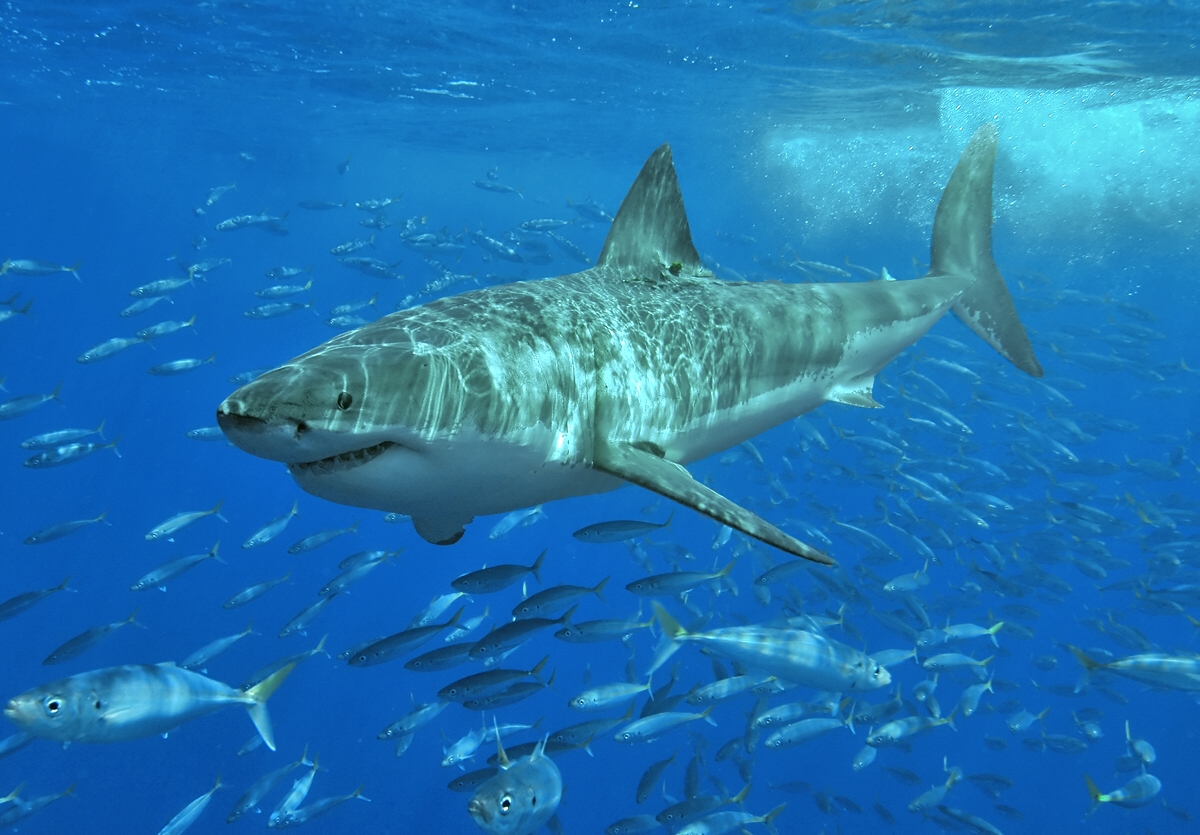
- 1 Primary weapon or tool — The bill, teeth, trunk, pouch or talon that field guides name first -- and that trade or c
- 2 Energy store — Fat, cache, crop or bamboo hours that decide whether a season closes.
- 3 Natal or breeding site — A redd, eyrie, den, anemone or ice lair -- often a single-point risk (Izumi, Natron, Gir).
- 4 Sensory organ — Ampullae of Lorenzini, a keen nose and rod-rich vision for a silhouette against the surfac
- 5 Human interface — Hunt, tourism, film or quota -- the surface where great white shark biology meets English-
Anatomy overlay
Four teaching regions on Great white shark. A schematic, not a dissection guide.
Every great white shark is a stack of tissues that must agree under season, prey and human pressure.
Meters below repeat the six atlas scores as gauges; they are relative marks, not laboratory certificates.
Systems
Support and integument
A conical snout, serrated triangular teeth and a homocercal tail. Vascular rete keep core muscle warm; the liver is a vast oil store for buoyancy.
Feeding apparatus
Ontogenetic shift from fish to pinnipeds where seals are dense. A single seal can fund days; scavenging whales is documented opportunistic income. The feeding kit sets the ecological-role score relative to the other 23 types.
Respiration and circulation
Gas exchange and blood flow are tuned to the great white shark energy budget -- dive, hover, sprint or bulk browse -- not to a generic vertebrate template.
Senses and neural control
Ampullae of Lorenzini, a keen nose and rod-rich vision for a silhouette against the surface -- the classic seal-shaped cue.
Reproduction and ontogeny
Replacement rate is the hidden resilience number. Late maturity and few pups. Hooks, nets and a 1975 story are ceilings teeth cannot cut.
Thermoregulation and salt/water
Climate and osmoregulation bound where a great white shark can close its daily budget. Field sites in the English-speaking world still measure that envelope first.
Relative meters
Hotspots
Primary weapon or tool
The bill, teeth, trunk, pouch or talon that field guides name first -- and that trade or conflict usually targets.
Energy store
Fat, cache, crop or bamboo hours that decide whether a season closes.
Natal or breeding site
A redd, eyrie, den, anemone or ice lair -- often a single-point risk (Izumi, Natron, Gir).
Sensory organ
Ampullae of Lorenzini, a keen nose and rod-rich vision for a silhouette against the surface -- the classic seal-shaped cue.
Human interface
Hunt, tourism, film or quota -- the surface where great white shark biology meets English-language law.
Tissues & materials
Keratin and integument
Feathers, fur, baleen or skin plates -- tissues, not metals. Moult and wear are the maintenance cycle.
Bone and cartilage
Load paths for stoop, lunge, knuckle-walk or hover. Marrow and pneumatic bone differ by family.
Muscle and tendon
The expensive tissue that speed and intelligence scores only hint at.
Fat, oil and glycogen
Stores that migration, fast and lactation spend. A market for those stores (oil, ivory, fin) is a historical threat.
Keep exploring
More in Fish
Salmon
Anadromous fishes that move ocean fat onto spawning gravels -- and into forests, treaties and hydropower fights.
Overall 63 🐟Atlantic bluefin tuna
A warm-bodied tuna whose Tokyo auction prices and ICCAT quotas made a single fish into a geopolitical unit.
Overall 54 🐠Clownfish
Anemone-dwelling damselfish whose 2003 film fame became a capture-and-reef case study.
Overall 41 🐴Seahorse
Male-pregnancy fish — Hippocampus since Linnaeus (1758), dried trade, and CITES Appendix II (2002).
Overall 28 🎏Koi
Domesticated carp whose Niigata colour mutations became a global pond aesthetic -- not a wild goldfish substitute.
Overall 42 🐡Pufferfish
Beak-toothed inflators whose tetrodotoxin made a Japanese cuisine and a genome project out of one family.
Overall 41 ⚡Electric eel
Amazon knifefishes whose stacked electrocytes taught Humboldt, Volta arguments and a 2019 species split.
Overall 36