Mission skins
Named for Europe
1869 made a mountain bear a Latin animal.
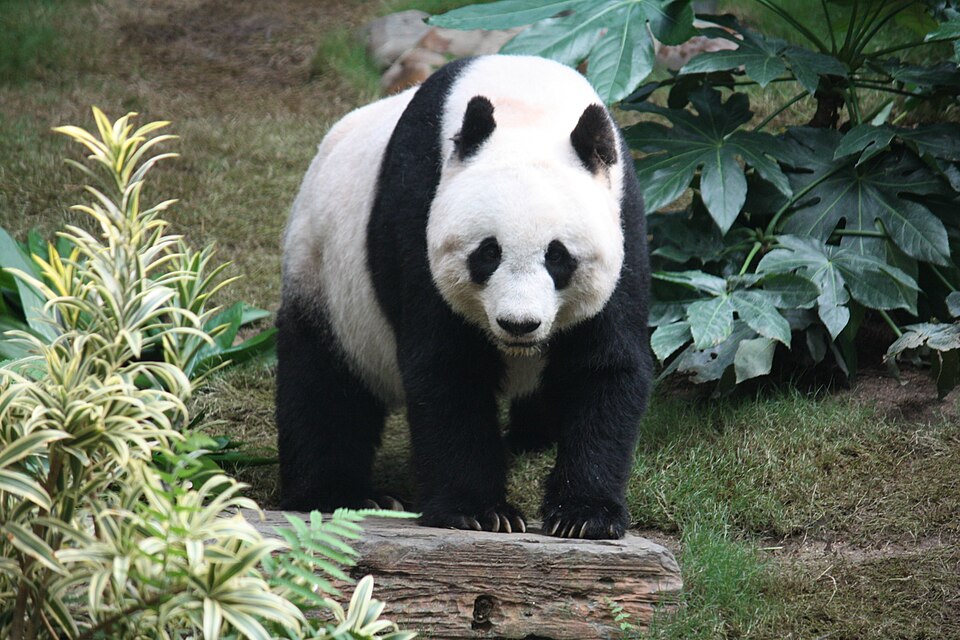
Giant panda · A bamboo specialist whose WWF logo, Wolong quake and 2016 IUCN downlist from EN to VU made a recovery into a brand.
Milestones in order. This is history, not a weekly activity grid.
Darker cells mean a higher score for this topic on that metric.
LessMore
Last reviewed Sources & creditsMedia creditsMethodology
Pandas are bamboo specialists in a small mountain belt. They do not engineer continents like elephants or move ocean nutrients like whales. The score is relative, not an insult.
VU is better than EN. Fragmented habitat, bamboo die-off cycles and a still-small wild number keep the species in a watch band, not a recovered one like koi or many owls.
The 1961 logo drew on Chi-Chi at London Zoo -- a high-contrast animal that printed well. The brand and the wild census later had to share one face.
Ling-Ling and Hsing-Hsing at the National Zoo made panda diplomacy a Cold War soft-power tool that China still uses as loans, not gifts.
The Sichuan earthquake killed staff and animals and wrecked the breeding centre. Rebuilding became a national reconstruction exhibit.
An American who took Su Lin out of China in 1936 -- a living-export story that predates modern loan contracts.
IUCN: VU (2016 downlist)
The giant panda did not enter English as a finished emblem. Hunts, films, listings and field stations rewrote the animal on a dated clock.
This chapter keeps ten timeline points, five eras and three milestones so a later translation can hold the same years.
Pere Armand David sent skins that named Ailuropoda for Europe.
A living cub reached the US -- the export-era opening.
A panda became the most printed conservation mark.
Ling-Ling and Hsing-Hsing arrived in Washington.
Field collaboration that later sat inside a reserve system.
Wolong centre destroyed; staff and animals died.
Loan cubs as a media cycle in Washington and Atlanta.
EN to VU -- the press treated a category as a cure.
China folded reserves into a larger landscape experiment.
US zoo loan expiries made diplomacy visible again.
1869 made a mountain bear a Latin animal.
Su Lin to Nixon -- living pandas as state objects.
A brand and a reserve grew together.
Reconstruction and a VU card shared a decade.
Corridors at home, contracts abroad.
A species became an NGO face.
Panda diplomacy as a template.
EN to VU -- a category fight that still returns.
Reading giant panda history beside the resilience score keeps a recovered stock from standing in for a threatened cousin.
Asia largest cat — subspecies maps, 1973 Project Tiger, and roughly 4,000 remaining wild animals still frame a century of recovery arithmetic.
Overall 62 🦁A social pantherine whose prides, Gir relic and 2015 Cecil killing still structure African conservation politics.
Overall 66 🐘The atlas type is the bush elephant -- an ecosystem engineer whose ivory ban (1989) and split from forest elephants still structure African conservation.
Overall 61 🐺A Holarctic pack hunter whose 1995 Yellowstone return and older Leopold ethics still structure predator politics.
Overall 78 🐻A marine bear whose seal-and-ice budget made Churchill, Knut and climate models into one public animal.
Overall 56 🦍The atlas type is the western gorilla -- a knuckle-walking ape whose Fossey-era mountain cousins and Koko lab fame split one public name.
Overall 45 🐋The largest animal whose 1966 IWC protection, 1982 moratorium and still-thin Antarctic recovery define a hunted giant.
Overall 65