Taxonomy
Named from the reef
19th-century types came from a trade that already moved colourful fish.
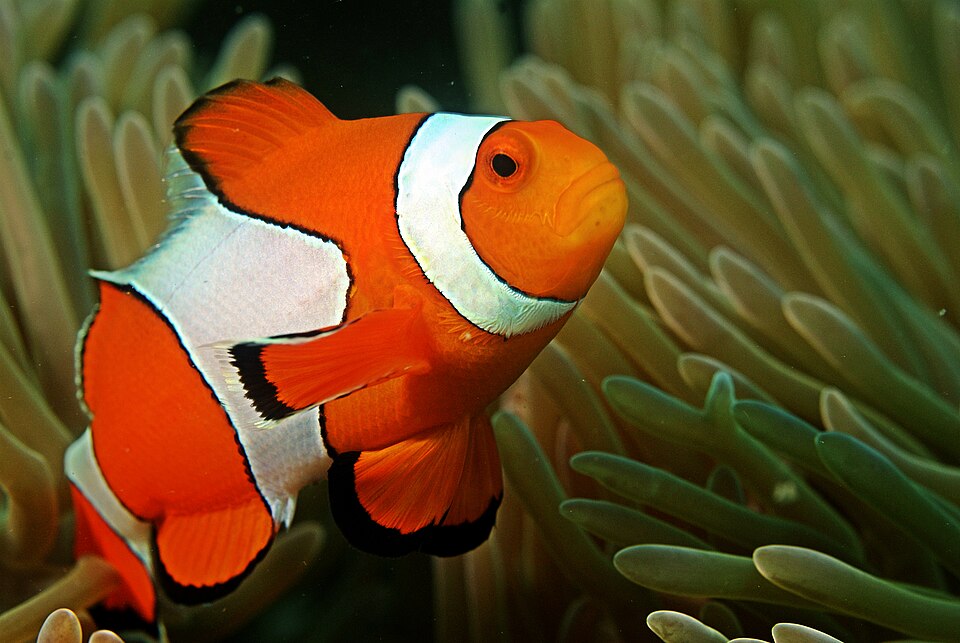
Clownfish · Anemone-dwelling damselfish whose 2003 film fame became a capture-and-reef case study.
Milestones in order. This is history, not a weekly activity grid.
Darker cells mean a higher score for this topic on that metric.
LessMore
Last reviewed Sources & creditsMedia creditsMethodology
Pixar Nemo is styled on Amphiprion ocellaris (this atlas type). Shops still mix ocellaris and percula under one common name.
A group is a female, a breeding male and non-breeders. If the female dies, the male changes sex. The film missing-mother plot skipped that rule.
Several trade analyses reported a demand spike after 2003. Captive-bred ocellaris later absorbed much of the legal market in the US and EU.
The fish mucus lacks the cues that trigger nematocysts, and acclimation behaviour matters. It is not a cartoon handshake.
Fish may linger on a dying anemone and then vanish from that site. Reef heatwaves are a housing crisis for the genus.
Males tend the nest of demersal eggs. The biology is paternal care, not a transoceanic search.
The clownfish did not enter English as a finished emblem. Hunts, films, listings and field stations rewrote the animal on a dated clock.
This chapter keeps ten timeline points, five eras and three milestones so a later translation can hold the same years.
Anemonefishes entered European systematics from Indo-Pacific collections.
Early captive breeding of clownfish became a tropical-aquarium footnote.
Gerald Allen work organised the genus for field and trade.
Philippine and Indonesian capture methods hit aquarium-trade press.
Pixar film made ocellaris the most recognised reef fish on Earth.
Trade and education journals began arguing over capture spikes.
US chain stores shifted many ocellaris SKUs to tank-raised.
A sequel reopened the do-not-release-pets PSA that aquariums had begged for in 2003.
Host anemones sat inside the same heat event as corals.
Successive bleaching years made host availability the new limiting story.
19th-century types came from a trade that already moved colourful fish.
Breeding existed; wild cyanide still stocked much of the shelf.
A film outsold every field guide; captive breeding scaled in response.
A sequel PSA met a hotter Coral Triangle.
Anemone survival, not cartoon fame, sets the wild future.
A children film became a capture-and-education case study.
Legal US/EU ocellaris shifted heavily to aquaculture.
Host anemones entered the same heat ledger as corals.
Reading clownfish history beside the resilience score keeps a recovered stock from standing in for a threatened cousin.
Apex lamnid whose warm muscle, broad diet and 1975 cinema still outrun the tagging papers.
Overall 66 🐟Anadromous fishes that move ocean fat onto spawning gravels -- and into forests, treaties and hydropower fights.
Overall 63 🐟A warm-bodied tuna whose Tokyo auction prices and ICCAT quotas made a single fish into a geopolitical unit.
Overall 54 🐴Male-pregnancy fish — Hippocampus since Linnaeus (1758), dried trade, and CITES Appendix II (2002).
Overall 28 🎏Domesticated carp whose Niigata colour mutations became a global pond aesthetic -- not a wild goldfish substitute.
Overall 42 🐡Beak-toothed inflators whose tetrodotoxin made a Japanese cuisine and a genome project out of one family.
Overall 41 ⚡Amazon knifefishes whose stacked electrocytes taught Humboldt, Volta arguments and a 2019 species split.
Overall 36