Darker cells mean a higher score for this topic on that metric.
LessMore
Last reviewed Sources & creditsMedia creditsMethodology
Quick answers
Is Nemo an ocellaris or a percula?
Pixar Nemo is styled on Amphiprion ocellaris (this atlas type). Shops still mix ocellaris and percula under one common name.
How does sex change work?
A group is a female, a breeding male and non-breeders. If the female dies, the male changes sex. The film missing-mother plot skipped that rule.
Did Finding Nemo increase wild take?
Several trade analyses reported a demand spike after 2003. Captive-bred ocellaris later absorbed much of the legal market in the US and EU.
Why do anemones not sting their fish?
The fish mucus lacks the cues that trigger nematocysts, and acclimation behaviour matters. It is not a cartoon handshake.
What happens when a host bleaches?
Fish may linger on a dying anemone and then vanish from that site. Reef heatwaves are a housing crisis for the genus.
Are clownfish good parents in the film sense?
Males tend the nest of demersal eggs. The biology is paternal care, not a transoceanic search.
Anatomy overlay
Numbered teaching hotspots on the species still — not a clinical diagnosis.
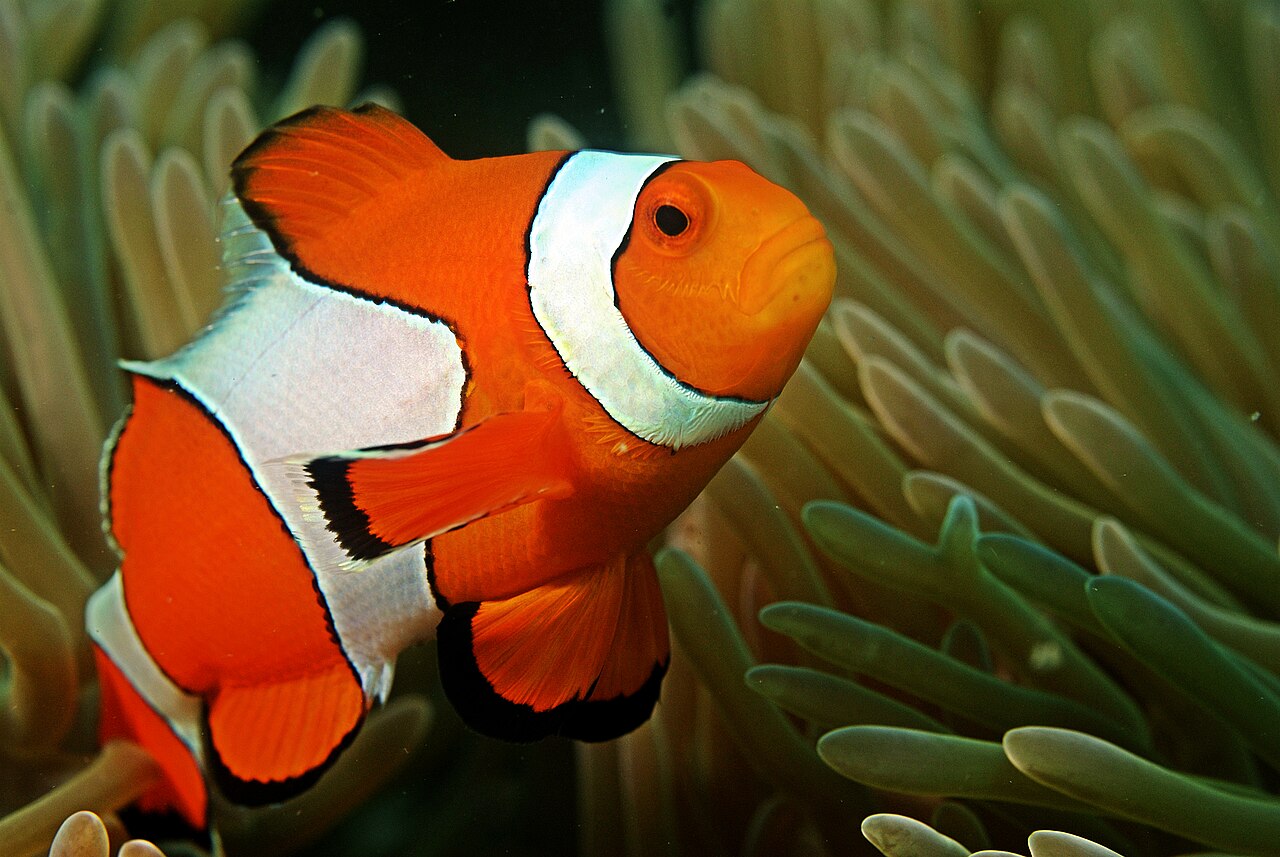
- 1 Primary weapon or tool — The bill, teeth, trunk, pouch or talon that field guides name first -- and that trade or c
- 2 Energy store — Fat, cache, crop or bamboo hours that decide whether a season closes.
- 3 Natal or breeding site — A redd, eyrie, den, anemone or ice lair -- often a single-point risk (Izumi, Natron, Gir).
- 4 Sensory organ — Chemical cues from the host and social rank by size. Vision is tuned to a bright, shallow
- 5 Human interface — Hunt, tourism, film or quota -- the surface where clownfish biology meets English-language
Every clownfish is a stack of tissues that must agree under season, prey and human pressure.
Meters below repeat the six atlas scores as gauges; they are relative marks, not laboratory certificates.
Systems
Support and integument
A small pomacentrid with a mucus coat and a body plan for hovering in tentacles. The swim bladder and pectorals are built for a tiny territory, not a gyre.
Feeding apparatus
Algae, zooplankton and anemone scraps inside a few cubic metres. The expensive trick is immunity, not speed. The feeding kit sets the ecological-role score relative to the other 23 types.
Respiration and circulation
Gas exchange and blood flow are tuned to the clownfish energy budget -- dive, hover, sprint or bulk browse -- not to a generic vertebrate template.
Senses and neural control
Chemical cues from the host and social rank by size. Vision is tuned to a bright, shallow reef, not to open water.
Reproduction and ontogeny
Replacement rate is the hidden resilience number. No anemone, no species behaviour. Heat and trade both remove the house or the household.
Thermoregulation and salt/water
Climate and osmoregulation bound where a clownfish can close its daily budget. Field sites in the English-speaking world still measure that envelope first.
Relative meters
Hotspots
Primary weapon or tool
The bill, teeth, trunk, pouch or talon that field guides name first -- and that trade or conflict usually targets.
Energy store
Fat, cache, crop or bamboo hours that decide whether a season closes.
Natal or breeding site
A redd, eyrie, den, anemone or ice lair -- often a single-point risk (Izumi, Natron, Gir).
Sensory organ
Chemical cues from the host and social rank by size. Vision is tuned to a bright, shallow reef, not to open water.
Human interface
Hunt, tourism, film or quota -- the surface where clownfish biology meets English-language law.
Tissues & materials
Keratin and integument
Feathers, fur, baleen or skin plates -- tissues, not metals. Moult and wear are the maintenance cycle.
Bone and cartilage
Load paths for stoop, lunge, knuckle-walk or hover. Marrow and pneumatic bone differ by family.
Muscle and tendon
The expensive tissue that speed and intelligence scores only hint at.
Fat, oil and glycogen
Stores that migration, fast and lactation spend. A market for those stores (oil, ivory, fin) is a historical threat.
Keep exploring
More in Fish
Great white shark
Apex lamnid whose warm muscle, broad diet and 1975 cinema still outrun the tagging papers.
Overall 66 🐟Salmon
Anadromous fishes that move ocean fat onto spawning gravels -- and into forests, treaties and hydropower fights.
Overall 63 🐟Atlantic bluefin tuna
A warm-bodied tuna whose Tokyo auction prices and ICCAT quotas made a single fish into a geopolitical unit.
Overall 54 🐴Seahorse
Male-pregnancy fish — Hippocampus since Linnaeus (1758), dried trade, and CITES Appendix II (2002).
Overall 28 🎏Koi
Domesticated carp whose Niigata colour mutations became a global pond aesthetic -- not a wild goldfish substitute.
Overall 42 🐡Pufferfish
Beak-toothed inflators whose tetrodotoxin made a Japanese cuisine and a genome project out of one family.
Overall 41 ⚡Electric eel
Amazon knifefishes whose stacked electrocytes taught Humboldt, Volta arguments and a 2019 species split.
Overall 36