Milestones in order. This is history, not a weekly activity grid.
- The first book on skating
- Jackson Haines reaches Vienna
- Axel Paulsen jumps in Vienna
- The ISU is founded
- First World Championships
- Madge Syers enters the men's event
- Figure skating enters the Olympics
- Chamonix and an eleven-year-old
- Henie's third gold and Hollywood
- Dick Button's double Axel
- The Sabena crash
- Ice dance becomes Olympic
- Torvill and Dean skate Boléro
- The first quad and the first triple Axel
Last reviewed Sources & creditsMedia creditsMethodology
Quick answers
What are the six jumps in figure skating and how do you tell them apart?
There are exactly six, and the only difference is how the skater leaves the ice. Three are toe jumps, launched by planting the free foot's toe pick: the toe loop from a back outside edge, the flip from a back inside edge, and the Lutz from a back outside edge after a long counter-rotated glide, usually into a corner. Three are edge jumps, launched from the blade alone: the Salchow from a back inside edge, the loop from a back outside edge with feet crossed, and the Axel from a forward outside edge. Because the Axel takes off facing forwards it contains an extra half turn, so a triple Axel is three and a half rotations. Base values rise in that same order.
How is figure skating actually scored?
Each skater's segment score has two halves. The Technical Element Score adds up every jump, spin and step sequence: each has a published base value, adjusted by a grade of execution that judges award from minus five to plus five as a percentage of that base value. A separate technical panel confirms what was performed, assigns levels from B to 4 for spins and steps, and applies calls for underrotation, downgrade or a wrong take-off edge. The Program Component Score then rates Composition, Presentation and Skating Skills from 0.25 to 10.00, multiplied by a factor. Deductions for falls, time violations and illegal elements are subtracted last. The short program and free skate scores are added, and the highest total wins.
What is the difference between the short program and the free skate?
The short program is 2 minutes 40 seconds and prescribes exactly seven elements: three jumping passes including a required Axel-type jump and a combination, three spins of different families, and a step sequence. Anything extra earns nothing, and a missed element cannot be replaced, so it is a compliance test under pressure. The free skate runs 4 minutes and allows up to twelve elements, including seven jumping passes, with the skater free to choose content and order. It carries roughly twice the available points and includes the second-half bonus, which multiplies the base value of the last three jumping passes by 1.1 if they start after the halfway mark. Ice dance uses a rhythm dance and free dance instead.
What is a quadruple Axel, and who has landed one?
A quadruple Axel is four and a half rotations, because the Axel is the only jump taken off facing forwards, which adds half a turn to whatever the skater completes in the air. It carries a base value of 12.50, the highest of any element in the sport, more than a triple Axel and a double Axel combined. Ilia Malinin of the United States landed the first ratified quadruple Axel at the US International Classic in Lake Placid on 14 September 2022, aged seventeen, after decades in which the jump was assumed to be beyond human capability. He has since made it a routine part of his free skate, and no other skater had landed one in competition as of the 2024-25 season.
Why did compulsory figures disappear from the sport?
For nearly two centuries skaters traced precise geometric patterns on clean ice and were judged on the marks left behind, which is where the name figure skating comes from. Figures once accounted for the majority of a competition's score, but they were slow to judge, impossible to televise, and consumed enormous amounts of ice time in training. The short program was introduced in 1973 to give broadcasters something watchable and reduce the weight of figures, and their share of the score fell repeatedly through the 1980s. The 1990 World Championships in Halifax were the last to include them. Critics argue their loss cost the sport a generation of edge quality; supporters point out that no audience ever paid to watch someone trace a circle.
What is the difference between pairs and ice dance?
Pairs is a jumping discipline performed by two people. It includes throw jumps, in which one partner launches the other into multiple rotations; twist lifts; overhead lifts in five permitted groups; the death spiral, in which one partner circles the ice with their head inches above it; and side-by-side jumps and spins judged on unison. Ice dance forbids nearly all of that. There are no throws, no jumps of more than one revolution, and no lift in which the man's hands rise above his head. Ice dance is scored on pattern dance sections with key points, twizzles, step sequences in and out of hold, dance spins and time-limited lifts. In short, pairs is about flight and ice dance is about edges.
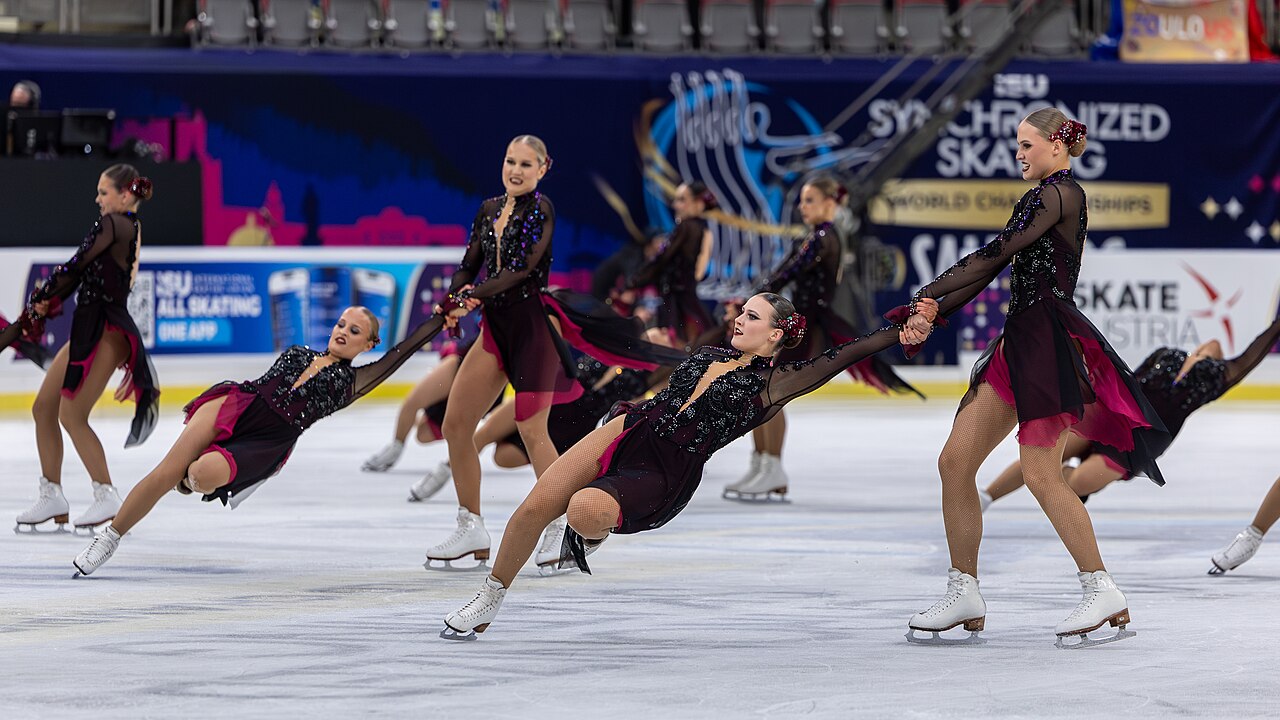
Skating for pleasure is medieval, but figure skating as a judged sport begins with two ideas colliding. The English school of the eighteenth and nineteenth centuries treated it as draughtsmanship: skaters traced precise geometric figures on the ice, stiff and upright, and were scored on the tracings left behind. Then Jackson Haines, an American ballet master who found no audience at home, took his balletic, music-driven style to Vienna in the 1860s and created what became known as the international style. Every modern program descends from that transplant.
The institutional history is more precise. The International Skating Union was founded at Scheveningen in the Netherlands in 1892, the first World Championships were held at St. Petersburg in 1896, and figure skating became the first winter sport at an Olympic Games in London in 1908. What follows divides into clear eras: Scandinavian and Austrian dominance before the war, Soviet supremacy after it, a television-driven boom in the 1980s and 1990s, the judging crisis of 2002 and the rebuilt scoring system that came out of it, and the quadruple-jump arms race of the present.
Timeline
Robert Jones, a British artillery lieutenant, publishes A Treatise on Skating, the earliest known instruction manual for the sport. It describes circles, spirals and the beginnings of what would become compulsory figures.
The American dancer and skater brings ballet posture, waltz timing and choreography set to music into a discipline that had been an exercise in tracing. The Viennese school he founds becomes the international style.
At the first major international competition, held in Vienna, the Norwegian Axel Paulsen performs the forward-take-off jump that still carries his name. He does it on speed skates.
Delegates meet at Scheveningen in the Netherlands in July and create the International Skating Union, the oldest international federation governing a winter sport. It still writes the rules today.
St. Petersburg stages the first World Figure Skating Championships, won by Germany's Gilbert Fuchs. The event is for men only, and consists almost entirely of compulsory figures.
No rule forbids it, so the Englishwoman competes at the World Championships and finishes second to Ulrich Salchow. The ISU promptly bars women, then creates a separate ladies' championship in 1906, which Syers wins.
At the London Summer Games, figure skating becomes the first winter sport contested at an Olympics. Salchow and Syers take the singles titles, and Russia's Nikolai Panin wins special figures for his country's first Olympic gold.
Figure skating joins the first Winter Olympics. Gillis Grafström wins the men's title, and a Norwegian girl named Sonja Henie finishes last in the women's field at the age of eleven.
Sonja Henie completes three consecutive Olympic titles at Garmisch-Partenkirchen and ten straight world championships, then turns professional, signs with 20th Century Fox and invents the touring ice revue.
At the St. Moritz Olympics the 18-year-old American lands the first double Axel in competition and takes the title, beginning the shift from figures to athleticism. He adds the first triple jump, a loop, at Oslo in 1952.
On 15 February, Sabena Flight 548 crashes near Brussels, killing all 72 aboard including the entire United States figure skating team travelling to the World Championships in Prague. The championships are cancelled and American skating is rebuilt from nothing.
Ice dance debuts at the Innsbruck Games, won by the Soviet pair Lyudmila Pakhomova and Alexandr Gorshkov. At the same Games, Terry Kubicka performs the only backflip in Olympic history before the element is banned.
At Sarajevo the British pair receive nine perfect 6.0s for artistic impression, the only unanimous set of maximum marks awarded in Olympic figure skating, and rewrite what ice dance is allowed to be about.
At the World Championships in Budapest, Canada's Kurt Browning lands the first ratified quadruple jump, a toe loop. In the same year Japan's Midori Ito becomes the first woman to land a triple Axel in competition.
The World Championships in Halifax are the last to include compulsory figures. After nearly two centuries, the discipline that gave the sport its name disappears from international competition.
The attack on Nancy Kerrigan in January turns Lillehammer into a global media event; Ukraine's Oksana Baiul wins gold. The women's competition becomes one of the most-watched broadcasts in United States television history.
A French judge admits to being pressured over the pairs result, and the IOC and ISU award a second gold to Canada's Jamie Salé and David Pelletier alongside Russia's Elena Berezhnaya and Anton Sikharulidze.
The 6.0 system is abandoned for a cumulative points system with published base values, grades of execution and program components. It becomes mandatory at ISU championships from the following season.
Sochi introduces the Olympic team event, won by Russia. Yuzuru Hanyu takes the men's title with the first short program over 100 points, and repeats in 2018 as the first back-to-back champion since Dick Button.
On 14 September at the US International Classic in Lake Placid, the 17-year-old American lands the first ratified quadruple Axel, the jump long considered the sport's outer physical limit.
The eras
From tracing to the international style
For its first century the sport was literally figure skating: competitors traced circles, loops, brackets and rockers onto clean ice and were judged on the accuracy of the marks left behind. Robert Jones's 1772 treatise codified an English school that prized rigidity, control and a body held almost motionless above the working blade. The rupture came from an outsider. Jackson Haines, a New York ballet master whose flowing style found no audience in America, moved to Europe in the 1860s and made Vienna his base, skating to music with balletic carriage and inventing the sit spin. The Viennese adopted him; the English mostly did not. The institutions followed the Viennese. Hamburg staged the first European Championships in 1891, the International Skating Union was founded at Scheveningen in 1892, and St. Petersburg hosted the first World Championships in 1896. Compulsory figures still dominated the marks, but the free skating segment that Haines had made possible was now part of every competition, and the two halves of the sport — the geometry and the performance — were locked into a single scoresheet where they would argue with each other for the next hundred years.
Salchow, Syers, Henie and the Olympic beginning
Ulrich Salchow won ten world titles between 1901 and 1911 and gave the sport a jump that bears his name. Madge Syers exposed the absurdity of excluding women by entering the 1902 World Championships, where no rule barred her, and finishing second to Salchow; the ISU responded by barring women and then, in 1906, creating a separate championship she immediately won. Both took the first Olympic titles when figure skating appeared at the 1908 London Summer Games, sixteen years before a Winter Olympics existed. Between the wars, Austria and Scandinavia ran the sport. Gillis Grafström of Sweden won three Olympic golds across the 1920 Summer Games and the 1924 and 1928 Winter Games, still the only skater to win at both. Karl Schäfer of Austria took seven consecutive world titles and two Olympic golds. And Sonja Henie changed the discipline's public face entirely: ten straight world titles from 1927, three Olympic golds, a hemline raised to mid-calf, white boots, and choreography drawn from ballet. When she turned professional in 1936 and signed with Hollywood, she proved that figure skating could be a mass entertainment product, not merely a competition.
The athletic turn and a catastrophe
Dick Button arrived after the war with a completely different premise: that jumps, not figures, would decide the sport's future. He landed the first double Axel at the 1948 Olympics and the first triple jump — a loop — at Oslo in 1952, won two Olympic titles and five straight world championships, and invented the flying camel spin. The rest of the field spent a decade catching up. Then, on 15 February 1961, Sabena Flight 548 crashed on approach to Brussels, killing everyone aboard including the entire eighteen-member United States team, their coaches and family members bound for the World Championships in Prague. The championships were cancelled, and American skating lost a generation in an afternoon. Rebuilding took most of the decade and produced, through the memorial fund created in the victims' names, the structure that later supported Peggy Fleming, Dorothy Hamill and their successors. Meanwhile the Soviet Union entered the sport seriously for the first time, targeting pairs with state resources and systematic coaching, and Lyudmila Belousova and Oleg Protopopov won Olympic gold in 1964 and 1968 with a lyrical style that made the discipline artistic rather than merely acrobatic.
Soviet pairs, ice dance and the television era
Irina Rodnina's run defines the period: undefeated from 1969 to 1980, ten consecutive world titles, eleven European championships and three Olympic golds with two different partners. Soviet pairs won every Olympic pairs title from 1964 to 2006, the longest continuous dominance in any Olympic sport, built on centralised coaching under Stanislav Zhuk and Tatiana Tarasova and a technical model of speed and unison nobody else could match. Ice dance, added to the World Championships in 1952 and the Olympics in 1976, initially followed the same pattern, with Pakhomova and Gorshkov taking the first Olympic title. Then Jayne Torvill and Christopher Dean arrived from Nottingham and turned the discipline into theatre, culminating in the 1984 Boléro that drew nine perfect 6.0s. Television drove everything. The 1973 introduction of the short program gave broadcasters a compact segment; ABC and Eurosport built winter schedules around the sport; and the 1988 Calgary Games delivered the Battle of the Brians and the Battle of the Carmens to enormous audiences. The same Games marked the technical future, as Kurt Browning and Midori Ito pushed past the quadruple and women's triple Axel barriers within months of each other.
Boom, scandal and the end of the 6.0
The abolition of compulsory figures after the 1990 World Championships removed the last barrier between figure skating and mainstream sport: what remained was four minutes of jumping and performing, perfectly shaped for television. Ratings exploded, then exploded again after the attack on Nancy Kerrigan in January 1994 turned the Lillehammer women's event into one of the most-watched broadcasts in American history. Professional tours, made-for-TV competitions and endorsement money followed, and reinstatement rules allowed Torvill and Dean and Katarina Witt to return to the Olympics. The technical standard rose in parallel: Elvis Stojko, Alexei Urmanov and then Alexei Yagudin and Evgeni Plushenko made the quadruple toe loop a competitive requirement. The reckoning came at Salt Lake City in 2002, when the French judge in the pairs event admitted she had been pressured to place the Russian couple first. The IOC awarded a duplicate gold to Salé and Pelletier, and the ISU, facing an existential credibility crisis, scrapped the ordinal-based 6.0 system entirely. The ISU Judging System that replaced it in 2004 made every element's worth public and every score cumulative, changing not only how skating is judged but how it is choreographed.
The quadruple era
Under a system that pays literally by the rotation, difficulty compounded fast. Yuzuru Hanyu broke 100 points in the short program at Sochi 2014 and 300 overall at the 2015 NHK Trophy, set nineteen world records, and became the first man since Dick Button in 1952 to defend an Olympic title. Nathan Chen answered with volume, winning three world titles and Beijing 2022 gold on a foundation of five different quadruple jumps. Ilia Malinin then landed the quadruple Axel in September 2022 and put six quads into a single free skate at the 2024 World Championships. The women's discipline lived through its own compression, as Russian teenagers coached by Eteri Tutberidze won three consecutive Olympic titles from 2014 while quadruple jumps and triple Axels became routine before the age of eighteen. The Kamila Valieva doping case at Beijing 2022, resolved by the Court of Arbitration for Sport in 2024, forced the reckoning: the ISU raised the senior minimum age from 15 to 17 in phases from 2023. Russia's exclusion after February 2022, the reduction of program components from five to three, and the legalisation of backflips in 2024 have all reshaped the sport since.
Figure skating's history is a long negotiation between the two things it asks of a skater. The English school wanted geometry; Jackson Haines wanted music; the ISU has spent 130 years building scoring systems that try to pay for both at once, and every crisis in the sport — the 2002 scandal, the abolition of figures, the argument over whether a fallen quadruple should outscore a clean triple — is really a dispute about the exchange rate. The current answer favours difficulty, which is why the jumps keep getting bigger. The next answer will probably favour something else, because it always has.
Keep exploring
More sports
Soccer
The simplest game on Earth, played by hundreds of millions and argued over by half the planet.
🏀Basketball
Five players, 24 seconds, and geometry at full sprint — the city game that conquered the world.
⚾Baseball
The clockless chess match where a round bat meets a round ball and the best hitters on earth still fail seven times out of ten.
🎾Tennis
The loneliest duel in sport: no clock, no teammates, no place to hide until the last point is won.
🏎️F1
Twenty drivers, a thousand horsepower, and the most expensive engineering arms race in sport.
⛳Golf
A six-century test of nerve where the only opponent is the ground, the wind, and yourself.
🏈Football
Four downs, ten yards, one end zone: the ultimate game of territory, collision, and coaching.
🏏Cricket
The bat-and-ball contest where a single match can last five days and still turn on one ball.