
Skip to content Skip to a section

🏈GOAT Rankings

Football · Four downs, ten yards, one end zone: the ultimate game of territory, collision, and coaching.

At a glance
All-time shape

#1 Tom Brady

#2 Jerry Rice

#3 Jim Brown

Last reviewed Sources & creditsMedia creditsMethodology

Quick answers

Why is it called football if players mostly use their hands?

The name traces back to the football codes of nineteenth-century England, from which the American game descended, where football simply meant a ball game played on foot rather than on horseback. American football evolved from rugby football, itself a handling variant, and kept the family name even as carrying and throwing became central. Kicking remains important, too: field goals, extra points, punts, and kickoffs are all decided by the foot, and games are frequently won or lost on a kicker leg. The sport that Americans call soccer is elsewhere called football, which is why the American version specifies American football to avoid confusion.

How long does an NFL game actually last?

The game clock covers sixty minutes of play, divided into four fifteen-minute quarters, but a broadcast typically runs about three hours and ten minutes. The gap exists because the clock stops constantly, on incomplete passes, out-of-bounds plays, scores, penalties, timeouts, and the two-minute warning, and because commercial breaks, replay reviews, and halftime add time. Remarkably, the ball is actually in play for only about eleven to eighteen minutes of that window; the rest is huddles, substitutions, and stoppages. This deliberate, stop-start rhythm is part of what makes the sport so strategic, giving coaches time to adjust between nearly every snap.

What is the difference between the AFC and NFC?

The American Football Conference and National Football Conference are the two halves of the NFL, each containing sixteen teams split into four divisions of four. They were created by the 1970 merger of the older NFL with the rival American Football League, whose teams largely formed the AFC. During the regular season teams play mostly within their own conference, and the playoffs run separately in each until the two conference champions meet in the Super Bowl. The distinction is organizational rather than a difference in rules or quality; both conferences play identical football and compete for the same championship.

How does overtime work in the NFL?

If the score is tied after sixty minutes, the game goes to overtime. In the regular season this is a single ten-minute period, and under rules adopted for 2025 both teams are now guaranteed at least one possession, ending the era in which a first-possession touchdown could win it outright. A regular-season game can still finish in a tie if neither team pulls ahead within the period. In the playoffs the rules differ: both teams are guaranteed a possession, and the game continues through as many overtime periods as necessary, because a postseason game cannot end in a tie and must produce a winner.

Why do teams punt on fourth down?

On fourth down a team that fails to gain the remaining yardage hands the ball to its opponent at that spot, often giving them excellent field position. Punting instead kicks the ball far downfield, forcing the opponent to drive a longer distance to score, a trade of possession for territory. Teams weigh the odds: deep in their own end or with long yardage to go, punting is the low-risk choice, while near midfield in short-yardage situations, or when trailing late, analytics increasingly favor going for it. The rise of data-driven decision-making has made coaches noticeably more willing to keep the offense on the field than they were a decade ago.

What is the salary cap and how does it work?

The salary cap is a hard limit on how much each team may spend on player salaries in a given year, designed to keep the league competitive by preventing wealthy franchises from simply buying the best rosters. Introduced in 1994, it rises with league revenue and reached about $255.4 million per team in 2024. Because every team operates under the same ceiling, general managers must make constant trade-offs, and the escalating cost of elite quarterbacks now consumes a large share of many teams cap. Creative contract structuring, signing bonuses, and restructures let teams manage the cap across years, making salary-cap strategy a crucial part of roster building.

Start with this section - GOAT Rankings

Ranking the greatest players in a sport this positionally specialized is inherently contentious, because a quarterback and a defensive tackle are almost impossible to compare directly. This list weighs sustained dominance at a position, championship impact, statistical records, and the degree to which a player changed how the game is played. It leans on hard numbers where they exist and on the eye of history where the era predates modern tracking.

The twelve below span from the 1950s to today and cover every phase of the game, offense, defense, and the trenches. Reasonable people will reorder them, and the debate is part of the fun. What is not debatable is that each of these players redefined the ceiling of their craft.

All-time podium

🥈
Jerry Rice
Jerry Rice
USA
2
🥇
Tom Brady
Tom Brady
USA
1
🥉
Jim Brown
Jim Brown
USA
3

Comparison Lab

Toggle athletes on and off — every bar rescales to the leader of your selection.

Peak keeps each athlete’s strongest metrics; Career averages the full published set. Both stay editorial teaching marks.

5 / 12

Drag only reorders the cosmetic shortlist — it does not change teaching scores.

Default shortlist below works without JavaScript. Toggle chips after load to rebuild bars.

Compare · in selection · Career

  1. 1Tom Brady92
  2. 2Jerry Rice89
  3. 3Jim Brown83
  4. 4Lawrence Taylor66
  5. 5Joe Montana60

Passing yards

Tom Brady89,214

Passing TDs

Tom Brady649
Joe Montana273

Super Bowl wins

Tom Brady7
Joe Montana4
Jerry Rice3

Regular-season wins

Tom Brady251

MVP awards

Tom Brady3
Jim Brown3

Receptions

Jerry Rice1,549

Receiving yards

Jerry Rice22,895

Receiving TDs

Jerry Rice197

Total TDs

Jerry Rice208

Rushing yards

Jim Brown12,312

Rushing TDs

Jim Brown106

Yards per carry

Jim Brown5.2

Career sacks

Lawrence Taylor132.5

Def. Player of Year

Lawrence Taylor3

NFL MVP

Joe Montana2
Lawrence Taylor1

Pro Bowls

Lawrence Taylor10

Super Bowl MVP

Joe Montana3

The top 10

1
Tom Brady

Tom Brady

USA · 2000-2022

The most accomplished winner in NFL history, Brady turned a 199th overall draft slot into a twenty-three-year career that rewrote the record book. He retired as the all-time leader in passing yards (89,214) and touchdown passes (649), and won a record seven Super Bowls across ten appearances, five of them as Super Bowl MVP. His 251 regular-season wins are the most of any quarterback, and he added three regular-season MVP awards. Brady case rests on longevity and, above all, the postseason, where his cool precision in fourth quarters, epitomized by the 28-3 comeback in Super Bowl LI, defined an era. He remained an elite passer into his forties, winning a title with Tampa Bay in 2020 at age 43, proof that his edge was as much mental as physical.

Passing yards
89,214
Passing TDs
649
Super Bowl wins
7
Regular-season wins
251
MVP awards
3
2
Jerry Rice

Jerry Rice

USA · 1985-2004

Rice is the most statistically dominant non-quarterback the sport has produced, and by consensus the greatest wide receiver ever. Over twenty seasons he set career records that still stand and may never fall: 1,549 receptions, 22,895 receiving yards, and 197 receiving touchdowns, plus 208 total touchdowns. His receiving-yardage total is more than 6,000 clear of second place. Rice paired freakish work-rate, his offseason hill runs became legend, with precise route-running and reliable hands rather than pure speed. He won three Super Bowls with the San Francisco 49ers and was named MVP of Super Bowl XXIII. Playing deep into his forties, he made thirteen Pro Bowls and remained productive long after most peers retired, a testament to conditioning and craft that let a supposedly ordinary athlete become an all-time force.

Receptions
1,549
Receiving yards
22,895
Receiving TDs
197
Total TDs
208
Super Bowl wins
3
3
Jim Brown

Jim Brown

USA · 1957-1965

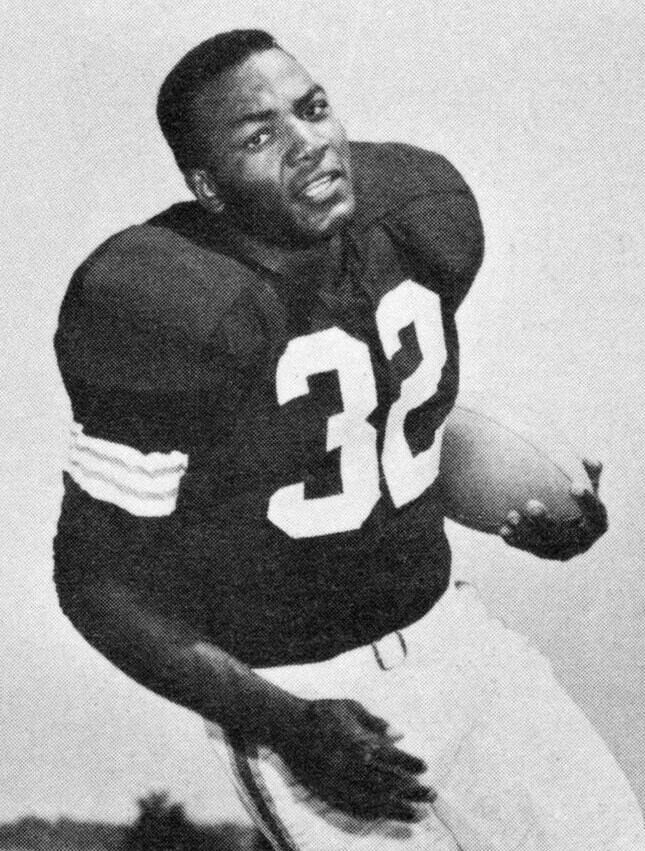
In just nine seasons Jim Brown established himself as the standard against which running backs are still measured. He led the NFL in rushing in eight of his nine years, retired as the all-time leader with 12,312 rushing yards and 106 rushing touchdowns, and averaged a staggering 5.2 yards per carry over his career. He won three MVP awards (1957, 1958, 1965) and never missed a game, an iron-man record made more remarkable by the punishment he absorbed as the focal point of every defense. Brown combined the power of a fullback with breakaway speed, and he walked away at his peak, age 29, to pursue acting and activism. Adjusted for era and workload, his dominance over his peers arguably exceeds that of any back who followed.

Rushing yards
12,312
Rushing TDs
106
Yards per carry
5.2
MVP awards
3
4
Lawrence Taylor

Lawrence Taylor

USA · 1981-1993

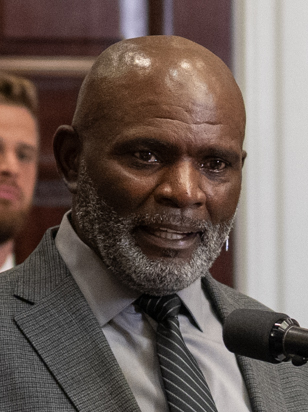
Lawrence Taylor is the defensive player most often credited with changing the game itself. As an outside linebacker for the New York Giants, his explosive edge rushing forced offenses to redesign protections and elevated the left tackle into a premium position charged with blocking his blind-side attacks. He recorded 132.5 official sacks, though the statistic was not tracked for his 1981 rookie year, and won three Defensive Player of the Year awards. In 1986 he became one of only two defensive players ever named NFL MVP, a season in which he tallied 20.5 sacks and dragged the Giants to a title. He won two Super Bowls and made ten Pro Bowls. Ferocious, instinctive, and relentless, he set the template for the modern pass-rushing edge defender.

Career sacks
132.5
Def. Player of Year
3
NFL MVP
1
Pro Bowls
10
5
Joe Montana

Joe Montana

USA · 1979-1994

Before Brady, Montana was the standard for postseason quarterbacking. The engine of Bill Walsh West Coast offense, he won four Super Bowls with the San Francisco 49ers and was named MVP of three of them, and, remarkably, threw eleven touchdowns and zero interceptions across those four championship games. His nickname, Joe Cool, captured a preternatural calm in the biggest moments, never more famous than his 92-yard game-winning drive to beat Cincinnati in Super Bowl XXIII. Montana won two regular-season MVP awards and finished with 40,551 passing yards and 273 touchdowns, numbers that undersell him because he played in a ball-control system and battled injuries. For efficiency, accuracy, and clutch command of a possession offense, he remains a benchmark.

Super Bowl wins
4
Super Bowl MVP
3
Passing TDs
273
NFL MVP
2
6
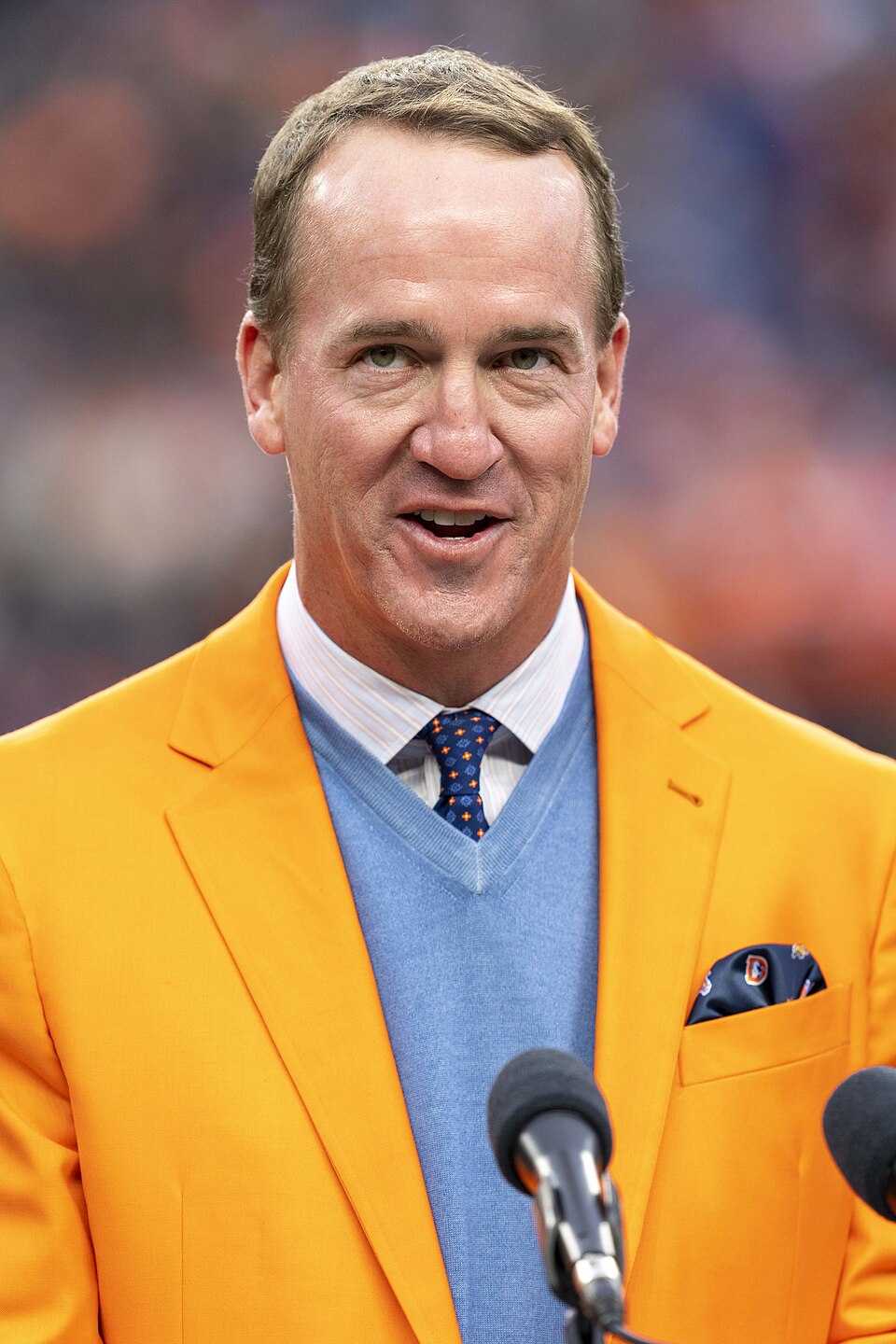
Peyton Manning

Peyton Manning

USA · 1998-2015

Manning was the most cerebral quarterback of his era, a pre-snap tactician who ran his offense like a coordinator on the field, shifting protections and audibling into the perfect play. He won a record five MVP awards and set single-season records with 55 touchdown passes and 5,477 passing yards in 2013. He retired second all-time with 71,940 passing yards and 539 touchdowns, and won two Super Bowls with two different franchises, the Colts and the Broncos, the second after a neck surgery that nearly ended his career. Manning influence on how quarterbacks prepare and control the line of scrimmage reshaped the position, and his rivalry with Brady defined the 2000s. His only knock, an uneven postseason record, does little to dim a monumental résumé.

Passing yards
71,940
Passing TDs
539
NFL MVP
5
Super Bowl wins
2
7
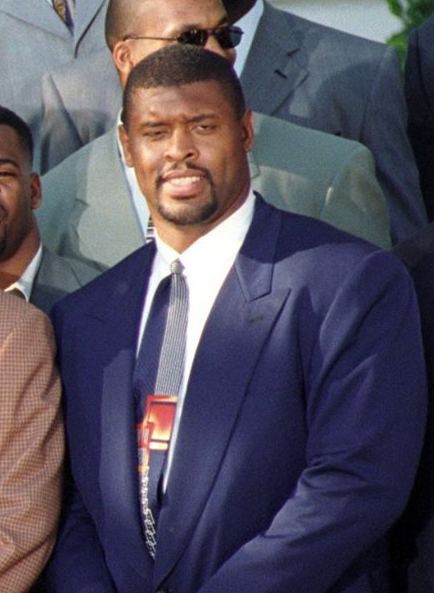
Reggie White

Reggie White

USA · 1985-2000

Known as the Minister of Defense, Reggie White combined rare size, power, and quickness to become one of the most unstoppable pass rushers ever. He retired as the NFL all-time sack leader with 198, a mark since passed only by Bruce Smith, and he twice won Defensive Player of the Year. White was a wrecking ball against both the run and the pass, capable of bull-rushing a guard into the backfield or dipping around a tackle. He made thirteen Pro Bowls across sixteen seasons and, after signing one of the landmark free-agent deals of the new era, delivered a Super Bowl to Green Bay, recording three sacks in the Packers Super Bowl XXXI win. Few players so thoroughly dominated the line of scrimmage for so long.

Career sacks
198
Def. Player of Year
2
Pro Bowls
13
Super Bowl wins
1
8
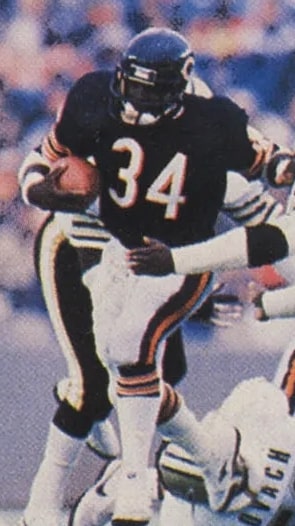
Walter Payton

Walter Payton

USA · 1975-1987

Sweetness combined grace, durability, and toughness into the most complete running back of his generation. Payton retired as the NFL all-time leader in rushing yards with 16,726 and rushing touchdowns with 110, and his 21,264 all-purpose yards reflected his value as a receiver and blocker as well as a runner. He was famed for finishing runs by lowering his shoulder into tacklers rather than avoiding them, and for near-perfect availability across thirteen seasons with the Chicago Bears. He won the 1977 MVP and a Super Bowl in the Bears dominant 1985 season. The NFL Man of the Year award now bears his name, honoring the character and community work that made him one of the sport most beloved figures as well as one of its greatest.

Rushing yards
16,726
Rushing TDs
110
All-purpose yards
21,264
NFL MVP
1
9
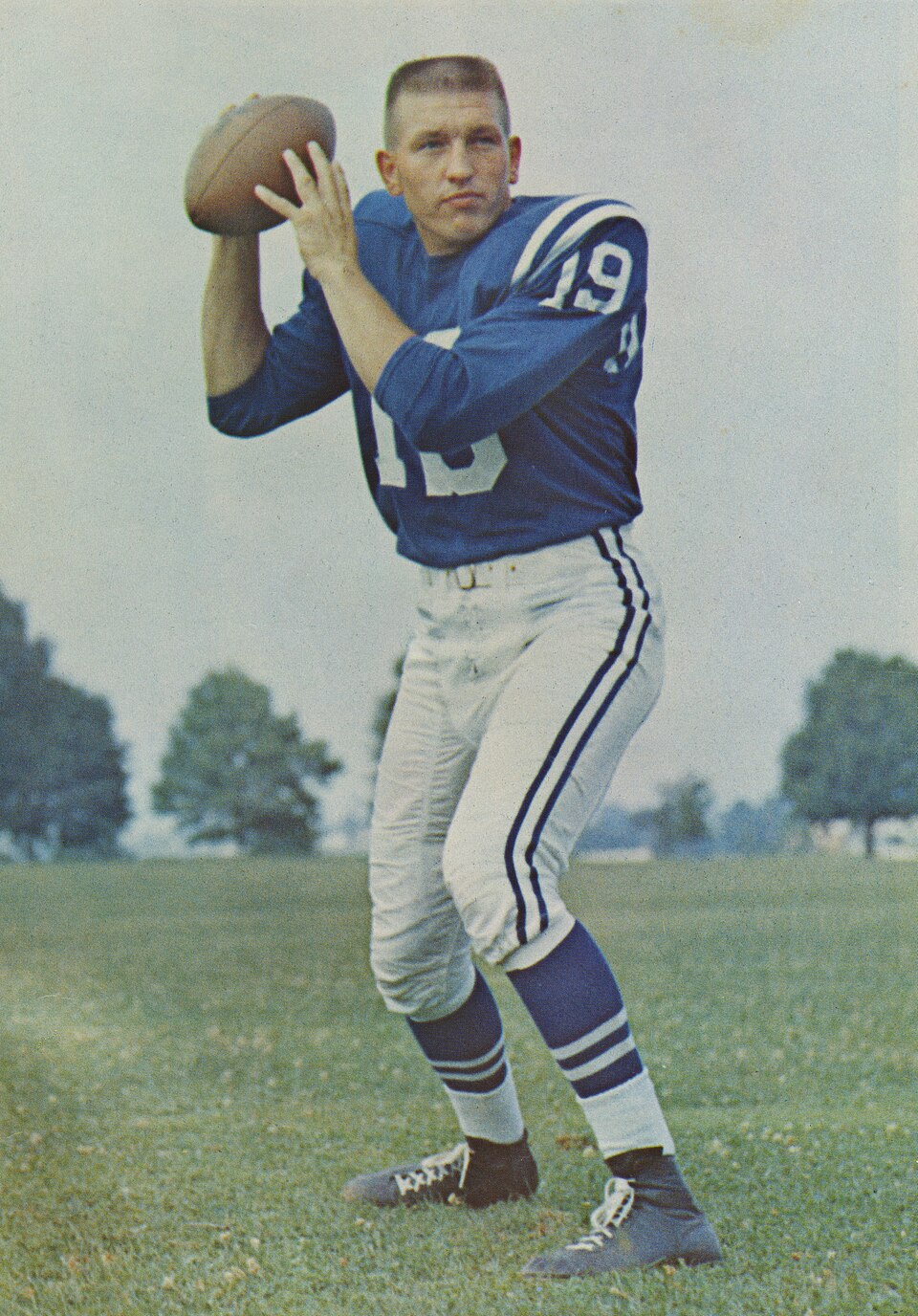
Johnny Unitas

Johnny Unitas

USA · 1956-1973

The prototype of the modern drop-back quarterback, Unitas rose from a semi-pro sandlot to become the face of the NFL as it conquered television. His masterful two-minute drive to force overtime in the 1958 Championship, the Greatest Game Ever Played, helped make pro football a national obsession. He threw a touchdown pass in 47 consecutive games, a record that stood from 1960 until 2012, and won three MVP awards. Unitas retired with 40,239 passing yards and 290 touchdowns, enormous totals for a run-heavy era, and led the Colts to three championships, including a win in Super Bowl V. His gunslinger command, audibling at the line and taking downfield shots, defined quarterback play for a generation that followed.

Passing yards
40,239
Passing TDs
290
NFL MVP
3
Championships
3
10
Barry Sanders

Barry Sanders

USA · 1989-1998

No runner was more electrifying, or more impossible to tackle in the open field, than Barry Sanders. In just ten seasons with a mostly modest Detroit Lions supporting cast, he ran for 15,269 yards and 99 touchdowns while averaging 5.0 yards per carry, and he made the Pro Bowl in all ten years. His 1997 MVP season saw him rush for 2,053 yards, one of only a handful of 2,000-yard campaigns in history. Sanders combined a preternaturally low center of gravity with stop-start agility that left defenders grasping at air, producing highlight runs that remain iconic. He shocked the sport by retiring at 30, within reach of the all-time rushing record, leaving fans to wonder just how high his numbers might have climbed.

Rushing yards
15,269
Rushing TDs
99
Yards per carry
5.0
NFL MVP
1
11

Aaron Donald

USA · 2014-2023

The defining interior defender of the modern era, Aaron Donald did from defensive tackle what pass rushers usually do from the edge. Undersized for the position at around 6-foot-1, he used explosive quickness and elite hand technique to collapse pockets from the inside, finishing with 111 career sacks, an extraordinary total for an interior lineman. He was named Defensive Player of the Year three times, earned first-team All-Pro honors eight times, and made the Pro Bowl in all ten of his seasons before retiring in 2024. Donald capped his career by helping the Los Angeles Rams win Super Bowl LVI, where his late pressure sealed the title. Offenses routinely double-teamed him and still failed to contain him, the surest sign of a truly dominant defender.

Career sacks
111
Def. Player of Year
3
First-team All-Pro
8
Pro Bowls
10
12

Ray Lewis

USA · 1996-2012

For seventeen seasons Ray Lewis was the emotional and tactical heart of the Baltimore Ravens defense, a middle linebacker who married ferocious hitting with brilliant diagnosis of plays. He won two Defensive Player of the Year awards and anchored one of the greatest defenses ever, the 2000 Ravens, whom he led to a Super Bowl XXXV title while earning game MVP honors. He captured a second ring in his final season in Super Bowl XLVII. Lewis intercepted 31 passes and amassed well over 2,000 tackles, an exceptional figure that reflects both his longevity and his sideline-to-sideline range. As a field general who set the defense and inspired teammates, he redefined what a middle linebacker could mean to a franchise.

Def. Player of Year
2
Super Bowl wins
2
Interceptions
31
Pro Bowls
13

Bars are scaled to the leader in this list.

The debate

The unavoidable friction in any NFL list is comparing across positions and eras. Brady tops most modern rankings on the strength of seven Super Bowls and every meaningful passing record, but purists argue that Jim Brown or Lawrence Taylor dominated their contemporaries by a wider margin, even if the raw numbers look smaller in a run-first, twelve-game-schedule world. Quarterback statistics have also inflated dramatically as rules opened up the passing game, which flatters modern passers relative to the pioneers who played behind weaker protection and stricter contact rules.

There is also the perennial tension between accumulation and peak. Rice and Payton hold career records built on remarkable longevity, while Barry Sanders and Jim Brown walked away early yet may have been more dominant per season. Defenders and linemen, whose contributions resist tidy box scores, are perpetually underrated in popularity-driven debates. The honest conclusion is that the top handful are close enough that reasonable cases can be made for several as the greatest, which is exactly why the argument never ends.

Embed this ranking

Paste this code into your blog or site — the ranking stays up to date.

Keep exploring

More in this category