Carpal bones
Eight small bones arranged in two rows form the wrist's core, allowing a combination of gliding and rotating movements between the forearm and hand.
Wrist & Hand · The wrist and hand pack more small joints, tendons, and nerves into a small space than almost any other body region, enabling fine motor control at the cost of frequent overuse injury.
Darker cells mean a higher score for this topic on that metric.
LessMore
Last reviewed Sources & creditsMedia creditsMethodology
Carpal tunnel syndrome is compression of the median nerve as it passes through a narrow tunnel on the palm side of the wrist, producing numbness, tingling, and sometimes weakness in the thumb, index, and middle fingers.
De Quervain's tenosynovitis is irritation of the tendons on the thumb side of the wrist, often associated with repetitive gripping or thumb use, and is a common cause of pain near the base of the thumb.
Research on keyboard use as an isolated cause of carpal tunnel syndrome is mixed; wrist position, overall repetitive hand use, and individual anatomical factors are all thought to contribute.
Night-time wrist splinting in a neutral position is commonly recommended for mild to moderate carpal tunnel syndrome and is supported by several clinical guidelines as an early conservative measure.
Trigger finger is a condition in which a finger tendon catches within its sheath, causing the finger to click, lock, or require extra effort to straighten after bending.
Surgical release is typically considered when symptoms are severe, when there is measurable nerve damage on testing, or when conservative measures have not provided adequate relief.
The wrist is formed by eight small carpal bones arranged in two rows, connecting the forearm bones to the hand's metacarpals. This arrangement allows a wide range of wrist motion while transmitting forces generated by the powerful forearm muscles to the fingers.
Long tendons originating in the forearm cross the wrist through fibrous tunnels to reach the fingers, and several major nerves, including the median nerve, pass through similarly narrow spaces, which is why compression syndromes are common in this region.
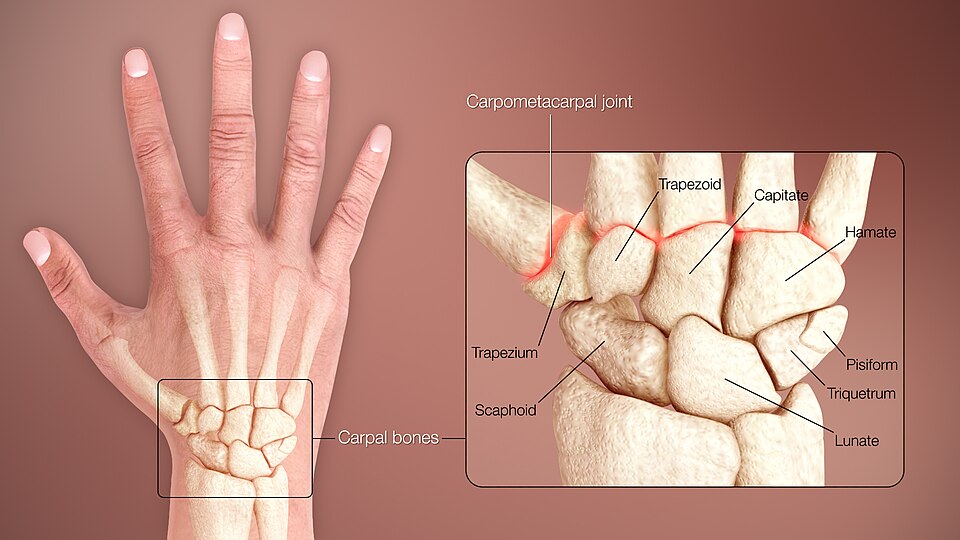
Eight small bones arranged in two rows form the wrist's core, allowing a combination of gliding and rotating movements between the forearm and hand.
This narrow tunnel on the palm side of the wrist, bounded by carpal bones and a tough ligament, is a common site of nerve compression when tissue swelling or thickening reduces the available space.
These long tendons run from the forearm through the wrist and palm to bend the fingers, and are commonly involved in overuse conditions such as trigger finger.
Tendons running across the back of the wrist and hand straighten the fingers and wrist, and can become irritated with repetitive use, as seen in De Quervain's tenosynovitis at the thumb side.
This nerve travels through the carpal tunnel to supply sensation to the thumb, index, and middle fingers and motor control to some thumb muscles, making it the nerve most often affected by wrist compression.
Passing through a separate tunnel at the wrist, the ulnar nerve supplies the ring and little fingers and many of the small muscles that control fine finger movements.
Combined wrist flexion (about 80°) and extension (about 70°) allow the hand to be positioned across a wide range for gripping and fine motor tasks, complemented by radial and ulnar deviation of roughly 20–35°.
This dense packing of bone, tendon, and nerve in a small space explains why wrist and hand conditions often involve a specific tunnel or tendon compartment rather than the joint as a whole.
Neighbouring topics share region literacy — not a severity ranking.
The shoulder trades stability for the greatest range of motion of any joint in the body, relying heavily on the rotator cuff muscles rather than bone to stay centered.
Pain frequency 60 Same body regionThe elbow's hinge-and-rotation design lets the forearm bend and turn simultaneously, but this dual role concentrates repetitive stress on a small set of tendons.
Pain frequency 45 Same body region