- 1 Start
- 2 Mid
- 3 End
Pendulum swing
●○○○○2 × 30s
Lean forward and let the arm hang, gently swinging it in small circles using body momentum rather than active muscle effort.
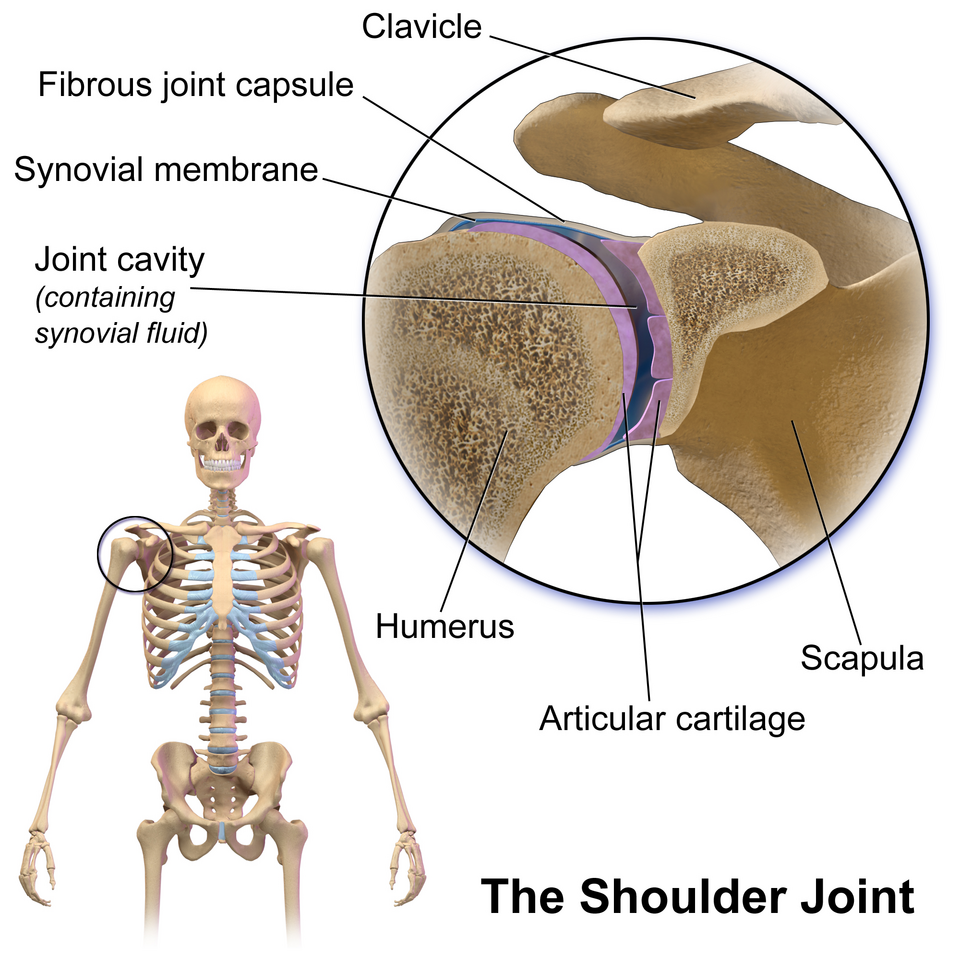
Shoulder · The shoulder trades stability for the greatest range of motion of any joint in the body, relying heavily on the rotator cuff muscles rather than bone to stay centered.
Darker cells mean a higher score for this topic on that metric.
LessMore
Last reviewed Sources & creditsMedia creditsMethodology
The rotator cuff is a group of four muscles — supraspinatus, infraspinatus, teres minor, and subscapularis — whose tendons wrap around the shoulder joint and help keep the arm bone centered in its socket while allowing rotation.
Many partial and even some full-thickness tears, especially in less active or older individuals, are managed successfully with structured exercise; surgery is more often considered for larger tears, significant weakness, or failed conservative care.
Shoulder impingement describes irritation of rotator cuff tendons or the bursa as they pass through a narrow space beneath the tip of the shoulder blade, often provoked by repeated overhead activity.
Frozen shoulder, or adhesive capsulitis, is a condition involving progressive stiffening of the joint capsule, typically moving through painful, stiff, and recovery phases over many months.
Shoulder pain is one of the most frequently reported musculoskeletal complaints, with population studies suggesting a substantial share of adults experience an episode at some point, particularly with advancing age.
Yes — some individuals have subtle instability or excessive joint laxity that causes a sense of looseness or apprehension without a full dislocation ever occurring.
Shoulder exercise programs typically emphasize rotator cuff and scapular muscle control, since the joint's stability depends heavily on these muscles rather than bony structure alone.
Programs generally progress from low-load isometric and range-of-motion work toward resisted strengthening, with overhead and sport-specific loading introduced only once baseline strength and control are established.
Simple picture of a move already published on this page — not a prescription or medical advice.
2 × 30s
Lean forward and let the arm hang, gently swinging it in small circles using body momentum rather than active muscle effort.
3 × 12 each side
With the elbow bent at the side, rotate the forearm outward against light resistance while keeping the elbow tucked in.
3 × 12
Squeeze the shoulder blades together and slightly down without shrugging the shoulders upward.
3 × 5 per direction, held 5–8s
Press the arm gently against a wall or hand in flexion, abduction, or rotation without allowing movement.
3 × 10 each side
Lying on the side with the top elbow bent and tucked to the body, lift the forearm upward against light resistance.
3 × 10 each side
Raise the arm at a slight angle forward of the body, thumb leading, to shoulder height without shrugging.
3 × 8 each position
Lying face-down, raise the arms into Y, T, and W shapes, squeezing the shoulder blades together each time.
3 × 8
Press a light weight overhead with controlled form, progressing load only once pain-free full range is established.
Exercise selection is often tailored to the specific condition — for example, favoring pain-free ranges in tendinopathy or progressive stretching in frozen shoulder — rather than following one fixed sequence for every diagnosis.
Neighbouring topics share region literacy — not a severity ranking.
The elbow's hinge-and-rotation design lets the forearm bend and turn simultaneously, but this dual role concentrates repetitive stress on a small set of tendons.
Pain frequency 45 Same body regionThe wrist and hand pack more small joints, tendons, and nerves into a small space than almost any other body region, enabling fine motor control at the cost of frequent overuse injury.
Pain frequency 55 Same body region