Glenohumeral joint
The humeral head articulates with the shallow glenoid fossa of the scapula, allowing an exceptionally wide range of motion at the cost of inherent bony stability.
Shoulder · The shoulder trades stability for the greatest range of motion of any joint in the body, relying heavily on the rotator cuff muscles rather than bone to stay centered.
Darker cells mean a higher score for this topic on that metric.
LessMore
Last reviewed Sources & creditsMedia creditsMethodology
The rotator cuff is a group of four muscles — supraspinatus, infraspinatus, teres minor, and subscapularis — whose tendons wrap around the shoulder joint and help keep the arm bone centered in its socket while allowing rotation.
Many partial and even some full-thickness tears, especially in less active or older individuals, are managed successfully with structured exercise; surgery is more often considered for larger tears, significant weakness, or failed conservative care.
Shoulder impingement describes irritation of rotator cuff tendons or the bursa as they pass through a narrow space beneath the tip of the shoulder blade, often provoked by repeated overhead activity.
Frozen shoulder, or adhesive capsulitis, is a condition involving progressive stiffening of the joint capsule, typically moving through painful, stiff, and recovery phases over many months.
Shoulder pain is one of the most frequently reported musculoskeletal complaints, with population studies suggesting a substantial share of adults experience an episode at some point, particularly with advancing age.
Yes — some individuals have subtle instability or excessive joint laxity that causes a sense of looseness or apprehension without a full dislocation ever occurring.
The shoulder complex actually involves several joints working together, though the glenohumeral joint — where the humeral head meets the shallow glenoid socket of the scapula — is the primary ball-and-socket articulation responsible for most arm motion.
Because the bony socket covers only a small portion of the humeral head, dynamic stability depends heavily on the rotator cuff muscles, the surrounding labrum, and the scapula's ability to rotate and tilt in coordination with arm movement, a relationship often described as scapulohumeral rhythm.
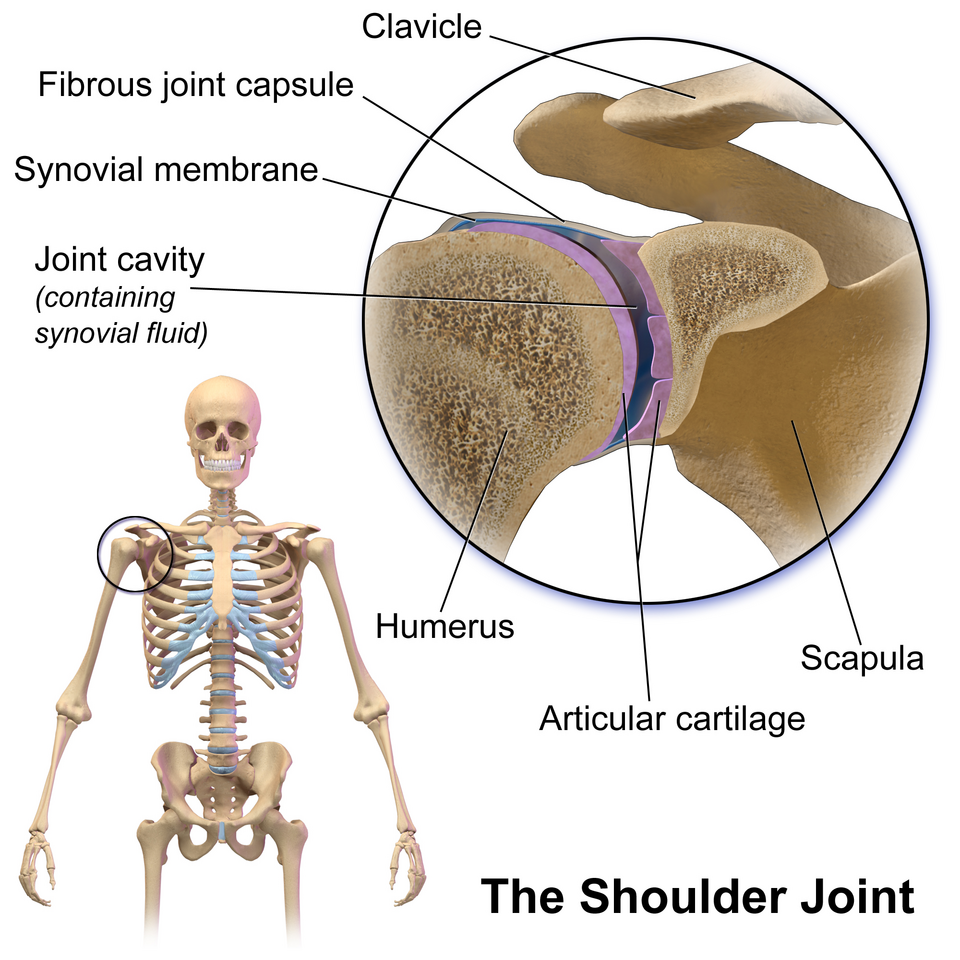
The humeral head articulates with the shallow glenoid fossa of the scapula, allowing an exceptionally wide range of motion at the cost of inherent bony stability.
This rotator cuff muscle initiates lifting the arm away from the body and is the most commonly injured tendon in rotator cuff conditions.
These posterior rotator cuff muscles rotate the arm outward and help center the humeral head during overhead movement.
The largest rotator cuff muscle rotates the arm inward and contributes significantly to anterior joint stability.
This large, superficial muscle covering the shoulder provides the bulk of the force for lifting the arm, working together with the smaller rotator cuff muscles that fine-tune joint positioning.
A ring of cartilage deepens the socket slightly, while the surrounding capsule and ligaments provide passive restraint at the extremes of motion.
Shoulder abduction, lifting the arm out to the side and overhead, represents the joint's largest range of motion and requires coordinated movement between the humerus and scapula to achieve its full arc.
This trade-off between mobility and stability explains why shoulder rehabilitation places heavy emphasis on rotator cuff and scapular muscle control rather than joint mobility alone.
Neighbouring topics share region literacy — not a severity ranking.
The elbow's hinge-and-rotation design lets the forearm bend and turn simultaneously, but this dual role concentrates repetitive stress on a small set of tendons.
Pain frequency 45 Same body regionThe wrist and hand pack more small joints, tendons, and nerves into a small space than almost any other body region, enabling fine motor control at the cost of frequent overuse injury.
Pain frequency 55 Same body region