Anterior cruciate ligament
This central ligament resists forward sliding of the shin bone and excessive internal rotation, and is placed under its highest strain during pivoting and landing movements.
ACL · The anterior cruciate ligament stabilizes the knee against pivoting and forward-sliding forces, and its rupture is one of the most studied and rehabilitation-intensive sports injuries.
Darker cells mean a higher score for this topic on that metric.
LessMore
Last reviewed Sources & creditsMedia creditsMethodology
Not necessarily — some individuals, particularly those with lower activity demands or good dynamic knee stability, can do well with structured non-surgical rehabilitation, while others, especially those returning to pivoting sports, are more often advised toward reconstruction.
Most rehabilitation protocols and return-to-sport guidelines describe a recovery period of roughly nine to twelve months before a full return to pivoting sport, reflecting the time needed for graft maturation and functional readiness.
Common graft choices include the patient's own patellar tendon, hamstring tendon, or quadriceps tendon, or occasionally donor tissue, each with different considerations regarding strength, donor-site symptoms, and recovery.
The reconstructed graft undergoes a biological remodeling process that takes many months to reach adequate strength, and rehabilitation must also rebuild strength, neuromuscular control, and confidence before a safe return to demanding sport.
Research suggests the risk of a second ACL injury, either to the same or the opposite knee, is meaningfully elevated compared with individuals without a prior tear, which is part of why structured return-to-sport testing is emphasized.
Multiple studies report a higher incidence of ACL injury in female athletes in comparable pivoting sports, with proposed contributing factors including anatomical, hormonal, and neuromuscular differences, though the exact causes remain an active area of research.
The anterior cruciate ligament runs diagonally from the back of the thigh bone to the front of the shin bone, crossing the posterior cruciate ligament in an X-shape at the center of the knee joint, which gives the pair their name.
Its primary mechanical role is to resist forward translation of the shin bone relative to the thigh bone and to help control rotational movement, both of which become critical during the rapid deceleration and directional changes typical of pivoting sports.
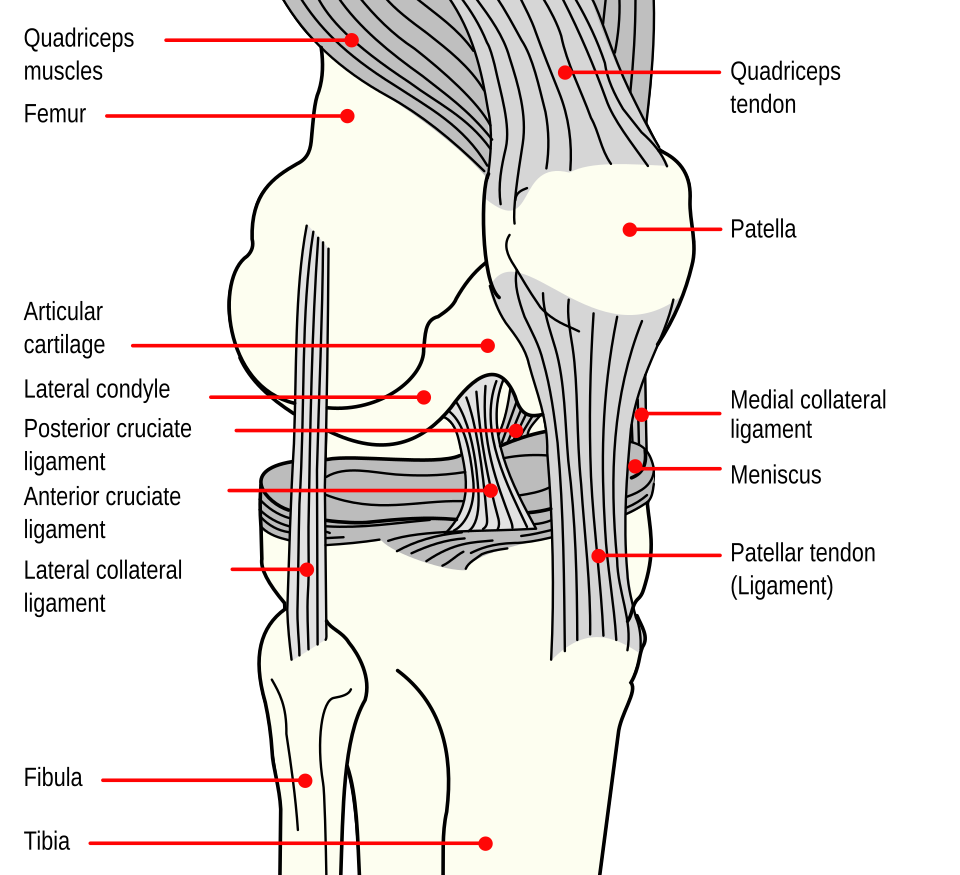
This central ligament resists forward sliding of the shin bone and excessive internal rotation, and is placed under its highest strain during pivoting and landing movements.
Crossing the ACL within the joint, this ligament resists backward sliding of the shin bone and is injured less frequently, often from direct impact to the front of the shin.
These cartilage cushions are frequently injured alongside the ACL during the same traumatic event, since similar rotational forces affect both structures.
These surrounding muscle groups provide dynamic stability that becomes especially important for protecting the knee both before and after ACL injury or reconstruction.
These ligaments are sometimes injured together with the ACL in more severe trauma, particularly from a direct blow to the outer knee during a planted foot.
Following surgical reconstruction, tissue taken from the patellar, hamstring, or quadriceps tendon is positioned to replicate the ACL's mechanical role while it gradually remodels and matures over many months.
Rather than a joint range of motion, the ACL's function is often described in terms of the amount of forward shin-bone movement it restrains, which clinicians assess using specific manual and instrumented tests.
Understanding the ACL's specific stabilizing role helps explain why rehabilitation after injury focuses heavily on rebuilding the dynamic control provided by surrounding muscles, particularly when the ligament itself cannot reliably heal on its own.
Neighbouring topics share region literacy — not a severity ranking.
The hip is a deep, stable ball-and-socket joint that bears several times body weight during walking and running, making it a common site of both overuse pain and degenerative change.
Pain frequency 55 Same body regionThe knee is the body's largest joint and one of its most frequently injured, relying on ligaments and surrounding muscles rather than bony shape for stability.
Pain frequency 65 Same body regionThe ankle and foot absorb and redirect the full force of body weight with every step, making sprains and overuse injuries among the most common in sport and daily life.
Pain frequency 70 Same body region