Sailor lore
Inflate and avoid
Tropical crews already knew the sphere-and-poison pair before binomials.
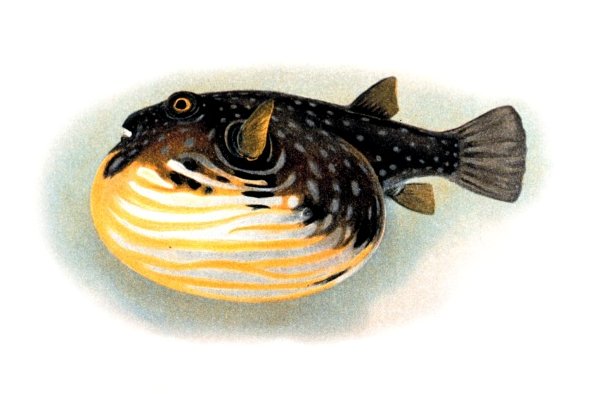
Pufferfish · Beak-toothed inflators whose tetrodotoxin made a Japanese cuisine and a genome project out of one family.
Milestones in order. This is history, not a weekly activity grid.
Darker cells mean a higher score for this topic on that metric.
LessMore
Last reviewed Sources & creditsMedia creditsMethodology
No. Toxin load varies by species, organ and season. Licensed fugu service still treats liver as forbidden in many prefectures after historic poisonings.
A compact genome (about 400 Mb) made it a 2002 model in Nature -- a puffer as a human-genome shortcut, not a menu story.
The fish gulps water into a specialised stomach diverticulum. Spines (in some species) erect. It is a mechanical jam, not a bluff only.
Much evidence points to bacterial and food-chain accumulation. Captive-raised puffers can be far less toxic -- a husbandry fact that complicates folklore.
Japan requires training and exams after 20th-century restaurant deaths. The licence is a public-health instrument, not a gourmet badge.
Hobbyists keep freshwater and brackish tetraodontids (e.g. figure-eight, Mbu). They share the beak and inflate; they are not all Takifugu.
The pufferfish did not enter English as a finished emblem. Hunts, films, listings and field stations rewrote the animal on a dated clock.
This chapter keeps ten timeline points, five eras and three milestones so a later translation can hold the same years.
Early binomials gathered inflating fishes that sailors already feared.
Meiji-era ordinances started treating puffer service as a police matter.
Occupation-era and later restaurant deaths tightened chef licensing.
Chemistry papers pinned the sodium-channel story that textbooks still recite.
Food-safety reviews treated fugu as a licensed exception, not a general seafood.
Takifugu rubripes draft in Nature -- compact vertebrate genome.
Japan kept tiger-puffer liver off the legal plate after testing debates.
Aquaculture papers showed tank puffers can carry little toxin -- a supply-chain fork.
FDA and exporters kept a tight licensed channel, not a supermarket fish.
Some coral-associated tetraodontids entered bleaching-adjacent habitat papers.
Tropical crews already knew the sphere-and-poison pair before binomials.
Japan turned a folk dish into an examined trade after repeated deaths.
A poison became a physiology tool and a WHO food note.
A compact genome and low-toxin aquaculture split science from tavern.
Tight trade channels and habitat heat are the quiet modern files.
Public-health law, not cuisine branding, made fugu a regulated animal.
A puffer became a vertebrate genomics workhorse.
Husbandry showed toxin is not an obligatory species essence.
Reading pufferfish history beside the resilience score keeps a recovered stock from standing in for a threatened cousin.
Apex lamnid whose warm muscle, broad diet and 1975 cinema still outrun the tagging papers.
Overall 66 🐟Anadromous fishes that move ocean fat onto spawning gravels -- and into forests, treaties and hydropower fights.
Overall 63 🐟A warm-bodied tuna whose Tokyo auction prices and ICCAT quotas made a single fish into a geopolitical unit.
Overall 54 🐠Anemone-dwelling damselfish whose 2003 film fame became a capture-and-reef case study.
Overall 41 🐴Male-pregnancy fish — Hippocampus since Linnaeus (1758), dried trade, and CITES Appendix II (2002).
Overall 28 🎏Domesticated carp whose Niigata colour mutations became a global pond aesthetic -- not a wild goldfish substitute.
Overall 42 ⚡Amazon knifefishes whose stacked electrocytes taught Humboldt, Volta arguments and a 2019 species split.
Overall 36