Scrolls and court
Longevity emblem
Chinese, Korean and Japanese arts treated the crane as a long-life bird centuries before Red Lists.
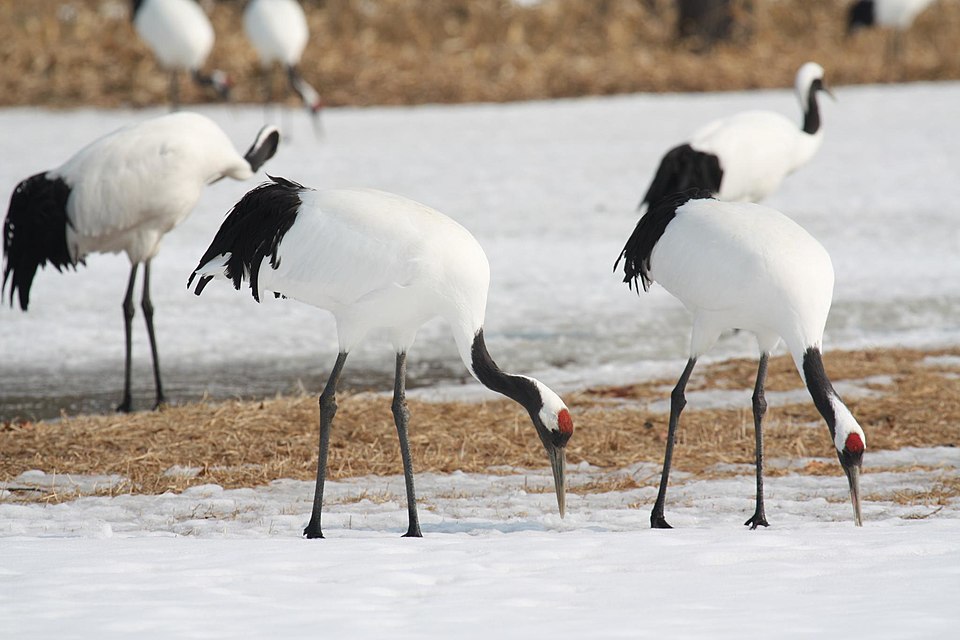
Crane · Tall wetland dancers whose red-crowned East Asian population is the atlas type and a conservation bottleneck.
Milestones in order. This is history, not a weekly activity grid.
Darker cells mean a higher score for this topic on that metric.
LessMore
Last reviewed Sources & creditsMedia creditsMethodology
The taxonomy hero is Grus japonensis -- Kushiro, the Korean DMZ and Izumi. Other Grus species appear as comparison, not as the page type.
The Aransas-Wood Buffalo flock was about 21 birds in 1941. That nadir still defines US recovery graphs.
He courtship-danced with a human-imprinted whooping crane named Tex so she would ovulate -- a 1980s method story, not a field census.
A large share of the migratory island population winters on one Kyushu floodplain. Influenza years there are species-level events.
Pairs are typically socially monogamous. The dance is pair-bond and territorial display, not a fairy-tale wedding.
Wintering red-crowned and white-naped cranes use the Civilian Control Zone. Peace-time development is a documented risk to that accidental reserve.
IUCN: Endangered
The crane did not enter English as a finished emblem. Hunts, films, listings and field stations rewrote the animal on a dated clock.
This chapter keeps ten timeline points, five eras and three milestones so a later translation can hold the same years.
Miocene fossils already show tall wetland gruines on northern continents.
The migratory US-Canada flock hit a counted nadir that still defines the recovery graph.
Postwar Hokkaido feeding and later park protection began the tancho local rebound.
George Archibald and Ron Sauey opened the Baraboo crane campus.
A whooping crane captive egg after a human-led dance became ICF lore.
Ultralights led whooping cranes on a Wisconsin-Florida route until 2015.
H5 outbreaks killed hundreds of wintering cranes on one floodplain.
US FWS stopped the ultralight-led whooping-crane migrations.
Korean winter surveys treated the border strip as a de facto sanctuary with an expiry risk.
IUCN kept Grus japonensis Endangered as four states split one flyway.
Chinese, Korean and Japanese arts treated the crane as a long-life bird centuries before Red Lists.
Whooping-crane collapse and then ICF framed modern crane science.
Hokkaido farmers and rangers winter-fed tancho until a resident flock stabilized.
A taught migration showed both the power and the fragility of captive-reared routes.
Izumi disease and DMZ land-use are now the East Asian crane headlines.
21 birds -- the number every later release is still measured against.
A single Wisconsin site compared all crane species as a living library.
One Kyushu basin became a winter bottleneck for island-hopping tancho.
Reading crane history beside the resilience score keeps a recovered stock from standing in for a threatened cousin.
Apex diurnal raptors whose stoops, territories and national emblems stretch from taiga cliffs to tropical canopy.
Overall 75 🦉Nocturnal raptors whose facial discs, silent flight and asymmetric ears turn darkness into a hunting map.
Overall 72 🐧Flightless southern divers that turned wings into flippers and ice edges into commute routes.
Overall 56 🐦New World nectar specialists that hover on figure-eight wings and migrate on a few grams of fat.
Overall 63 🦩Long-legged filter feeders whose bent bills and carotenoid diets turn alkaline lakes into pink cities.
Overall 52 🦜Zygodactyl hookbills whose social brains, mimicry and nest-cavity needs collide with the cage trade.
Overall 58 🪽Dynamic-soaring ocean birds whose metres-long wings and baited longlines now share the same latitudes.
Overall 58