Talocrural joint
This joint between the shin bones and the talus allows dorsiflexion and plantarflexion, the ankle's largest range of motion, essential for walking, running, and absorbing impact.
Ankle & Foot · The ankle and foot absorb and redirect the full force of body weight with every step, making sprains and overuse injuries among the most common in sport and daily life.
Darker cells mean a higher score for this topic on that metric.
LessMore
Last reviewed Sources & creditsMedia creditsMethodology
The large majority of ankle sprains are inversion injuries affecting the ligaments on the outer side of the ankle, most often the anterior talofibular ligament.
Mild sprains often improve substantially within two to three weeks, while moderate to severe sprains can take four to eight weeks or longer for a full return to sport-level activity.
Clinical decision rules such as the Ottawa ankle rules help determine when an X-ray is needed, generally reserving imaging for cases with specific bony tenderness or an inability to bear weight.
Chronic ankle instability describes a persistent tendency for the ankle to give way or feel unstable, often following an inadequately rehabilitated sprain, and is associated with a higher risk of repeat sprains.
Plantar fasciitis is irritation of the thick band of tissue running along the bottom of the foot, commonly producing sharp heel pain that is often most noticeable with the first steps in the morning.
Ice is commonly used for short-term pain and swelling relief after an acute sprain, though current guidance places comparatively more emphasis on early protected movement and graded loading for the overall recovery process.
The ankle joint is formed where the shin bones meet the talus, a bone that also connects to the rest of the foot's complex arrangement of bones, joints, and arches that together distribute load during standing and movement.
Ligaments on the outer and inner sides of the ankle provide stability against the sideways forces generated during uneven surfaces or sudden directional changes, while the Achilles tendon and plantar fascia play central roles in propulsion and shock absorption, respectively.
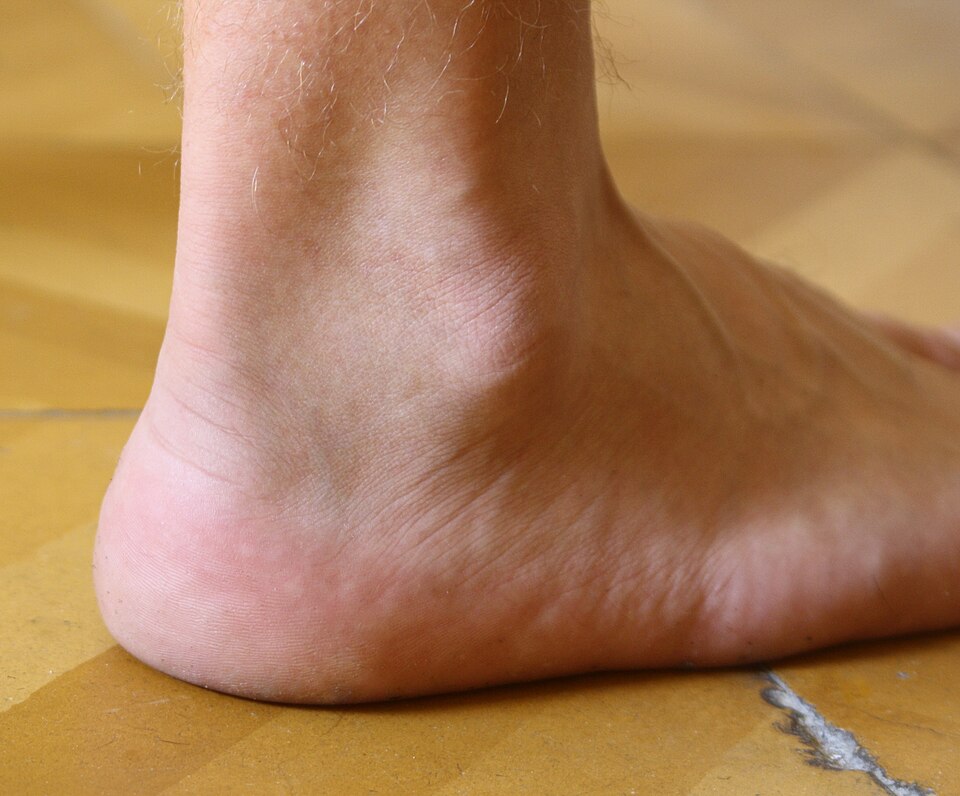
This joint between the shin bones and the talus allows dorsiflexion and plantarflexion, the ankle's largest range of motion, essential for walking, running, and absorbing impact.
This group of ligaments, most notably the anterior talofibular ligament, resists excessive inward rolling of the foot and is the structure most often injured in a typical ankle sprain.
This strong ligament on the inner ankle resists excessive outward rolling of the foot and is injured less frequently than the lateral ligaments, though such injuries can be more significant when they occur.
The body's largest tendon connects the calf muscles to the heel bone and is essential for propulsion during walking, running, and jumping, making it a common site of overuse injury.
This thick band of connective tissue runs along the bottom of the foot, supporting the arch and absorbing shock, and is the structure most often implicated in plantar fasciitis.
Located just below the ankle joint, this joint allows the foot to tilt side to side, which is important for adapting to uneven ground and is involved in the mechanism of most ankle sprains.
Ankle plantarflexion, pointing the toes downward, represents the joint's largest single motion, complemented by roughly 15–20° of dorsiflexion and additional inversion and eversion at the subtalar joint below.
This combination of a stable but mobile joint, supporting ligaments, and load-absorbing soft tissue explains why the ankle and foot are prone to both sudden ligament injuries and gradual overuse conditions depending on the type of stress applied.
Neighbouring topics share region literacy — not a severity ranking.
The hip is a deep, stable ball-and-socket joint that bears several times body weight during walking and running, making it a common site of both overuse pain and degenerative change.
Pain frequency 55 Same body regionThe knee is the body's largest joint and one of its most frequently injured, relying on ligaments and surrounding muscles rather than bony shape for stability.
Pain frequency 65 Same body regionThe anterior cruciate ligament stabilizes the knee against pivoting and forward-sliding forces, and its rupture is one of the most studied and rehabilitation-intensive sports injuries.
Pain frequency 50 Same body region