Darker cells mean a higher score for this topic on that metric.
LessMore
Last reviewed Sources & creditsMedia creditsMethodology
Quick answers
How can a hummingbird hover when other birds cannot?
The shoulder allows a nearly horizontal figure-eight. Lift on the upstroke as well as the downstroke pays the hover bill that a typical avian stroke cannot.
Do hummingbirds live on sugar water alone?
No. Nectar is fuel. Arthropods supply protein, especially for chicks. Feeders that omit insects do not replace a territory.
How does a 3-gram bird cross the Gulf of Mexico?
Ruby-throated hummingbirds fatten, then fly 800+ km nonstop. Tailwinds and a high mass-specific power output make the crossing possible, not a rest on ships.
What is torpor in hummingbirds?
A controlled drop in body temperature and metabolic rate overnight. Without it, many species would exhaust nectar stores before sunrise.
Are hummingbirds only tropical?
Diversity peaks in the Andes. Anna’s hummingbirds now winter in Vancouver gardens; ruby-throated breed to southern Canada.
Who first illustrated hummingbirds for Europe?
John Gould’s 19th-century monographs and skins made trochilids a Victorian craze — with a collecting cost that modern field work still cites.
Anatomy overlay
Numbered teaching hotspots on the species still — not a clinical diagnosis.
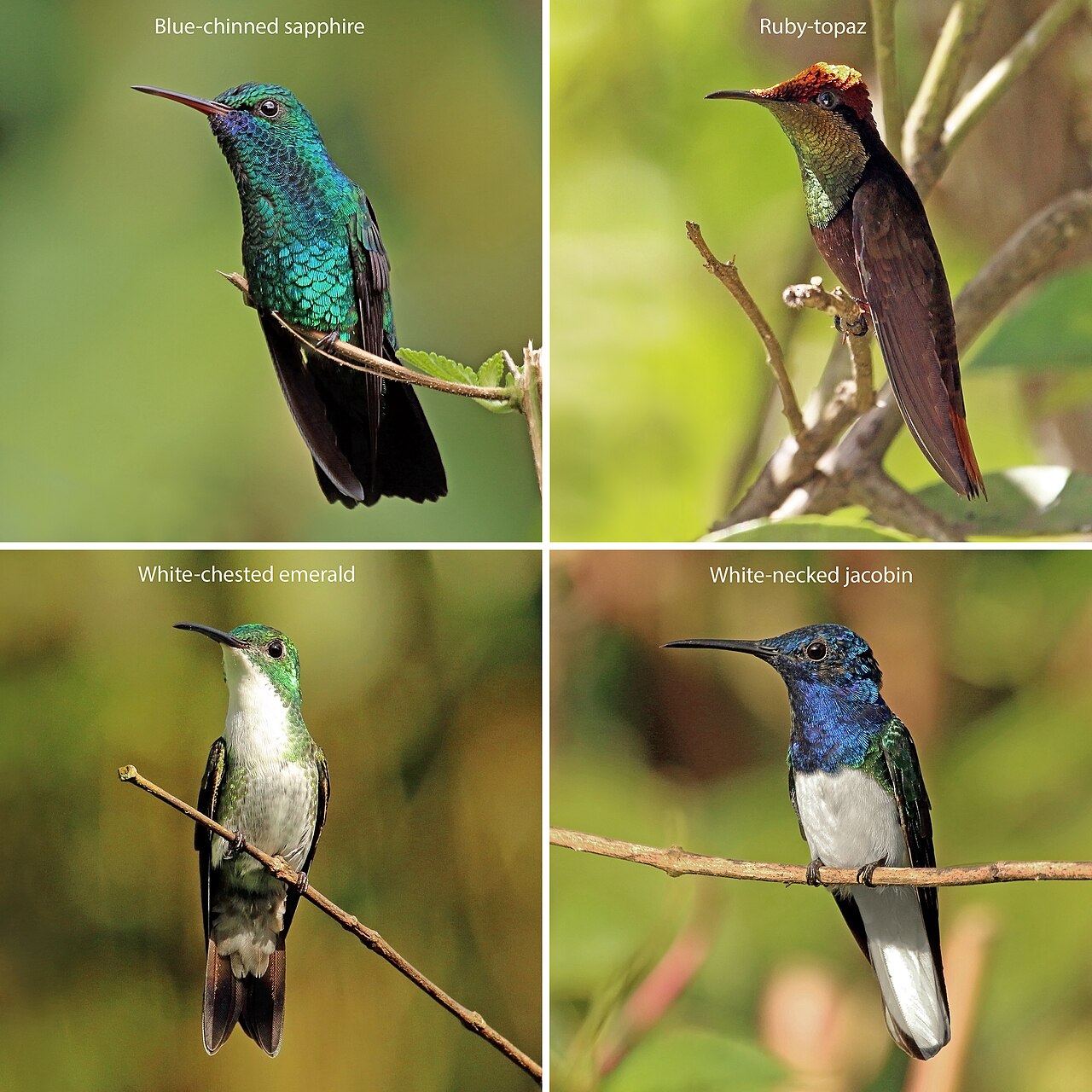
- 1 Primary weapon or tool — The bill, teeth, trunk, pouch or talon that field guides name first -- and that trade or c
- 2 Energy store — Fat, cache, crop or bamboo hours that decide whether a season closes.
- 3 Natal or breeding site — A redd, eyrie, den, anemone or ice lair -- often a single-point risk (Izumi, Natron, Gir).
- 4 Sensory organ — Colour vision into the near-ultraviolet helps flower finding. Spatial memory of traplines
- 5 Human interface — Hunt, tourism, film or quota -- the surface where hummingbird biology meets English-langua
Every hummingbird is a stack of tissues that must agree under season, prey and human pressure.
Meters below repeat the six atlas scores as gauges; they are relative marks, not laboratory certificates.
Systems
Support and integument
A tiny fuselage, a long bill and a shoulder joint that lets the wing invert. Pectoralis and supracoracoideus are both huge for the upstroke’s lift.
Feeding apparatus
Nectar sugars plus insect protein. Hovering is among the costliest vertebrate gaits; torpor is the nightly rebate. The feeding kit sets the ecological-role score relative to the other 23 types.
Respiration and circulation
Gas exchange and blood flow are tuned to the hummingbird energy budget -- dive, hover, sprint or bulk browse -- not to a generic vertebrate template.
Senses and neural control
Colour vision into the near-ultraviolet helps flower finding. Spatial memory of traplines is the cognitive load.
Reproduction and ontogeny
Replacement rate is the hidden resilience number. Gram-scale fat stores and weather windows bound migration. Island endemics have nowhere to shift when scrub is cleared.
Thermoregulation and salt/water
Climate and osmoregulation bound where a hummingbird can close its daily budget. Field sites in the English-speaking world still measure that envelope first.
Relative meters
Hotspots
Primary weapon or tool
The bill, teeth, trunk, pouch or talon that field guides name first -- and that trade or conflict usually targets.
Energy store
Fat, cache, crop or bamboo hours that decide whether a season closes.
Natal or breeding site
A redd, eyrie, den, anemone or ice lair -- often a single-point risk (Izumi, Natron, Gir).
Sensory organ
Colour vision into the near-ultraviolet helps flower finding. Spatial memory of traplines is the cognitive load.
Human interface
Hunt, tourism, film or quota -- the surface where hummingbird biology meets English-language law.
Tissues & materials
Keratin and integument
Feathers, fur, baleen or skin plates -- tissues, not metals. Moult and wear are the maintenance cycle.
Bone and cartilage
Load paths for stoop, lunge, knuckle-walk or hover. Marrow and pneumatic bone differ by family.
Muscle and tendon
The expensive tissue that speed and intelligence scores only hint at.
Fat, oil and glycogen
Stores that migration, fast and lactation spend. A market for those stores (oil, ivory, fin) is a historical threat.
Keep exploring
More in Birds
Eagle
Apex diurnal raptors whose stoops, territories and national emblems stretch from taiga cliffs to tropical canopy.
Overall 75 🦉Owl
Nocturnal raptors whose facial discs, silent flight and asymmetric ears turn darkness into a hunting map.
Overall 72 🐧Penguin
Flightless southern divers that turned wings into flippers and ice edges into commute routes.
Overall 56 🦩Flamingo
Long-legged filter feeders whose bent bills and carotenoid diets turn alkaline lakes into pink cities.
Overall 52 🦜Parrot
Zygodactyl hookbills whose social brains, mimicry and nest-cavity needs collide with the cage trade.
Overall 58 🪽Albatross
Dynamic-soaring ocean birds whose metres-long wings and baited longlines now share the same latitudes.
Overall 58 🦢Crane
Tall wetland dancers whose red-crowned East Asian population is the atlas type and a conservation bottleneck.
Overall 53