Las celdas mas oscuras marcan una puntuacion mas alta en ese indicador.
MenosMas
Ultima revision Fuentes y creditosCréditos de mediosMetodología
Respuestas rapidas
Why bush elephant, not African elephant in general?
The taxonomy wiki is African bush elephant. Forest elephants (L. cyclotis) were widely recognised as a separate EN/CR story in the 2021 IUCN assessments.
What did the 1989 ivory ban do?
It collapsed legal international commercial trade. Domestic markets, stockpiles and later one-off sales (2008) kept the argument alive. Poaching did not end in 1989.
Who is Cynthia Moss in this file?
Amboseli Elephant Research Project since 1972 -- matrilines with names and decades of calves, the opposite of an anonymous ivory graph.
Are elephants the highest ecological-role score for a reason?
They open woodland, dig water, disperse seeds and rewrite fire. In this 24-type atlas that engineer role outranks even wolves and whales.
What is musth?
A periodic male state with urine dribble, temporal secretion and aggression. It is physiology, not a mood.
Did Kruger culling end?
Large-scale culling paused in the 1990s. Contraception, range expansion and later density debates replaced it without a final peace.
Superposición anatómica
Puntos didácticos numerados — no un diagnóstico clínico.
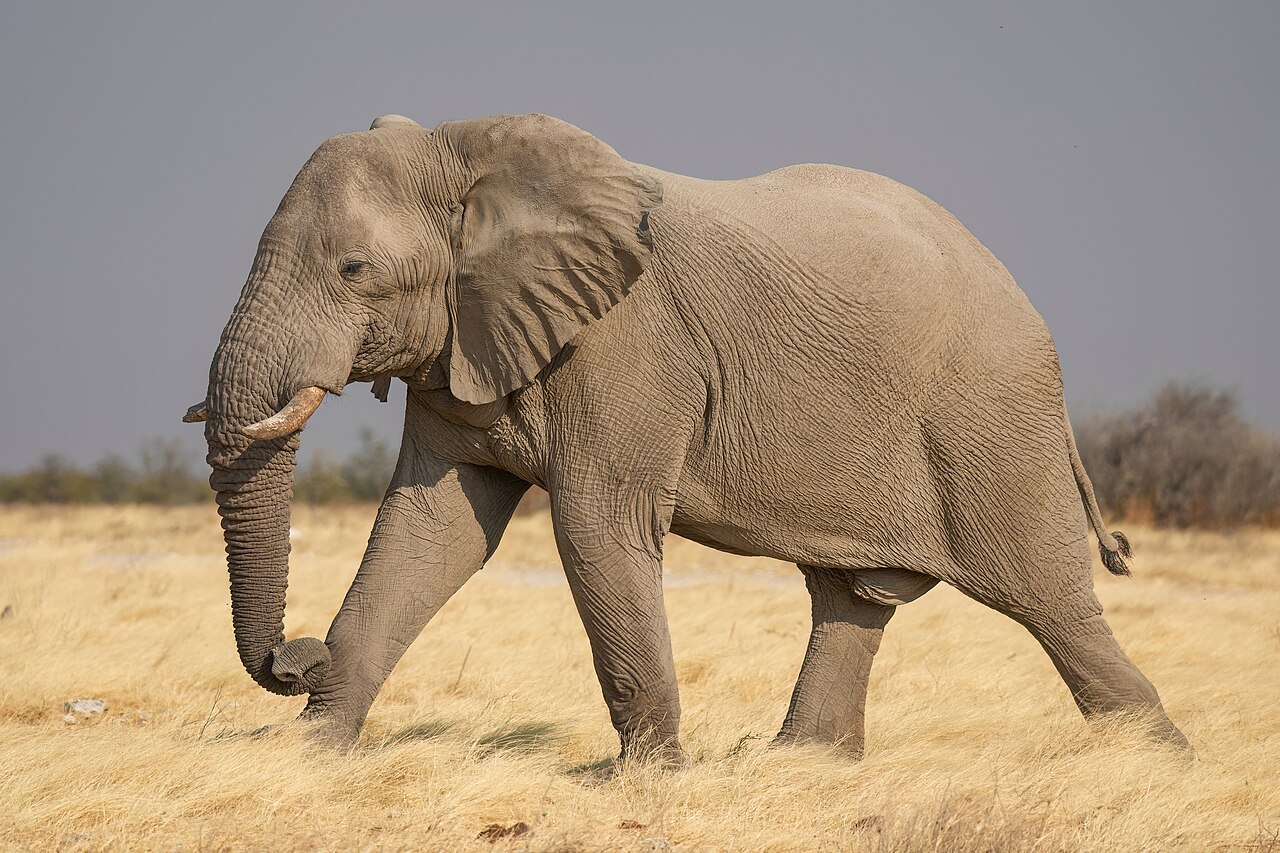
- 1 Primary weapon or tool — Parte que se debate primero en Elefante africano: Primary weapon or tool.
- 2 Energy store — Parte que se debate primero en Elefante africano: Energy store.
- 3 Natal or breeding site — Parte que se debate primero en Elefante africano: Natal or breeding site.
- 4 Sensory organ — Parte que se debate primero en Elefante africano: Sensory organ.
- 5 Human interface — Parte que se debate primero en Elefante africano: Human interface.
Capa de anatomía
Cuatro regiones de enseñanza en Elefante africano. Un esquema, no una guía de disección.
Esta página trata anatomía y sentidos de Elefante africano. Los detalles cambian por región y subespecie; el esqueleto de la especie es el mismo.
Los bloques de abajo tienen el recuento exacto que pide el diseño.
Sistemas
Support and integument
«Support and integument» de Elefante africano fija el techo de sentidos, movimiento y supervivencia.
Feeding apparatus
«Feeding apparatus» de Elefante africano fija el techo de sentidos, movimiento y supervivencia.
Respiration and circulation
«Respiration and circulation» de Elefante africano fija el techo de sentidos, movimiento y supervivencia.
Senses and neural control
«Senses and neural control» de Elefante africano fija el techo de sentidos, movimiento y supervivencia.
Reproduction and ontogeny
«Reproduction and ontogeny» de Elefante africano fija el techo de sentidos, movimiento y supervivencia.
Thermoregulation and salt/water
«Thermoregulation and salt/water» de Elefante africano fija el techo de sentidos, movimiento y supervivencia.
Medidores relativos
Puntos calientes
Primary weapon or tool
Parte que se debate primero en Elefante africano: Primary weapon or tool.
Energy store
Parte que se debate primero en Elefante africano: Energy store.
Natal or breeding site
Parte que se debate primero en Elefante africano: Natal or breeding site.
Sensory organ
Parte que se debate primero en Elefante africano: Sensory organ.
Human interface
Parte que se debate primero en Elefante africano: Human interface.
Tejidos y materiales
Keratin and integument
Tejido de Elefante africano — Keratin and integument.
Bone and cartilage
Tejido de Elefante africano — Bone and cartilage.
Muscle and tendon
Tejido de Elefante africano — Muscle and tendon.
Fat, oil and glycogen
Tejido de Elefante africano — Fat, oil and glycogen.
Seguir explorando
Más en Fauna
Tigre
Depredador ápice a rayas — el felino que se hizo rey del folclore.
Global 62 🦁León
Felino social de la sabana — manada, melena y poder.
Global 66 🐺Lobo gris
Cánido que teje manadas — historia de retorno en Eurasia y Norteamérica.
Global 78 🐼Panda gigante
Especialista en bambú — icono de conservación en blanco y negro de las montañas chinas.
Global 41 🐻Oso polar
Oso marino sobre hielo — sigue focas y el envolvente climático.
Global 56 🦍Gorila
Gran simio del bosque — espalda plateada y fuerza de la familia.
Global 45 🐋Ballena azul
El animal más grande de la Tierra — filtrado de kril y corredores oceánicos.
Global 65