Darker cells mean a higher score for this topic on that metric.
LessMore
Last reviewed Sources & creditsMedia creditsMethodology
Quick answers
Did Alex the parrot really use words as labels?
Irene Pepperberg’s papers treated English tokens as categories, not circus tricks. Alex (1976–2007) identified colours, shapes and same/different above chance. The debate is about the ceiling, not whether the tasks happened.
Why did African greys move to CITES Appendix I in 2017?
Wild capture for pets plus forest loss cut Psittacus erithacus. Appendix I ended most commercial international trade in wild greys.
What is the kakapo recovery model?
Every Strigops is named and managed on predator-free New Zealand islands. Supplementary feeding and nest cameras make it closer to intensive care than to a hands-off reserve.
Are London’s ring-necked parakeets a conservation win?
They are an introduced boom, not a restored native. Cavity competition with starlings and bats is the local argument.
Why do so many macaws remain threatened?
Cavity trees come down with forest. The pet trade added a second cut. Spix’s macaw went extinct in the wild before a 2019–20s reintroduction attempt in Bahia.
Do parrots “talk” in the wild?
They learn contact calls in flocks. Human-word mimicry is the lab and living-room version of a general vocal-learning kit shared with songbirds and hummingbirds.
Anatomy overlay
Numbered teaching hotspots on the species still — not a clinical diagnosis.
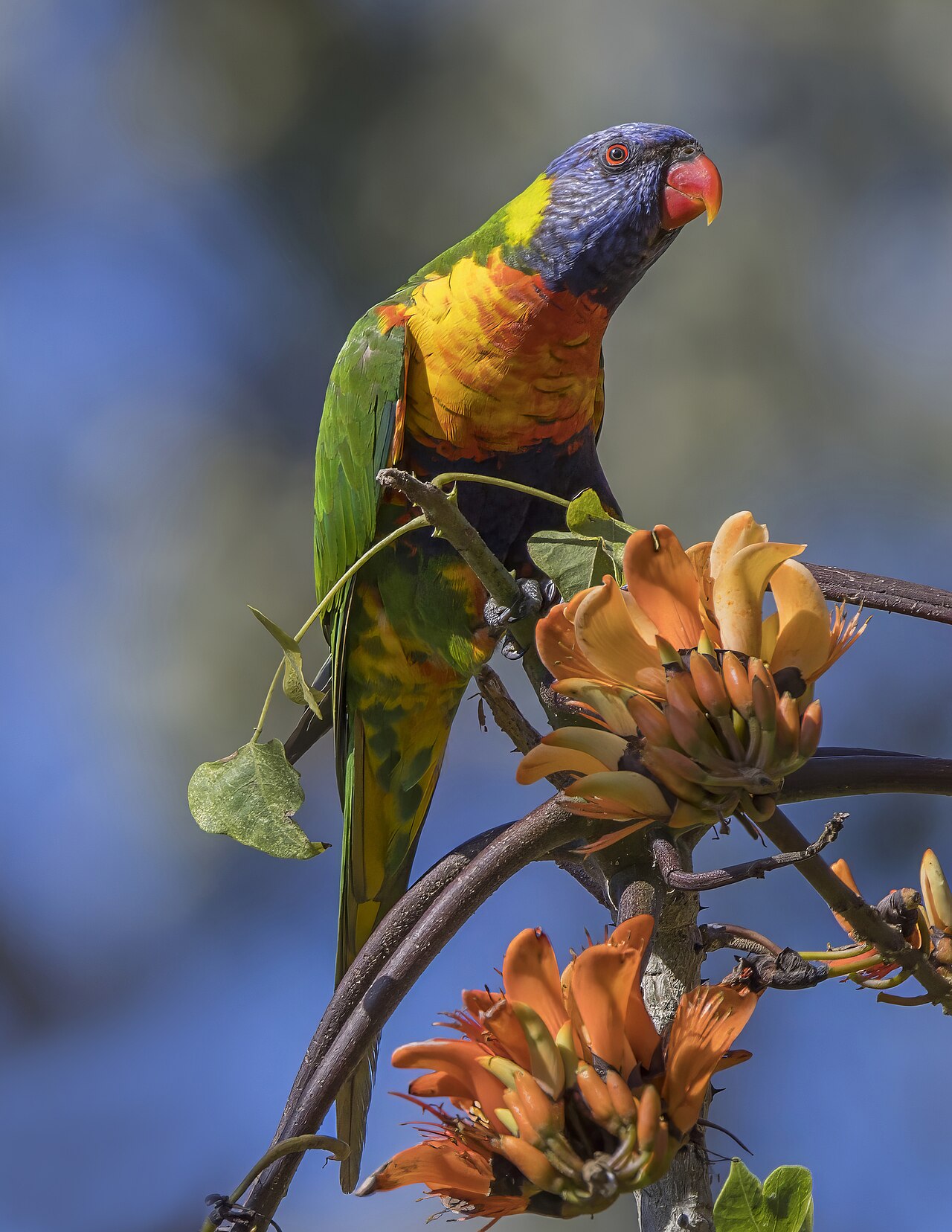
- 1 Primary weapon or tool — The bill, teeth, trunk, pouch or talon that field guides name first -- and that trade or c
- 2 Energy store — Fat, cache, crop or bamboo hours that decide whether a season closes.
- 3 Natal or breeding site — A redd, eyrie, den, anemone or ice lair -- often a single-point risk (Izumi, Natron, Gir).
- 4 Sensory organ — High visual acuity and UV plumage signals. Vocal learning is the social sense that made th
- 5 Human interface — Hunt, tourism, film or quota -- the surface where parrot biology meets English-language la
Every parrot is a stack of tissues that must agree under season, prey and human pressure.
Meters below repeat the six atlas scores as gauges; they are relative marks, not laboratory certificates.
Systems
Support and integument
A kinetic upper mandible, zygodactyl feet and a muscular tongue. The skull is built to crack and to climb; the syrinx is built to learn.
Feeding apparatus
Fruits, seeds, nectar and clay licks. Large macaws commute to palm stands; kakapo browse night vegetation on a low metabolic budget. The feeding kit sets the ecological-role score relative to the other 23 types.
Respiration and circulation
Gas exchange and blood flow are tuned to the parrot energy budget -- dive, hover, sprint or bulk browse -- not to a generic vertebrate template.
Senses and neural control
High visual acuity and UV plumage signals. Vocal learning is the social sense that made the cage trade inevitable.
Reproduction and ontogeny
Replacement rate is the hidden resilience number. Cavity trees and legal trade loopholes. Long lives in cages do not replace wild recruitment.
Thermoregulation and salt/water
Climate and osmoregulation bound where a parrot can close its daily budget. Field sites in the English-speaking world still measure that envelope first.
Relative meters
Hotspots
Primary weapon or tool
The bill, teeth, trunk, pouch or talon that field guides name first -- and that trade or conflict usually targets.
Energy store
Fat, cache, crop or bamboo hours that decide whether a season closes.
Natal or breeding site
A redd, eyrie, den, anemone or ice lair -- often a single-point risk (Izumi, Natron, Gir).
Sensory organ
High visual acuity and UV plumage signals. Vocal learning is the social sense that made the cage trade inevitable.
Human interface
Hunt, tourism, film or quota -- the surface where parrot biology meets English-language law.
Tissues & materials
Keratin and integument
Feathers, fur, baleen or skin plates -- tissues, not metals. Moult and wear are the maintenance cycle.
Bone and cartilage
Load paths for stoop, lunge, knuckle-walk or hover. Marrow and pneumatic bone differ by family.
Muscle and tendon
The expensive tissue that speed and intelligence scores only hint at.
Fat, oil and glycogen
Stores that migration, fast and lactation spend. A market for those stores (oil, ivory, fin) is a historical threat.
Keep exploring
More in Birds
Eagle
Apex diurnal raptors whose stoops, territories and national emblems stretch from taiga cliffs to tropical canopy.
Overall 75 🦉Owl
Nocturnal raptors whose facial discs, silent flight and asymmetric ears turn darkness into a hunting map.
Overall 72 🐧Penguin
Flightless southern divers that turned wings into flippers and ice edges into commute routes.
Overall 56 🐦Hummingbird
New World nectar specialists that hover on figure-eight wings and migrate on a few grams of fat.
Overall 63 🦩Flamingo
Long-legged filter feeders whose bent bills and carotenoid diets turn alkaline lakes into pink cities.
Overall 52 🪽Albatross
Dynamic-soaring ocean birds whose metres-long wings and baited longlines now share the same latitudes.
Overall 58 🦢Crane
Tall wetland dancers whose red-crowned East Asian population is the atlas type and a conservation bottleneck.
Overall 53