Paleogene
Filter waders appear
The bent-bill soda-lake niche is old; living species are a thin remnant of a wider grade.
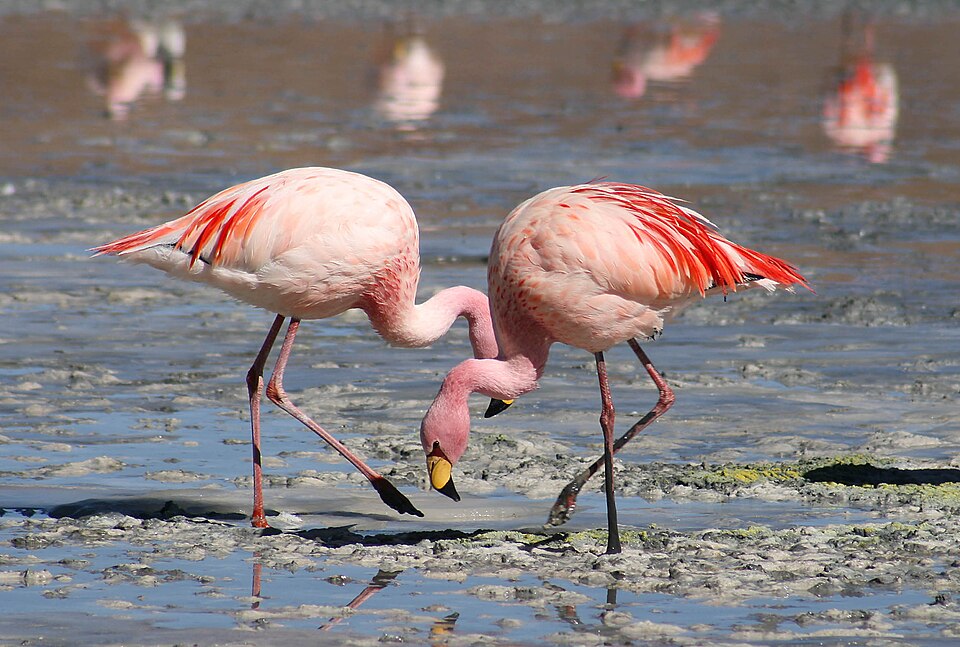
Flamingo · Long-legged filter feeders whose bent bills and carotenoid diets turn alkaline lakes into pink cities.
Milestones in order. This is history, not a weekly activity grid.
Darker cells mean a higher score for this topic on that metric.
LessMore
Last reviewed Sources & creditsMedia creditsMethodology
Dietary carotenoids from brine shrimp and cyanobacteria deposit in feathers. A white flamingo is usually a diet or age story, not a different species.
The bird feeds with the head inverted. The upper jaw is the mobile filter; lamellae comb a soup of algae and invertebrates.
Yes. Phoeniconaias minor can number more than a million on Rift soda lakes when Arthrospira blooms. Breeding still hinges on sites like Lake Natron.
Salt pans and Tour du Valat management rebuilt a greater flamingo colony that now seeds Mediterranean satellites.
A breeding population has returned to Florida Bay after a long absence. Some birds are escapees; others are wild Caribbean wanderers — the mix is a current field argument.
High-Andean salars face lithium and water extraction. Three highland species share a small set of lakes.
The flamingo did not enter English as a finished emblem. Hunts, films, listings and field stations rewrote the animal on a dated clock.
This chapter keeps ten timeline points, five eras and three milestones so a later translation can hold the same years.
Oligocene bones already show the filter-wader grade on saline shallows.
Mission and later colonial accounts flagged East African soda lakes as lesser-flamingo theatres.
Luc Hoffmann founded the Camargue station that later midwifed European greater-flamingo recovery.
Featherstone’s lawn ornament set the US suburban pink standard.
Kenya gazetted the lake that postcards treated as the flamingo capital.
American flamingo surveys at Inagua and Yucatán framed the Atlantic population.
Industrial schemes on Lake Natron raised a breeding-site fight that still returns.
Salar water budgets entered flamingo papers as extraction scaled.
Confirmed American flamingo nesting in Florida ended a long “only escapees” shrug.
Nakuru and Bogoria counts tracked boom-bust Arthrospira years under changing hydrology.
The bent-bill soda-lake niche is old; living species are a thin remnant of a wider grade.
A research station and a national park became the two public flamingo addresses.
Plastic birds outnumbered wild ones in many US postcodes.
Breeding lakes met factories and battery metals.
A lost North American breeder nested again — wild, feral, or both.
Camargue management showed salt-pan industry and flamingos can share a delta if water is timed.
Lesser flamingo nesting was treated as a single-lake problem, not a postcard backdrop.
American flamingos re-entered the US breeding fauna in documented form.
Reading flamingo history beside the resilience score keeps a recovered stock from standing in for a threatened cousin.
Apex diurnal raptors whose stoops, territories and national emblems stretch from taiga cliffs to tropical canopy.
Overall 75 🦉Nocturnal raptors whose facial discs, silent flight and asymmetric ears turn darkness into a hunting map.
Overall 72 🐧Flightless southern divers that turned wings into flippers and ice edges into commute routes.
Overall 56 🐦New World nectar specialists that hover on figure-eight wings and migrate on a few grams of fat.
Overall 63 🦜Zygodactyl hookbills whose social brains, mimicry and nest-cavity needs collide with the cage trade.
Overall 58 🪽Dynamic-soaring ocean birds whose metres-long wings and baited longlines now share the same latitudes.
Overall 58 🦢Tall wetland dancers whose red-crowned East Asian population is the atlas type and a conservation bottleneck.
Overall 53