Lumbar vertebrae (L1–L5)
Five large vertebrae form the lower back's bony column, progressively increasing in size toward the pelvis to handle greater compressive load.
Lower Back · The lumbar spine bears more compressive load than any other spinal region, making low back pain the single most common musculoskeletal complaint worldwide.
Darker cells mean a higher score for this topic on that metric.
LessMore
Last reviewed Sources & creditsMedia creditsMethodology
Population studies suggest that a large majority of adults will experience at least one episode of low back pain during their lifetime, making it one of the most frequent reasons for clinic visits.
Current guidelines, including those from the American College of Physicians, generally advise against prolonged bed rest and instead recommend staying as active as tolerated.
Most disc herniations improve with conservative management such as exercise and time; surgery is typically reserved for cases with significant, persistent nerve compression or red-flag features.
Sciatica describes pain radiating along the sciatic nerve path into the buttock and leg, usually caused by irritation of a lumbar nerve root rather than the sciatic nerve itself being diseased.
Trunk and hip strengthening is commonly recommended to support the lumbar spine, though research suggests general physical activity and load management play a comparably important role in prevention.
Recurrence is common because contributing factors such as deconditioning, prolonged sitting, or heavy lifting mechanics often persist after the initial episode resolves.
The lumbar spine's five vertebrae are the largest in the spinal column, built to bear substantial compressive load while still permitting bending, extension, and rotation. Thick intervertebral discs between each vertebra act as shock absorbers and allow controlled movement across the segment.
A layered system of muscles, from deep segmental stabilizers to large superficial extensors, works together with the abdominal wall and hip muscles to control movement and protect the spine during lifting, twisting, and prolonged postures.
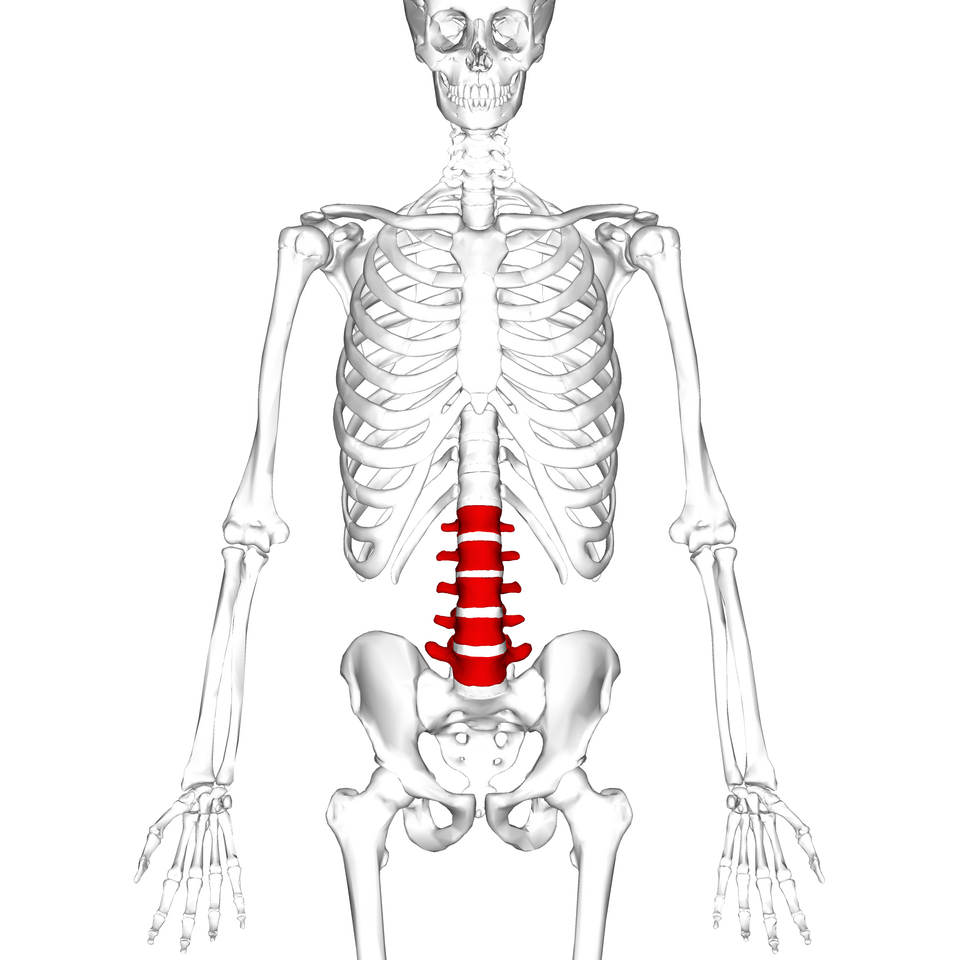
Five large vertebrae form the lower back's bony column, progressively increasing in size toward the pelvis to handle greater compressive load.
Thick fibrocartilage discs cushion each lumbar segment and allow bending and twisting; their outer fibers can tear under repeated or heavy loading, sometimes leading to herniation.
This group of long muscles running along the spine extends the trunk and controls forward bending, and is one of the most commonly strained muscle groups in acute low back pain.
Small, deep muscles spanning individual vertebral segments provide fine control and stability, and are frequently found to be inhibited or deconditioned in people with recurrent low back pain.
This deep abdominal muscle wraps around the trunk like a corset, working with the multifidus to stabilize the spine before limb movement occurs.
Nerve roots exiting the lumbar spine combine to form the sciatic nerve, which supplies the back of the leg; compression of these roots produces the radiating pain known as sciatica.
Forward flexion is the lumbar spine's largest single motion, though a substantial portion of what looks like low back bending actually occurs at the hips, a distinction clinicians assess when evaluating movement patterns.
The lumbar spine's combination of load-bearing bone, shock-absorbing discs, and layered stabilizing muscles explains why low back pain can arise from many different tissues, and why treatment often addresses movement patterns and strength rather than a single structure.
Neighbouring topics share region literacy — not a severity ranking.
The seven cervical vertebrae and the soft tissues that carry the head — posture load, disc and facet pain, and graded mobility work.
Pain frequency 82 Same body regionThe core is the coordinated group of trunk muscles that stabilizes the spine and pelvis, transferring force between the upper and lower body during nearly every movement.
Pain frequency 35 Same body region