At a glance
Small, deep muscles running along the spine provide fine-tuned control at each vertebral level and are frequently found to be underactive in people with a history of low back pain. Because the core rarely sustains an acute traumatic injury on its own, most issues in this region relate to deconditioning, imbalance, or coordination problems that contribute to symptoms elsewhere, particularly the low back.
Weigh it for yourself
Mark each measure High, Any or Low for what you want. The fit number moves with every mark, and your marks follow you to the next page in this app.
| Measure | Core | Elbow | You want |
|---|---|---|---|
| Pain frequency | |||
| Recovery length | |||
| Exercise load | |||
| Clinician need | |||
| Self-care fit | |||
| Recurrence risk |
Mark at least one measure to see a fit number.
Scores are the atlas’s 0–100 teaching marks for each topic. They are not a diagnosis, a dose or a treatment choice.
Reading checklist
Tick a point once you could explain it in your own words. Ticks stay on this device.
0 of 4 points done
All points done. Next: Open the topic: Core
Core · Rectus abdominis
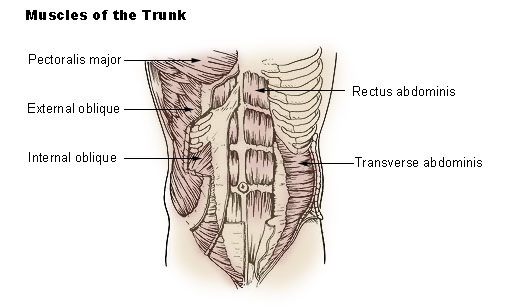
This long, superficial muscle running down the front of the abdomen flexes the trunk and is most visible when body fat is low, though it plays a smaller stabilizing role than the deeper muscles. These layered muscles at the sides of the trunk control rotation and side-bending and contribute significantly to force transfer between the upper and lower body during twisting movements.
Core · Multifidus
Small, deep muscles running along the spine provide fine-tuned control at each vertebral level and are frequently found to be underactive in people with a history of low back pain. Because the core rarely sustains an acute traumatic injury on its own, most issues in this region relate to deconditioning, imbalance, or coordination problems that contribute to symptoms elsewhere, particularly the low back.
Core · These issues are typically identified through functional assessm
These issues are typically identified through functional assessment rather than imaging, since strength and motor control deficits generally do not appear on standard scans. Because core issues frequently overlap with or contribute to low back and hip conditions, assessment often considers the trunk alongside these neighboring regions rather than in isolation.
Core · General core deconditioning
Reduced endurance and activation of trunk stabilizing muscles, often related to a sedentary lifestyle, and commonly addressed as a preventive or supportive measure. Widening of the connective tissue between the rectus abdominis muscles, common during and after pregnancy, which can reduce effective trunk support until addressed with targeted exercise.
This is education from the atlas. It does not diagnose and does not prescribe a dose. It does not replace the full topic page.
What is the next question after this?
These issues are typically identified through functional assessment rather than imaging, since strength and motor control deficits generally do not appear on standard scans. Because core issues frequently overlap with or contribute to low back and hip conditions, assessment often considers the trunk alongside these neighboring regions rather than in isolation.
Does this page rank people or nations?
This is education from the atlas. It does not diagnose and does not prescribe a dose. It does not replace the full topic page.
Where is the longer entry?
Reduced endurance and activation of trunk stabilizing muscles, often related to a sedentary lifestyle, and commonly addressed as a preventive or supportive measure. Widening of the connective tissue between the rectus abdominis muscles, common during and after pregnancy, which can reduce effective trunk support until addressed with targeted exercise.