Myth and correction
Botulism spores risk before 12 months — never give honey to infants.
Twenty-four topics, each taken apart seven ways: where the idea came from, what the science says, how to practice it day to day, how cultures treat it, who shaped the field, which myths still circulate, and how the world actually does it.
Short paths into the atlas — pick one and follow the seven sections.
Saved topics appear here on this device.
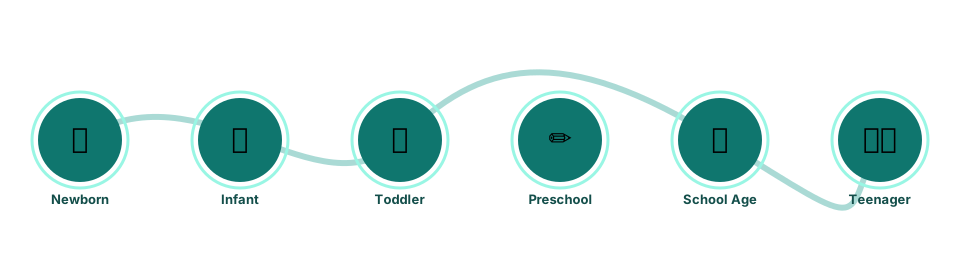
Six developmental stages on one journey. Hover or focus a stage for scores; click to open it.
Download atlas (SVG) → · Open printable SVG → · By age and stage →
Jump straight into the everyday issue that is keeping you up.
High-intent questions mapped to situations, topics and essays — the paths people actually type into a search box.
Age → tonight tips, sleep window, screen budget, and fit quiz.
Open →
Five quick questions → the topics that fit tonight.
Open →
Practice items from parent capacities — check them off as you go.
Open →
Put topics side by side on evidence, impact and difficulty.
Open →
Everyday moments mapped into the atlas — now with deep-read bridges.
When nights stretch long — sleep science, regulation, and toddler/infant cues.
5 →
Food refusal, pacing, and keeping connection at the table.
5 →
Devices, school-age and teens — talk and consistency over pure bans.
5 →
Rivalry, fairness, and teaching repair without endless comparison.
5 →
Readiness beyond flashcards — preschool to school-age transition.
5 →
Disclosure, presence, and empathy when adolescents pull away.
5 →
Aligned rules across caregivers without turning every chat into a fight.
5 →
Newborn reality — sleep, feeding, closeness, and parental presence.
5 →
Big feelings in toddlers — soft limits, co-regulation, firm kindness.
5 →
Connection through play before correction — infancy through toddlerhood.
5 →
High warmth plus clear expectations when discipline conflicts escalate.
5 →
When the adult is depleted — regulation, presence, and shared load.
5 →
Same rules, different wiring — fairness without identical treatment.
5 →
When load, sleep and soft limits matter more than lectures.
5 →
Kin care, inherited scripts, and aligning safety without a culture war.
5 →
When guilt says “all parenting” or “all genes” — find the middle path.
5 →
When the child manages adult mood — fear climates, consistency, and repair.
5 →
Provided for but unseen — presence, empathy, and turning back toward.
5 →
When desks become battlegrounds — pressure, talk and repair.
5 →
Chaotic starts — routines, regulation and fewer ruptures before school.
5 →
Big feelings in public — co-regulation without humiliation.
5 →
When feeds win the table — presence islands and device design.
5 →
Ranks, sleep and belonging when tests own the calendar.
5 →
Relocation or two-home shifts — predictability, talk and grief room.
5 →
When the calendar finally opens — free play vs default screens.
5 →
Exclusion, friction and bullying — coaching without invading.
5 →
Weight talk at meals — protecting dignity around food.
5 →
Death, goodbye and upheaval — truth, routine and not parentifying.
5 →
When the house forgot how to like each other — micro-joy practice.
5 →
Fifteen journeys across diversity — care, culture, harm and repair, school pressure, presence, play, peers, bodies, grief and joy.
Genes and temperament set ranges; caregiving still steers the odds.
3 · 5 →
Who else holds the child — kin, partners, night shifts, first weeks.
3 · 5 →
Warmth travels; control is coded — methods across cultures without shame wars.
3 · 5 →
Sleep diversity, sensory load, and the biology underneath hard evenings.
3 · 5 →
Global advice vs local wisdom — curate without fatalism or omnipotent guilt.
3 · 5 →
Two children, one home — fairness, rivalry, and different wiring.
3 · 5 →
What chronic harmful climates cost a child — and how safety, apology and help still rewrite the path.
5 · 5 →
Village care, nights and attention from newborn into the toddler bridge.
4 · 5 →
Readiness, homework, mornings and exams — pressure with belonging.
4 · 5 →
Attention economy, repair and play — faces that answer bids.
4 · 5 →
Praise climates, genes and fit — high standards without exile.
4 · 5 →
Free time, friendship and joy — the climates beyond adult instruction.
4 · 5 →
Food talk and appearance scripts — dignity at the table.
4 · 5 →
Loss, migration, separation — accompanying children through upheaval.
4 · 5 →
Joy as protection — play, presence and rupture-return with warmth.
4 · 5 →
Longer essays on how care, culture and temperament differ — with a local lens in every language.
Across history and continents, children have been raised by networks — not only by a lone mother–father pair. Here is what that diversity means for modern families.
Read →
10 min readWarmth and structure travel globally — but the recipes for respect, independence and obedience are not universal. Diversity here is a feature of human childhoods.
Read →
9 min readSeparate nurseries, family beds, hammocks, and shared mats — sleep arrangements are cultural technologies, not a single moral test.
Read →
10 min readCultures disagree on spanking, scolding and silence — yet humiliation and unpredictable force keep failing children. Here is how to hold diversity and a clear ethical floor.
Read →
9 min readImmigrant, refugee, expatriate and mixed families parent on a border. Diversity here is daily translation — of language, respect and belonging.
Read →
8 min readParenting diversity includes who holds the baby. Father involvement, grandparent care, LGBTQ+ families and single parents all reshape the old script.
Read →
9 min readGlobal parenting content travels faster than context. Learning to filter experts, influencers and elders is itself a parenting skill.
Read →
10 min readParenting diversity includes the child. Temperament and neurodivergence mean the same household climate lands differently on different nervous systems.
Read →
10 min readChildren arrive with predispositions. Caregivers do not rewrite DNA — yet the climate they build shapes which traits flower, strain, or stay buffered. Both truths belong in one story.
Read →
10 min readOccasional anger is human. A home where the child must stay small to stay safe trains a nervous system for threat — and that training follows them into school, friendship and adulthood.
Read →
10 min readA child can have food, clothes and school fees — and still grow up alone inside. Emotional neglect is not drama; it is the absence of being known.
Read →
9 min readWhen rules, moods and safety swing without pattern, the child cannot build a map. Hypervigilance becomes a life skill — and a life tax.
Read →
10 min readChildren borrow the nervous systems around them. Untreated rage, panic, addiction or collapse in a caregiver becomes the child’s weather — and can reshape their life odds.
Read →
9 min readHarm climates raise real risks — and human development remains plastic. Repair, safety and one steady relationship can change a child’s path.
Read →
9 min readEvery home ruptures. What separates safe climates from wounding ones is not perfection — it is how quickly and honestly adults return.
Read →
10 min readEncouragement builds skill. Praise that only arrives with ranks and scores can train a child to confuse love with performance — and to fear ordinary mistakes.
Read →
9 min readChildren bid for eye contact in a market flooded with feeds. When adult attention is chronically fragmented, the child experiences a modern form of being unseen.
Read →
9 min readChildhood needs unrehearsed hours. When every slot is optimised — classes, drills, feeds — the nervous system loses the laboratory where creativity, conflict repair and joy are practised.
Read →
10 min readParents set the base. Peers set the daily weather of belonging, status and shame. Ignoring that second climate leaves children alone in their hardest social hours.
Read →
9 min readChildren learn to inhabit a body by listening to family chatter about plates, weight and “good” vs “bad” food. That mirror can nourish — or train lifelong shame.
Read →
10 min readDeath, divorce, migration, illness, pet loss — children grieve inside adult storms. Honest, paced accompaniment is a form of protection.
Read →
8 min readWarnings matter. So does laughter at the table. Shared joy is not frivolous — it is a regulating climate that buffers stress and teaches children they are a pleasure, not a project.
Read →
Curated packs that mix stages, methods and capacities — then open into deep reads.
Newborn to infant care — sleep, feeding, and close caregiving.
5 topics in this pack →
Limits, conflict, siblings, and firm-and-kind discipline.
5 topics in this pack →
Middle childhood — readiness, screens, consistency, talk.
5 topics in this pack →
Adolescence with presence, empathy, and self-regulation.
5 topics in this pack →
Six named approaches side by side — pick a stance, not a tribe.
6 topics in this pack →
The capacities that make any method work: empathy through play.
6 topics in this pack →
Sleep, early ages, and the self-regulation that makes nights quieter.
5 topics in this pack →
Feeding, conversation, and play around everyday meals.
5 topics in this pack →
Screens with school-age and teens — limits that still leave room for play.
5 topics in this pack →
Co-parenting with consistency, talk, and fairness across households.
5 topics in this pack →
Authoritative, positive, and gentle approaches when conflict rises.
5 topics in this pack →
School readiness through play, Montessori cues, and steady habits.
5 topics in this pack →
Regulation, empathy and limits when the same home meets different nervous systems.
5 topics in this pack →
Attachment, co-parents and presence — care beyond a lone pair.
5 topics in this pack →
Talk, empathy and consistency when norms collide across homes and schools.
5 topics in this pack →
Genes and temperament matter — and so does the climate you still build.
5 topics in this pack →
Fear, neglect, chaos, adult storms — and the repair path that still changes odds.
5 topics in this pack →
Homework, screens and reconnection in the hours that make or break evenings.
5 topics in this pack →
Rupture-and-return skills that keep attachment intact after hard moments.
5 topics in this pack →
Presence, play and screens — protecting the bids that build belonging.
5 topics in this pack →
Standards without conditional worth — school-age and teen pressure maps.
5 topics in this pack →
Newborn through toddler — sleep, feeding, attachment and first attention.
5 topics in this pack →
Open time, play connection and screens — defending childhood’s laboratory.
5 topics in this pack →
Friendship, belonging and school-age social weather beyond the family.
5 topics in this pack →
Food talk, dignity and meals without appearance ranking.
5 topics in this pack →
Loss, moves and family upheaval — honest accompaniment.
5 topics in this pack →
Delight as protective climate — humour, play and liking your child aloud.
5 topics in this pack →
Head-to-head profiles built from the same score axes — no new prose, just the shape of the evidence.
Every topic placed by daily impact and strength of evidence. Bubble size is urgency.
Top-right: high daily stakes with a solid research base.
From the first weeks through adolescence — what changes, and what parents need at each step.
6 topics →
🧭Approaches with names and research trails: attachment, authoritative, Montessori and more.
6 topics →
💛The conditions of a good parent — empathy, consistency, presence, communication, self-regulation, play.
6 topics →
🔧Sleep, feeding, screens, conflict, siblings and school readiness — the problems that keep people searching.
6 topics →
Every topic on this atlas ranked by one score at a time — evidence, impact, difficulty, age span, consensus and urgency.
Open →
Every topic match-up on this atlas — evidence, impact, difficulty, age span, consensus and urgency.
Open →
Score axes and nicknames used across the parenting atlas.
Open →
Key moments from every topic, placed on one shared timeline of how parenting knowledge grew.
Open →
Put up to six topics side by side on evidence strength, daily impact, difficulty and more.
Open →
Practical checklist items drawn from the parent-capacity topics — what to practice, and why.
Open →
Jump straight to newborn, infant, toddler, preschool, school-age or teenager.
Open →
Every myth on the site, with the evidence-backed correction beside it.
Open →
Filter by category or type a name, age, or issue.
No topics match that filter.
The first 28 days after birth — physiology, bonding, feeding rhythms, and the shift from womb to world.
Evidence 88 🍼From one month to twelve months — motor milestones, first foods, attachment deepening, and emerging sleep patterns.
Evidence 90 🧸Walking, talking, and testing limits — the toddler years blend motor explosion, language bursts, and autonomy struggles.
Evidence 85 ✏️Imaginative play, peer entry, and executive function growth define the preschool years before formal schooling.
Evidence 82 📚Industry, friendships, and academic skill-building mark middle childhood between toddler chaos and adolescent identity work.
Evidence 78 🧑🎓Brain remodeling, identity formation, and increasing autonomy define adolescence — risk and capability both rise.
Evidence 80Proximity, responsiveness, and physical closeness — attachment parenting emphasises cue-based care popularised by William Sears.
Evidence 75 ⚖️High warmth plus clear expectations — Diana Baumrind's authoritative style links to competence in dozens of cohort studies.
Evidence 92 🧩Self-directed activity, hands-on materials, and mixed-age classrooms — Maria Montessori's method spread to over 20,000 schools worldwide.
Evidence 78 ✅Firm and kind limits without punishment — Jane Nelsen's Adlerian-based model teaches problem-solving over punitive control.
Evidence 85 🕊️Connection before correction — gentle parenting prioritises empathy and co-regulation over fear-based obedience.
Evidence 70 🤝Raising children across households — co-parenting frameworks address communication, schedules, and conflict when parents live apart.
Evidence 68Seeing the child's inner world — parental empathy predicts secure attachment and emotion coaching success across cultures.
Evidence 88 🔁Same rules, same calm — behavioural science shows children learn faster when caregiver responses are predictable and aligned.
Evidence 86 👁️Quality of attention over quantity of hours — presence means undistracted engagement, not perfection or constant entertainment.
Evidence 72 💬How families talk — Faber and Mazlish, Gordon, and Gottman research link communication patterns to conflict and closeness.
Evidence 90 🧘Managing one's own arousal before guiding a child — parental self-regulation mediates the impact of stress on discipline quality.
Evidence 87 🎲Play is the language of attachment — child-directed play builds trust, reduces behaviour problems, and teaches social rules.
Evidence 84Circadian development, night waking, and safe sleep environments — among the most researched and debated parenting topics globally.
Evidence 91 🍽️Breast, bottle, solids, and picky eating — Ellyn Satter's division of responsibility frames feeding as a relational not battlefield task.
Evidence 93 📱Screens displace sleep, movement, and conversation — WHO, AAP, and UNESCO guidance converges on limits under five with quality over quantity debates.
Evidence 82 🚧When limits meet resistance — discipline conflicts escalate when stress, inconsistency, or developmental mismatch go unaddressed.
Evidence 79 👯Competition for attention and resources — Judy Dunn's sibling research shows conflict is normative but manageable with fair attention and teaching repair.
Evidence 76 🎒Self-regulation beats flashcards — school readiness combines executive function, language, and social entry more than early academic drilling.
Evidence 88