Eukaryotic cells
Nucleus, endomembranes, usually mitochondria or remnants (mitosomes, hydrogenosomes).
Protozoa — Motile unicellular eukaryotes — a teaching grade that includes pond ciliates and a minority of serious parasites.
Darker cells mean a higher score for this topic on that metric.
LessMore
Last reviewed Sources & creditsMedia creditsMethodology
Read Identity → How they live → Body & health, then use compare rails.
Public-health education — not a care plan, prescription, or outbreak briefing.
It names everyday desks for Tree of microbes before English norms look universal.
No — editorial 0–100 browsing aids inside this atlas only.
Use related cards and best-of / quiz rails after the first three chapters.
How they live and Body & health carry mechanisms; skim Identity first.
Protozoa is a useful classroom word for animal-like single cells: amoebae that crawl, flagellates that swim, ciliates that row with thousands of cilia. Modern trees split them across several eukaryotic kingdoms.
They are not bacteria, not yeasts, not viruses. A typical cell is 10–50 µm, with a nucleus, organelles and — in parasites — often complex host cycles.
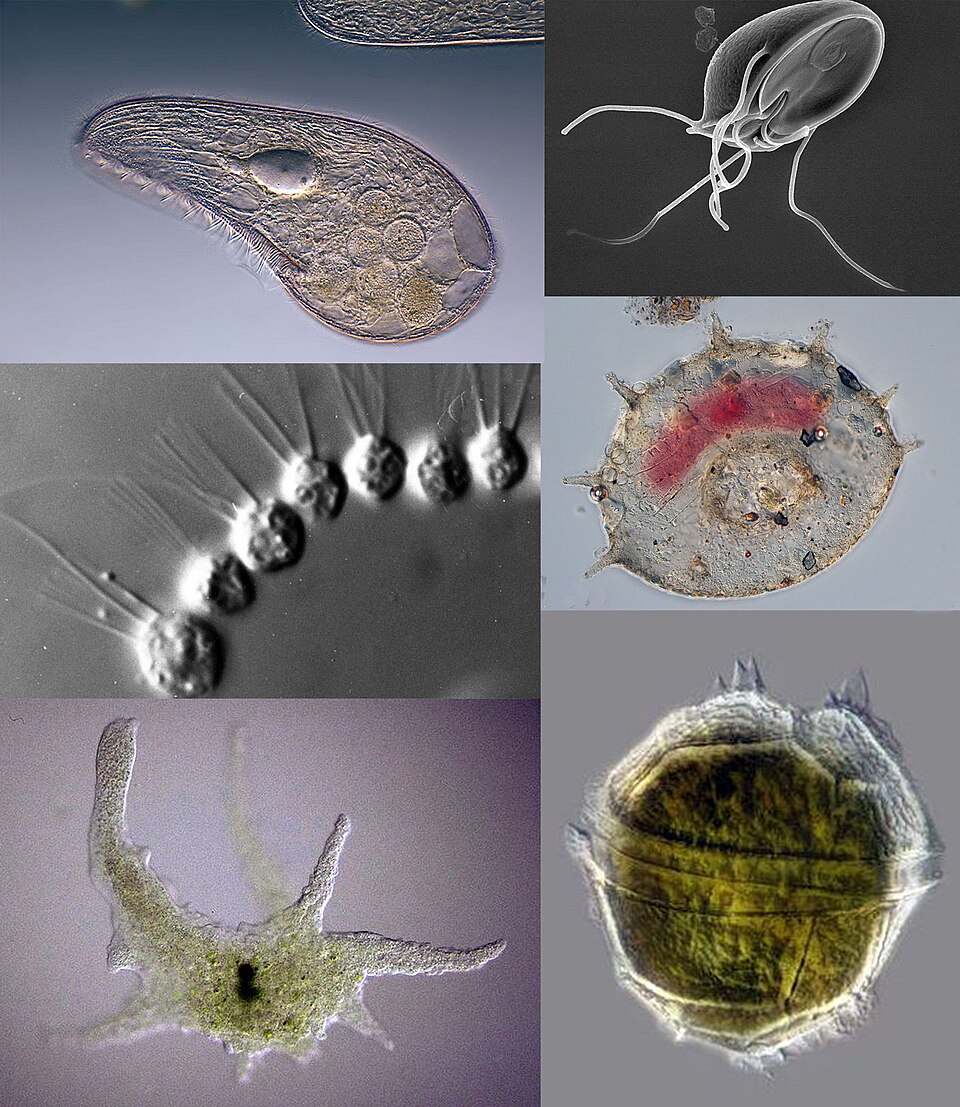
Nucleus, endomembranes, usually mitochondria or remnants (mitosomes, hydrogenosomes).
Pseudopodia, flagella or cilia. The style is a teaching label, not a single family crest.
Many protozoa are naked or have pellicles and tests, not chitin walls like fungi.
Amoebozoa, excavates, alveolates and others do not form one clade. The word still organises clinics and schools.
Ciliates in a hay infusion were Leeuwenhoek's delight. Predators of bacteria, not villains.
Plasmodium, Trypanosoma, Giardia, Entamoeba — famous because they meet people, not because they are typical.
Malaria's Plasmodium made protozoa medically famous. Most species are free-living in soil and water and never infect a person.
Single-celled prokaryotes with cell walls — the oldest widespread life form, and both partners and pathogens.
Familiarity 95Packets of DNA or RNA that are not cells — they replicate only inside living hosts.
Familiarity 96A eukaryotic kingdom of yeasts, moulds and mushrooms — chitin walls, external digestion, partners of plants.
Familiarity 80A prokaryotic domain that is not bacteria — methanogens, extremophiles and no known human pathogens.
Familiarity 35Viruses that infect bacteria — Earth's most abundant biological entities, and a concept-level idea in medicine.
Familiarity 42