Chitin walls
Unlike cellulose in plants or peptidoglycan in bacteria. Chitin also appears in arthropod shells — a hint of shared history with animals.
Fungi — A eukaryotic kingdom of yeasts, moulds and mushrooms — chitin walls, external digestion, partners of plants.
Darker cells mean a higher score for this topic on that metric.
LessMore
Last reviewed Sources & creditsMedia creditsMethodology
Read Identity → How they live → Body & health, then use compare rails.
Public-health education — not a care plan, prescription, or outbreak briefing.
It names everyday desks for Tree of microbes before English norms look universal.
No — editorial 0–100 browsing aids inside this atlas only.
Use related cards and best-of / quiz rails after the first three chapters.
How they live and Body & health carry mechanisms; skim Identity first.
Fungi are neither plants nor animals, though molecular trees place them closer to animals. They digest outside the cell and absorb the soup — osmotrophy — behind a chitin-rich wall.
The familiar mushroom is a fruiting body. Most of the organism is mycelium in soil, wood, leaf litter or a living partner.
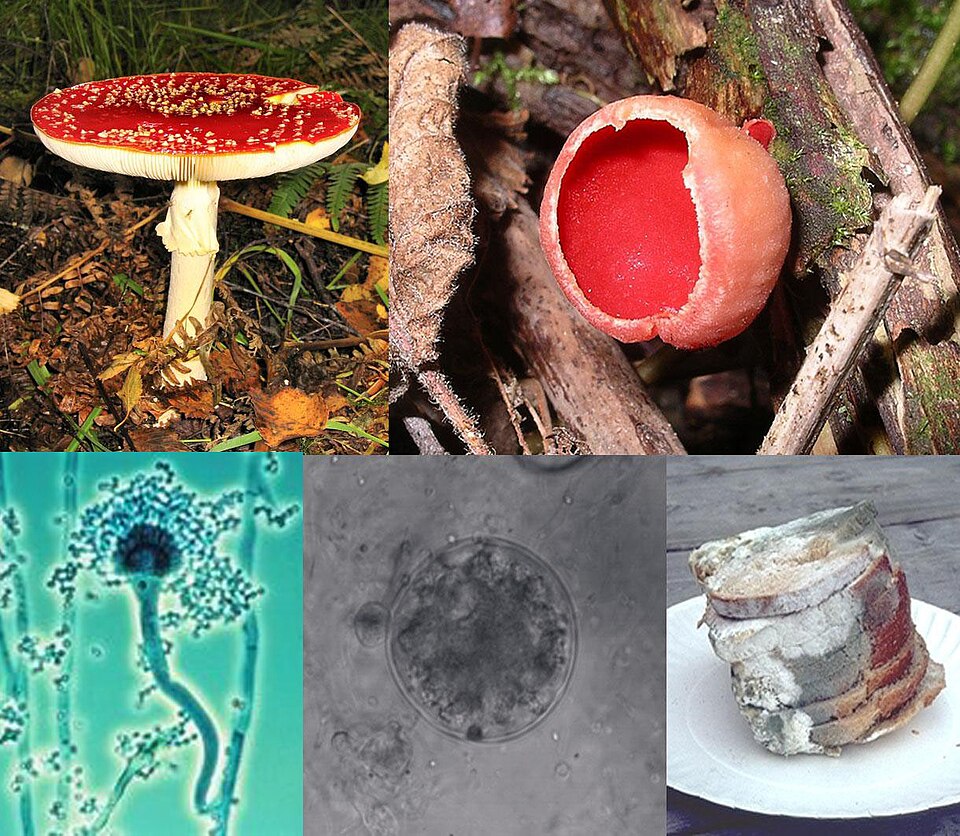
Unlike cellulose in plants or peptidoglycan in bacteria. Chitin also appears in arthropod shells — a hint of shared history with animals.
Enzymes go out; sugars and peptides come in. A fungus is a digestive tract turned inside out.
Filaments explore space; yeasts are single cells that bud. Candida can switch forms — dimorphism — in some settings.
Opisthokonts share a flagellated ancestor story. Fungi are not 'failed plants'.
Meiotic and mitotic spores travel on air and animals. A single puffball can release billions of particles.
Mycorrhizae link most land plants to phosphorus. Lichens are fungi farming phototrophs.
Once you see fungi as a kingdom, 'mould on bread' becomes one lifestyle among yeasts, mycorrhizae and human pathogens.
Single-celled prokaryotes with cell walls — the oldest widespread life form, and both partners and pathogens.
Familiarity 95Packets of DNA or RNA that are not cells — they replicate only inside living hosts.
Familiarity 96A prokaryotic domain that is not bacteria — methanogens, extremophiles and no known human pathogens.
Familiarity 35Viruses that infect bacteria — Earth's most abundant biological entities, and a concept-level idea in medicine.
Familiarity 42Motile unicellular eukaryotes — a teaching grade that includes pond ciliates and a minority of serious parasites.
Familiarity 58