Not bacteria
Separate domain Archaea. Shared 'prokaryote' is a grade: no nucleus, not a family reunion.
Archaea — A prokaryotic domain that is not bacteria — methanogens, extremophiles and no known human pathogens.
Darker cells mean a higher score for this topic on that metric.
LessMore
Last reviewed Sources & creditsMedia creditsMethodology
Read Identity → How they live → Body & health, then use compare rails.
Public-health education — not a care plan, prescription, or outbreak briefing.
It names everyday desks for Tree of microbes before English norms look universal.
No — editorial 0–100 browsing aids inside this atlas only.
Use related cards and best-of / quiz rails after the first three chapters.
How they live and Body & health carry mechanisms; skim Identity first.
Archaea look like bacteria under a cheap microscope: no nucleus, small cells. Their lipids, ribosomes and information genes tell another story. Carl Woese's rRNA trees in 1977 split them from 'bacteria' as a mixed bag.
Many famous archaea love extremes — boiling springs, saturated salt, anoxic mud. Others live in ordinary soils, oceans and the animal gut as methanogens. None is a documented human pathogen.
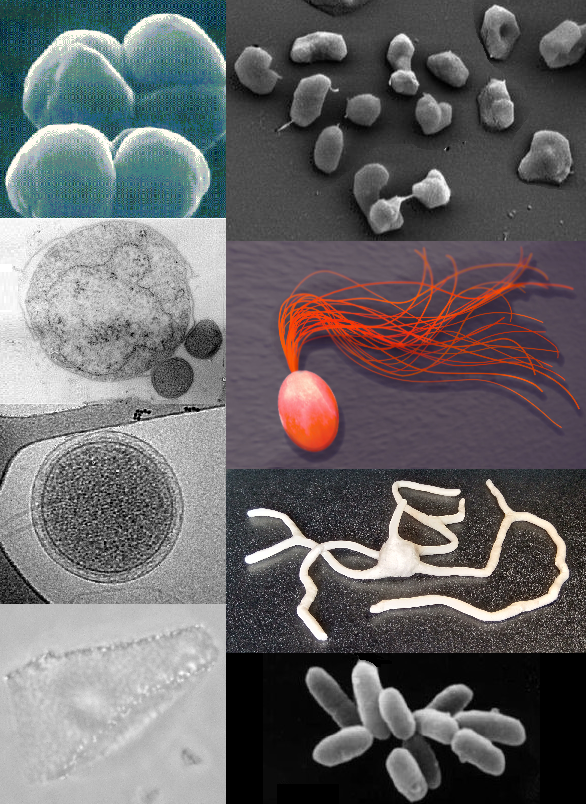
Separate domain Archaea. Shared 'prokaryote' is a grade: no nucleus, not a family reunion.
Isoprenoid chains on glycerol via ether bonds, sometimes as monolayers. Bacterial and eukaryotic esters differ.
Walls, when present, use other polymers. Pseudopeptidoglycan in some methanogens is not Gram's mesh.
Only archaea run the methanogenic pathway that turns CO2 or acetate into methane in guts and wetlands.
Pyrococcus and Halobacterium taught textbooks about heat and salt. Extremophily is a subset, not the whole domain.
Surveys have not tied an archaeal species to a transmissible human disease the way Streptococcus is tied.
Calling them 'ancient bacteria' is a naming fossil. They are contemporaries with their own domain.
Single-celled prokaryotes with cell walls — the oldest widespread life form, and both partners and pathogens.
Familiarity 95Packets of DNA or RNA that are not cells — they replicate only inside living hosts.
Familiarity 96A eukaryotic kingdom of yeasts, moulds and mushrooms — chitin walls, external digestion, partners of plants.
Familiarity 80Viruses that infect bacteria — Earth's most abundant biological entities, and a concept-level idea in medicine.
Familiarity 42Motile unicellular eukaryotes — a teaching grade that includes pond ciliates and a minority of serious parasites.
Familiarity 58