1791
Gregor mineral
William Gregor identified a magnetic black sand later named titanium.
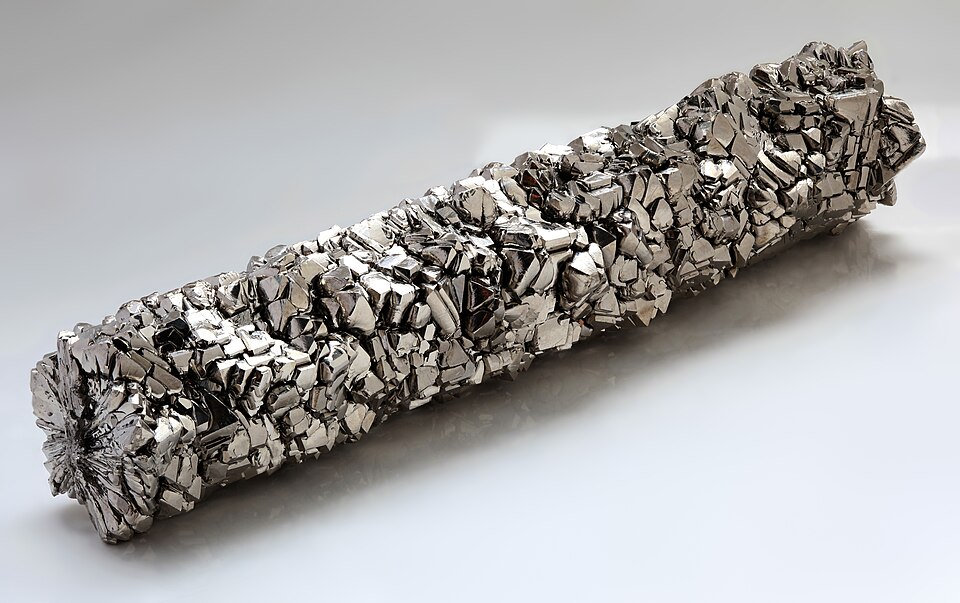
Titanium · High specific strength and chloride-tolerant films — airframes, implants and seawater.
Milestones in order. This is history, not a weekly activity grid.
Darker cells mean a higher score for this topic on that metric.
LessMore
Last reviewed Sources & creditsMedia creditsMethodology
Declared reaction class in this atlas: A1 metal. Assemblies still need resistance tests.
Thermal mark 14/100 versus the atlas. Conductivity note: ~22 W/m·K.
4.51 g/cm³
Origin story: Kroll process 1940 (Luxembourg / US).
Circularity mark 48/100 — editorial, route-specific.
1668 °C
heat 78 · fire 80
Titanium did not arrive as a finished commodity. Kroll process 1940 around Luxembourg / US still explains who makes it and which tests it sits in.
Ten dated points, five eras and three milestones below are the spine — not a complete industrial history.
William Gregor identified a magnetic black sand later named titanium.
Matthew Hunter isolated ductile titanium metal in the US.
Wilhelm Kroll reduced TiCl4 with magnesium — still the industrial route.
US and Soviet aero programmes paid for sponge capacity.
The workhorse α+β alloy was standardised for airframes and later implants.
Lockheed used titanium for sustained Mach 3 skin temperatures.
Commercially pure grades entered chemical plant and seawater.
Implant specs tightened interstitial limits (ELI).
EBM/LPBF of Ti-6Al-4V for lattices and patient-specific implants.
Aerospace lead times still track a few Kroll plants, not a commodity pit.
William Gregor identified a magnetic black sand later named titanium.
Wilhelm Kroll reduced TiCl4 with magnesium — still the industrial route.
The workhorse α+β alloy was standardised for airframes and later implants.
Commercially pure grades entered chemical plant and seawater.
EBM/LPBF of Ti-6Al-4V for lattices and patient-specific implants.
US and Soviet aero programmes paid for sponge capacity.
Commercially pure grades entered chemical plant and seawater.
Aerospace lead times still track a few Kroll plants, not a commodity pit.
Knowing this timeline is how to read a mill certificate without treating Titanium as timeless.
The iron–carbon workhorse of buildings, ships, rails and tools — endlessly recast.
Overall 66 🥫Light structural metal from Hall–Héroult cells — aircraft skins, cans and façades.
Overall 59 🔶The first industrial conductor — wiring, heat exchangers, roofs that go green.
Overall 57 🍴Chromium passive films that keep kitchens, chemical plant and façades from rusting like carbon steel.
Overall 64