At a glance
Tank · taglineThe armoured fighting vehicle born on the Somme in 1916 -- a history of a…
Tank · Interwar theorists (Fuller, Liddell Hart, Guderian, TukhachevskyInterwar theorists (Fuller, Liddell Hart, Guderian, Tukhachevsky, de Gaulle)…
Tank · Cultural memory is thick: war-film silhouettes, model kits, and Cultural memory is thick: war-film silhouettes, model kits, and "tankie" as a…
Tank · paras 1Mark I to FT: reliability was the scandal, not the idea. Cambrai (1917) and…
Interwar theorists (Fuller, Liddell Hart, Guderian, Tukhachevsky, de Gaulle) argued whether armour was an infantry helper or a decisive arm. 1939-41 seemed to answer; 1943-45 and later 1973 (Sinai) reopened the argument with guns and missiles. The main battle tank of the Cold War (Centurion, T-54/55, M60, Leopard 1/2, M1) was an industrial-political object as much as a vehicle.
Tank · tagline
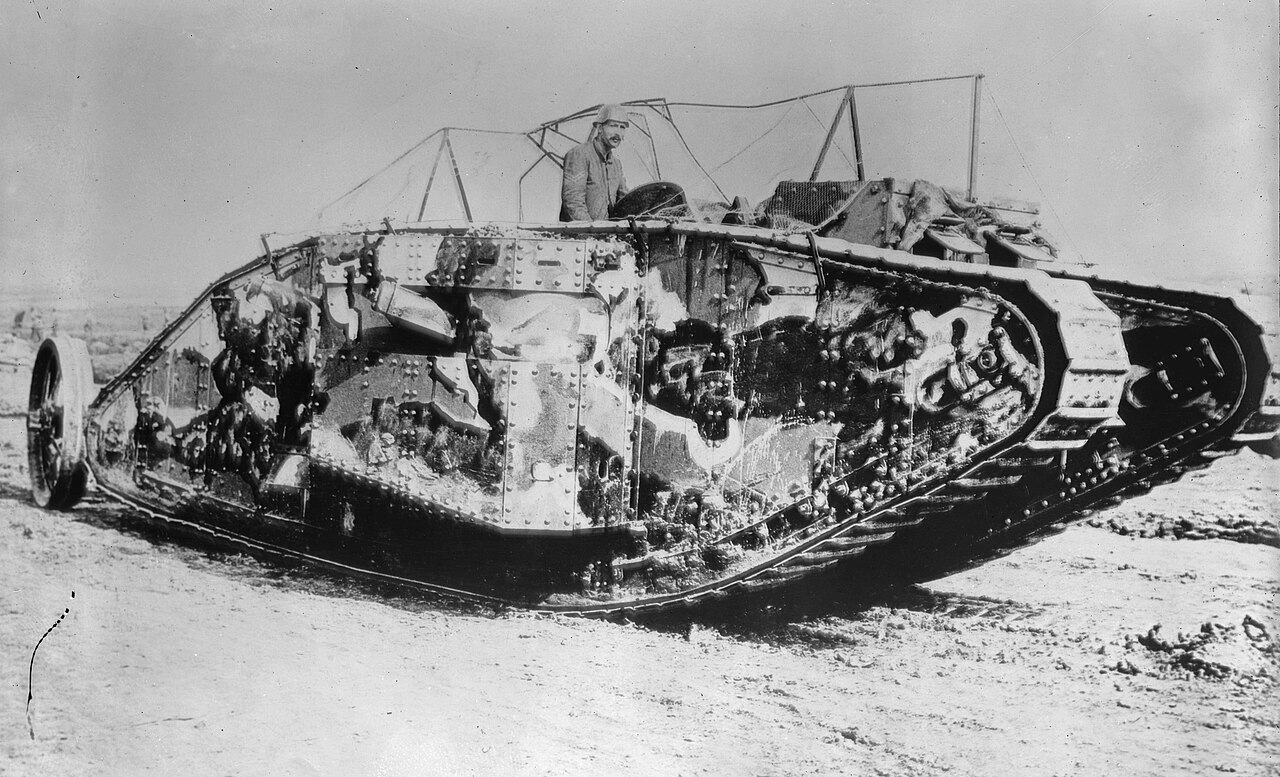
The armoured fighting vehicle born on the Somme in 1916 -- a history of a type, not a guide to building or fighting in one. The tank appeared as a British attempt to cross 1916 trench ground: Mark I machines at Flers-Courcelette on 15 September 1916. The cover name "tank" stuck. France's Schneider and Saint-Chamond, then the Renault FT (turret, rear engine), set a layout the twentieth century would repeat.
Tank · Interwar theorists (Fuller, Liddell Hart, Guderian, Tukhachevsky
Interwar theorists (Fuller, Liddell Hart, Guderian, Tukhachevsky, de Gaulle) argued whether armour was an infantry helper or a decisive arm. 1939-41 seemed to answer; 1943-45 and later 1973 (Sinai) reopened the argument with guns and missiles. The main battle tank of the Cold War (Centurion, T-54/55, M60, Leopard 1/2, M1) was an industrial-political object as much as a vehicle.
Tank · Cultural memory is thick: war-film silhouettes, model kits, and
Cultural memory is thick: war-film silhouettes, model kits, and "tankie" as a later political insult. Korean memory includes the T-34 in 1950 and the later K1/K2 as ROK industry. Intensity in this atlas is moderate -- a weapon type, not a world war -- while techShift is high. No paragraph here is a how-to for armour employment.
Tank · paras 1
Mark I to FT: reliability was the scandal, not the idea. Cambrai (1917) and 1918 combined arms are the first "tank battle" stories -- dated, not copied.
This explains a campaign, battle, or weapon in context. It is not a league of nations. It does not replace the full topic page.
Questions
- What is the next question after this?
- Cultural memory is thick: war-film silhouettes, model kits, and "tankie" as a later political insult. Korean memory includes the T-34 in 1950 and the later K1/K2 as ROK industry. Intensity in this atlas is moderate -- a weapon type, not a world war -- while techShift is high. No paragraph here is a how-to for armour employment.
- Does this page rank people or nations?
- This explains a campaign, battle, or weapon in context. It is not a league of nations. It does not replace the full topic page.
- Where is the longer entry?
- Mark I to FT: reliability was the scandal, not the idea. Cambrai (1917) and 1918 combined arms are the first "tank battle" stories -- dated, not copied.
Next question: Thirty Years' War · Open the topic: Tank
Why is "a single assassination headline" the wrong stop when reading the August mobilization in 1914? · Why is "a paper count of tanks" the wrong stop when reading the campaign in France in 1940? · Why is "the landing nickname alone" the wrong stop when reading the Inchon landing in 1950? · Why is "a body-count column" the wrong stop when reading the Tet offensive in 1968? · Why is "the battle nickname alone" the wrong stop when reading Austerlitz in 1805? · Why is "one casualty total" the wrong stop when reading Gettysburg in 1863? · 50 campaign reading notes