At a glance
Swimming · Who is the greatest swimmer of all time?By any objective measure it is Michael Phelps. The American won 28 Olympic…
Swimming · Why is freestyle the fastest stroke?Freestyle (front crawl) is fastest because it minimises drag and keeps at…
Swimming · What is the 15-metre underwater rule?After the start and every turn, a swimmer may travel underwater, usually in a…
Swimming · Why were the 2009 super-suits banned?In 2008 and 2009 manufacturers introduced full-body suits made of…
Freestyle (front crawl) is fastest because it minimises drag and keeps at least one arm generating propulsion almost continuously. The alternating over-water arm recovery lets the swimmer maintain near-constant forward force while the body rotates along its long axis, staying flat and streamlined. The flutter kick is compact and produces little braking.
Swimming · Who is the greatest swimmer of all time?
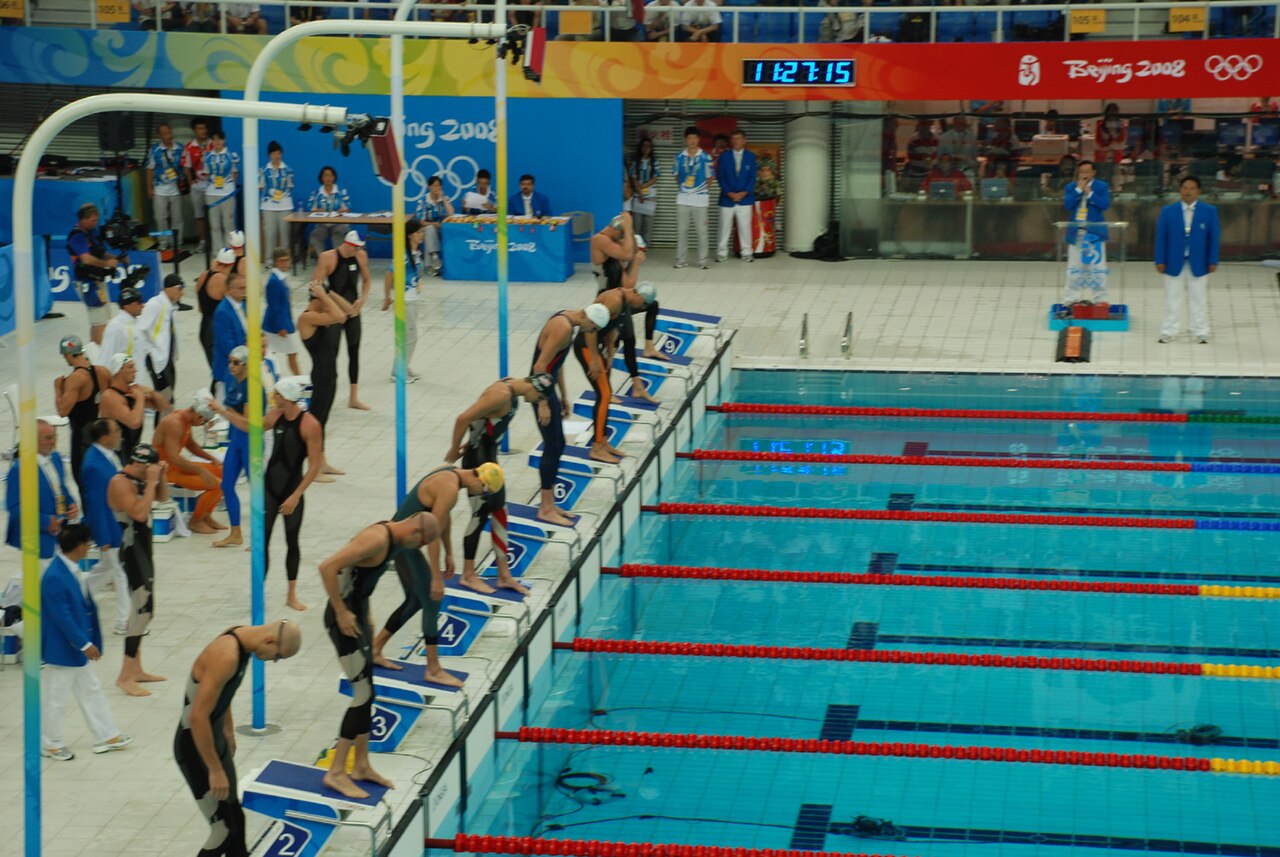
By any objective measure it is Michael Phelps. The American won 28 Olympic medals, 23 of them gold, across five Games from 2000 to 2016, including a record eight golds at Beijing 2008, and set 39 world records and 26 world-championship titles. No other swimmer is close on career hardware, and his versatility across butterfly, freestyle and individual medley is unmatched.
Swimming · Why is freestyle the fastest stroke?
Freestyle (front crawl) is fastest because it minimises drag and keeps at least one arm generating propulsion almost continuously. The alternating over-water arm recovery lets the swimmer maintain near-constant forward force while the body rotates along its long axis, staying flat and streamlined. The flutter kick is compact and produces little braking.
Swimming · What is the 15-metre underwater rule?
After the start and every turn, a swimmer may travel underwater, usually in a streamlined dolphin kick, but the head must break the surface no later than the 15-metre mark in freestyle, backstroke and butterfly. Staying under past 15 metres is an immediate disqualification.
Swimming · Why were the 2009 super-suits banned?
In 2008 and 2009 manufacturers introduced full-body suits made of polyurethane and other non-textile materials that trapped air, added buoyancy and slashed drag, effectively making swimmers faster without any change in fitness. The effect was so extreme that 43 world records fell at the 2009 World Championships in Rome alone, and races became partly a technology contest.
This is a reading check for the atlas, not personal advice, a live price, or a booking. It does not replace the full topic page.
Questions
- What is the next question after this?
- After the start and every turn, a swimmer may travel underwater, usually in a streamlined dolphin kick, but the head must break the surface no later than the 15-metre mark in freestyle, backstroke and butterfly. Staying under past 15 metres is an immediate disqualification.
- Does this page rank people or nations?
- This is a reading check for the atlas, not personal advice, a live price, or a booking. It does not replace the full topic page.
- Where is the longer entry?
- In 2008 and 2009 manufacturers introduced full-body suits made of polyurethane and other non-textile materials that trapped air, added buoyancy and slashed drag, effectively making swimmers faster without any change in fitness. The effect was so extreme that 43 world records fell at the 2009 World Championships in Rome alone, and races became partly a technology contest.
Next question: Table Tennis · Open the topic: Swimming
⚽ How to read the GOAT score — Soccer (2022) · 🏀 When peak versus career changes the order — Basketball (1946) · 🎾 What a fair head-to-head holds constant — Tennis (1968) · ⚾ How a rules card differs from a record — Baseball (1903) · 🏎️ Which years the era window includes — F1 (1950) · ⛳ A shared prize versus one name — Golf (1860) · How to read a sports comparison