At a glance
Volleyball · Who is the greatest volleyball player of all time?Most experts name Karch Kiraly of the United States, the only player to win…
Volleyball · What is the difference between indoor and beach volleyball?Indoor volleyball is played six against six on an 18-by-9-metre hard court,…
Volleyball · How many players are on a volleyball team?Six players from each team are on the court at any time, arranged in the…
Volleyball · The object is simple to state and hard to execute: ground the baThe object is simple to state and hard to execute: ground the ball inside the…
Indoor volleyball is played six against six on an 18-by-9-metre hard court, with specialised positions, rotations, substitutions and a libero, in a best-of-five match to 25 points a set. Beach volleyball pits two against two on a smaller 16-by-8-metre sand court, with no positional specialisation, no substitutions and players covering the whole court themselves.
Volleyball · Who is the greatest volleyball player of all time?
Most experts name Karch Kiraly of the United States, the only player to win Olympic gold both indoors, in 1984 and 1988, and on the sand, in 1996, and the figure FIVB honoured as the best male player of the 20th century. In the women's game the equivalent is Cuba's Regla Torres, a three-time Olympic champion whom FIVB named the best female player of the century.
Volleyball · What is the difference between indoor and beach volleyball?
Indoor volleyball is played six against six on an 18-by-9-metre hard court, with specialised positions, rotations, substitutions and a libero, in a best-of-five match to 25 points a set. Beach volleyball pits two against two on a smaller 16-by-8-metre sand court, with no positional specialisation, no substitutions and players covering the whole court themselves.
Volleyball · How many players are on a volleyball team?
Six players from each team are on the court at any time, arranged in the three-front, three-back rotational order. A full match-day roster typically carries 12 to 14 players, including one or two liberos and specialists who substitute in. Teams rotate one position clockwise each time they win back the serve, so every player must play front and back court.
Volleyball · The object is simple to state and hard to execute: ground the ba
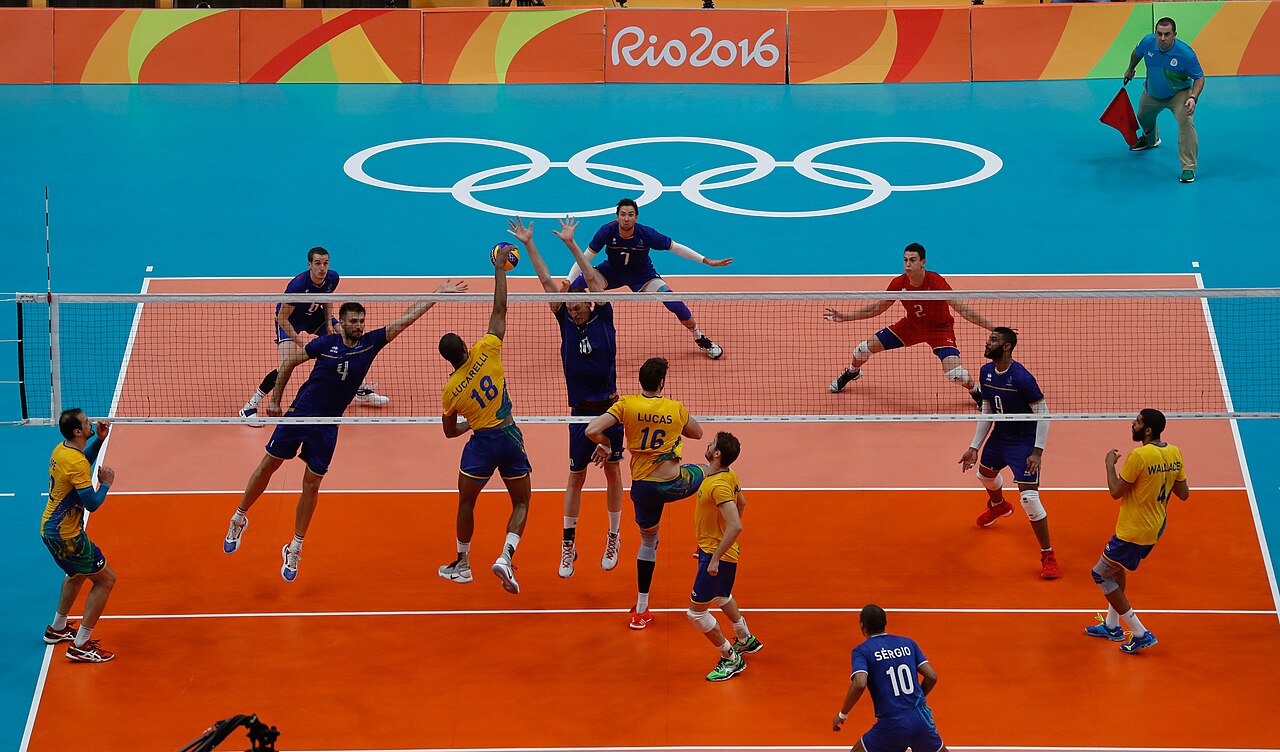
The object is simple to state and hard to execute: ground the ball inside the opponent's 9-by-9-metre court, or force them into an error, before they can do the same to you. A team may contact the ball three times - conventionally a dig or pass, a set, and an attack - and must send it back over the net without catching, carrying or hitting it twice in a row. A block does not count as one of the three touches.
This is a reading check for the atlas, not personal advice, a live price, or a booking. It does not replace the full topic page.
Questions
- What is the next question after this?
- Six players from each team are on the court at any time, arranged in the three-front, three-back rotational order. A full match-day roster typically carries 12 to 14 players, including one or two liberos and specialists who substitute in. Teams rotate one position clockwise each time they win back the serve, so every player must play front and back court.
- Does this page rank people or nations?
- This is a reading check for the atlas, not personal advice, a live price, or a booking. It does not replace the full topic page.
- Where is the longer entry?
- The object is simple to state and hard to execute: ground the ball inside the opponent's 9-by-9-metre court, or force them into an error, before they can do the same to you. A team may contact the ball three times - conventionally a dig or pass, a set, and an attack - and must send it back over the net without catching, carrying or hitting it twice in a row. A block does not count as one of the three touches.
Next question: Ski Racing · Open the topic: Volleyball
⚽ How to read the GOAT score — Soccer (2022) · 🏀 When peak versus career changes the order — Basketball (1946) · 🎾 What a fair head-to-head holds constant — Tennis (1968) · ⚾ How a rules card differs from a record — Baseball (1903) · 🏎️ Which years the era window includes — F1 (1950) · ⛳ A shared prize versus one name — Golf (1860) · How to read a sports comparison