At a glance
MotoGP · Why do MotoGP riders drag their knees and elbows?Hanging off the inside of the bike moves the combined centre of mass of rider…
MotoGP · Do MotoGP riders make pit stops?Not in normal conditions. A MotoGP race is run start to finish on one set of…
MotoGP · What are Moto2 and Moto3?They are the two support classes that run at every Grand Prix and form the…
MotoGP · MotoGP's rulebook splits into three parts: the sporting regulatiMotoGP's rulebook splits into three parts: the sporting regulations that…
Not in normal conditions. A MotoGP race is run start to finish on one set of tyres and one tank of fuel, with no refuelling and no scheduled stops, which is why tyre management over the closing laps decides so many races. The exception is the flag-to-flag rule for changing weather.
MotoGP · Why do MotoGP riders drag their knees and elbows?
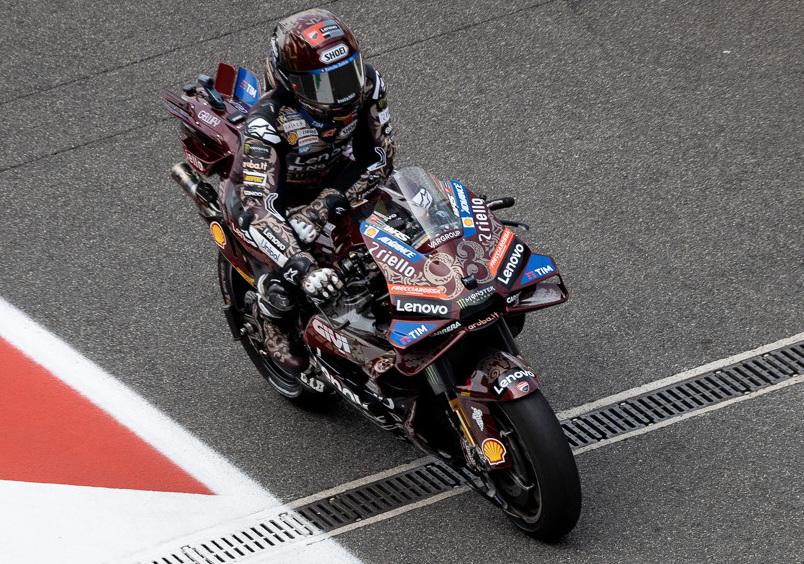
Hanging off the inside of the bike moves the combined centre of mass of rider and machine inwards, which means the motorcycle itself can stay more upright for a given cornering speed and keep a larger, safer contact patch on the tyre. Knee sliders came first, in the 1970s, as riders such as Kenny Roberts began moving their bodies off the seat.
MotoGP · Do MotoGP riders make pit stops?
Not in normal conditions. A MotoGP race is run start to finish on one set of tyres and one tank of fuel, with no refuelling and no scheduled stops, which is why tyre management over the closing laps decides so many races. The exception is the flag-to-flag rule for changing weather.
MotoGP · What are Moto2 and Moto3?
They are the two support classes that run at every Grand Prix and form the official ladder into MotoGP. Moto3, which replaced the 125cc class in 2012, uses 250cc single-cylinder four-strokes with cost caps and a rev limit; low power means slipstreaming dominates and races are decided in huge packs.
MotoGP · MotoGP's rulebook splits into three parts: the sporting regulati
MotoGP's rulebook splits into three parts: the sporting regulations that govern the weekend and the points, the technical regulations that define the motorcycle, and the disciplinary code administered by the FIM MotoGP Stewards. Almost all of it is written around one constraint, the tyre.
This is a reading check for the atlas, not personal advice, a live price, or a booking. It does not replace the full topic page.
Questions
- What is the next question after this?
- They are the two support classes that run at every Grand Prix and form the official ladder into MotoGP. Moto3, which replaced the 125cc class in 2012, uses 250cc single-cylinder four-strokes with cost caps and a rev limit; low power means slipstreaming dominates and races are decided in huge packs.
- Does this page rank people or nations?
- This is a reading check for the atlas, not personal advice, a live price, or a booking. It does not replace the full topic page.
- Where is the longer entry?
- MotoGP's rulebook splits into three parts: the sporting regulations that govern the weekend and the points, the technical regulations that define the motorcycle, and the disciplinary code administered by the FIM MotoGP Stewards. Almost all of it is written around one constraint, the tyre.
Next question: Rowing · Open the topic: MotoGP
⚽ How to read the GOAT score — Soccer (2022) · 🏀 When peak versus career changes the order — Basketball (1946) · 🎾 What a fair head-to-head holds constant — Tennis (1968) · ⚾ How a rules card differs from a record — Baseball (1903) · 🏎️ Which years the era window includes — F1 (1950) · ⛳ A shared prize versus one name — Golf (1860) · How to read a sports comparison