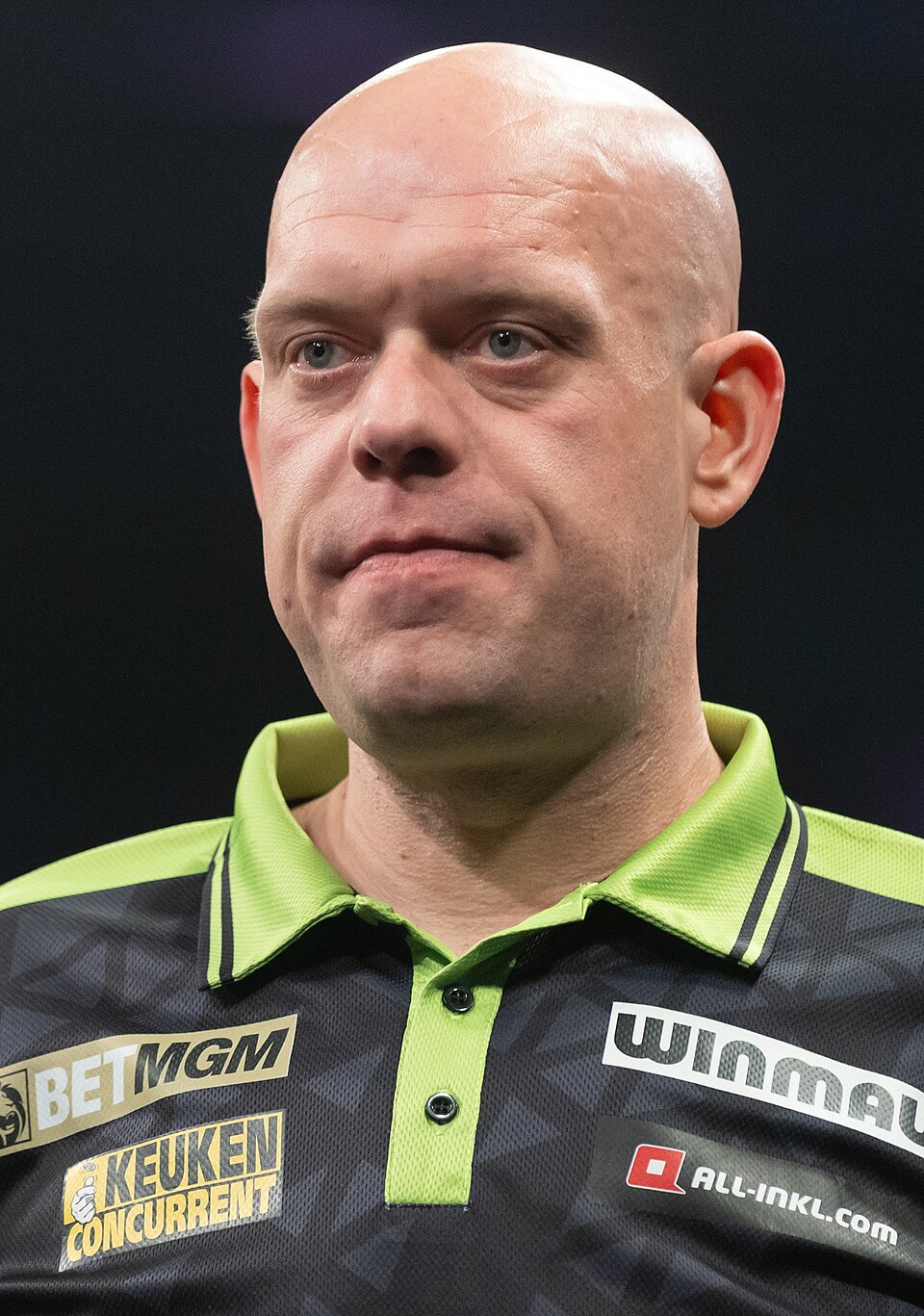
Michael van Gerwen
John Lowe
Stat by stat
Bars are scaled to the leader in this list.
The verdict
Dead even across the measured categories. Our all-time ranking places Michael van Gerwen at #2 and John Lowe at #5.
Head-to-head FAQ
Who leads more shared metrics?
How do the published ranks compare?
Are these live stats?
The case for Michael van Gerwen
The best player of the post-Taylor era and the most naturally gifted thrower the sport has seen. Van Gerwen won the Winmau World Masters in 2006 at 17, becoming the youngest world champion of any description at the time, then took three PDC world titles in 2014, 2017 and 2019 from five finals, seven Premier League crowns and three World Matchplays among more than 25 televised majors. His statistical peak is unmatched: the highest televised three-dart average in history, 123.40 against Michael Smith in the 2016 Premier League, and the highest average in a World Championship final, 114.05 in the 2017 win over Gary Anderson. He held the world number one ranking continuously for roughly seven years from early 2014. Where Taylor's dominance was built on relentless accumulation, van Gerwen's was built on speed and a scoring ceiling nobody else could reach — he throws fast, rarely reconsiders, and at his best simply outscores opponents into irrelevance.
The case for John Lowe
The only player to win world titles in three different decades — 1979, 1987 and 1993 — from seven world finals, across a career that bridged the pub era and the professional one. Old Stoneface was the technical antithesis of Bristow: unhurried, expressionless, orthodox in stance and grip, and admired by coaches as the model throw. He added two Winmau World Masters and a News of the World title among more than ten televised majors, and on 13 October 1984 he threw the first nine-dart finish ever seen on television, at the MFI World Matchplay against Keith Deller, closing 180, 180 and treble 17, treble 18, double 18 for a prize of £102,000 — an enormous sum for any British sportsman of the period. He was among the sixteen players who broke away in 1992 to found what became the PDC, and he remained competitive on television into his fifties.