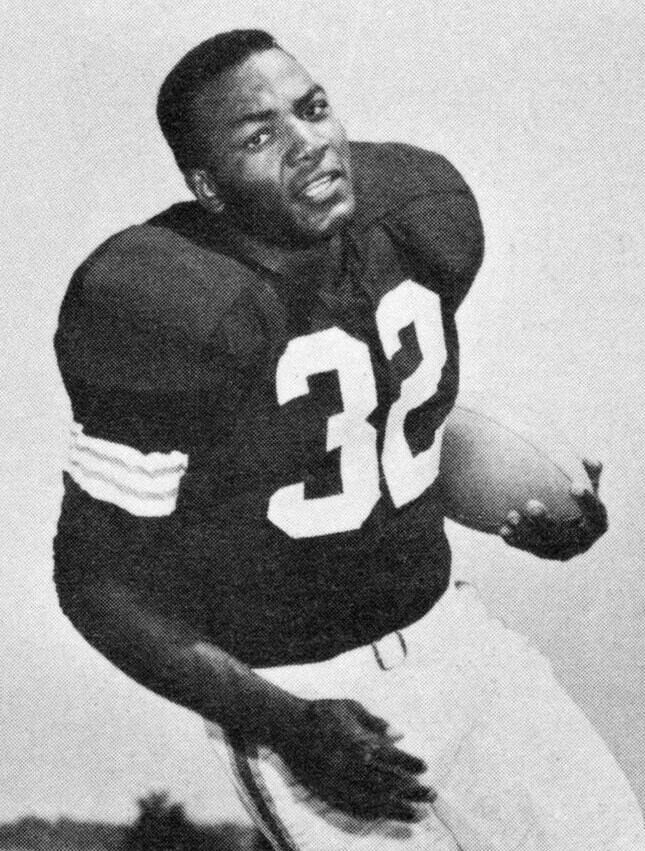
Jim Brown
Walter Payton
Stat by stat
Bars are scaled to the leader in this list.
The verdict
Walter Payton leads 2 of 2 categories. Our all-time ranking places Jim Brown at #3 and Walter Payton at #8.
Head-to-head FAQ
Who leads more shared metrics?
How do the published ranks compare?
Are these live stats?
The case for Jim Brown
In just nine seasons Jim Brown established himself as the standard against which running backs are still measured. He led the NFL in rushing in eight of his nine years, retired as the all-time leader with 12,312 rushing yards and 106 rushing touchdowns, and averaged a staggering 5.2 yards per carry over his career. He won three MVP awards (1957, 1958, 1965) and never missed a game, an iron-man record made more remarkable by the punishment he absorbed as the focal point of every defense. Brown combined the power of a fullback with breakaway speed, and he walked away at his peak, age 29, to pursue acting and activism. Adjusted for era and workload, his dominance over his peers arguably exceeds that of any back who followed.
The case for Walter Payton
Sweetness combined grace, durability, and toughness into the most complete running back of his generation. Payton retired as the NFL all-time leader in rushing yards with 16,726 and rushing touchdowns with 110, and his 21,264 all-purpose yards reflected his value as a receiver and blocker as well as a runner. He was famed for finishing runs by lowering his shoulder into tacklers rather than avoiding them, and for near-perfect availability across thirteen seasons with the Chicago Bears. He won the 1977 MVP and a Super Bowl in the Bears dominant 1985 season. The NFL Man of the Year award now bears his name, honoring the character and community work that made him one of the sport most beloved figures as well as one of its greatest.