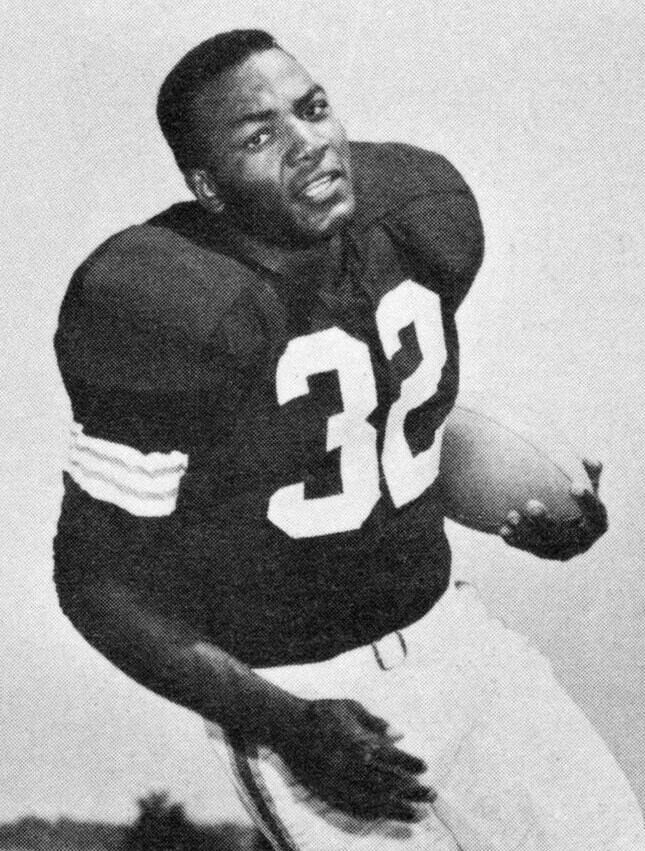
Jim Brown

Barry Sanders
Stat by stat
Bars are scaled to the leader in this list.
The verdict
Jim Brown leads 2 of 3 categories. Our all-time ranking places Jim Brown at #3 and Barry Sanders at #10.
Head-to-head FAQ
Who leads more shared metrics?
How do the published ranks compare?
Are these live stats?
The case for Jim Brown
In just nine seasons Jim Brown established himself as the standard against which running backs are still measured. He led the NFL in rushing in eight of his nine years, retired as the all-time leader with 12,312 rushing yards and 106 rushing touchdowns, and averaged a staggering 5.2 yards per carry over his career. He won three MVP awards (1957, 1958, 1965) and never missed a game, an iron-man record made more remarkable by the punishment he absorbed as the focal point of every defense. Brown combined the power of a fullback with breakaway speed, and he walked away at his peak, age 29, to pursue acting and activism. Adjusted for era and workload, his dominance over his peers arguably exceeds that of any back who followed.
The case for Barry Sanders
No runner was more electrifying, or more impossible to tackle in the open field, than Barry Sanders. In just ten seasons with a mostly modest Detroit Lions supporting cast, he ran for 15,269 yards and 99 touchdowns while averaging 5.0 yards per carry, and he made the Pro Bowl in all ten years. His 1997 MVP season saw him rush for 2,053 yards, one of only a handful of 2,000-yard campaigns in history. Sanders combined a preternaturally low center of gravity with stop-start agility that left defenders grasping at air, producing highlight runs that remain iconic. He shocked the sport by retiring at 30, within reach of the all-time rushing record, leaving fans to wonder just how high his numbers might have climbed.