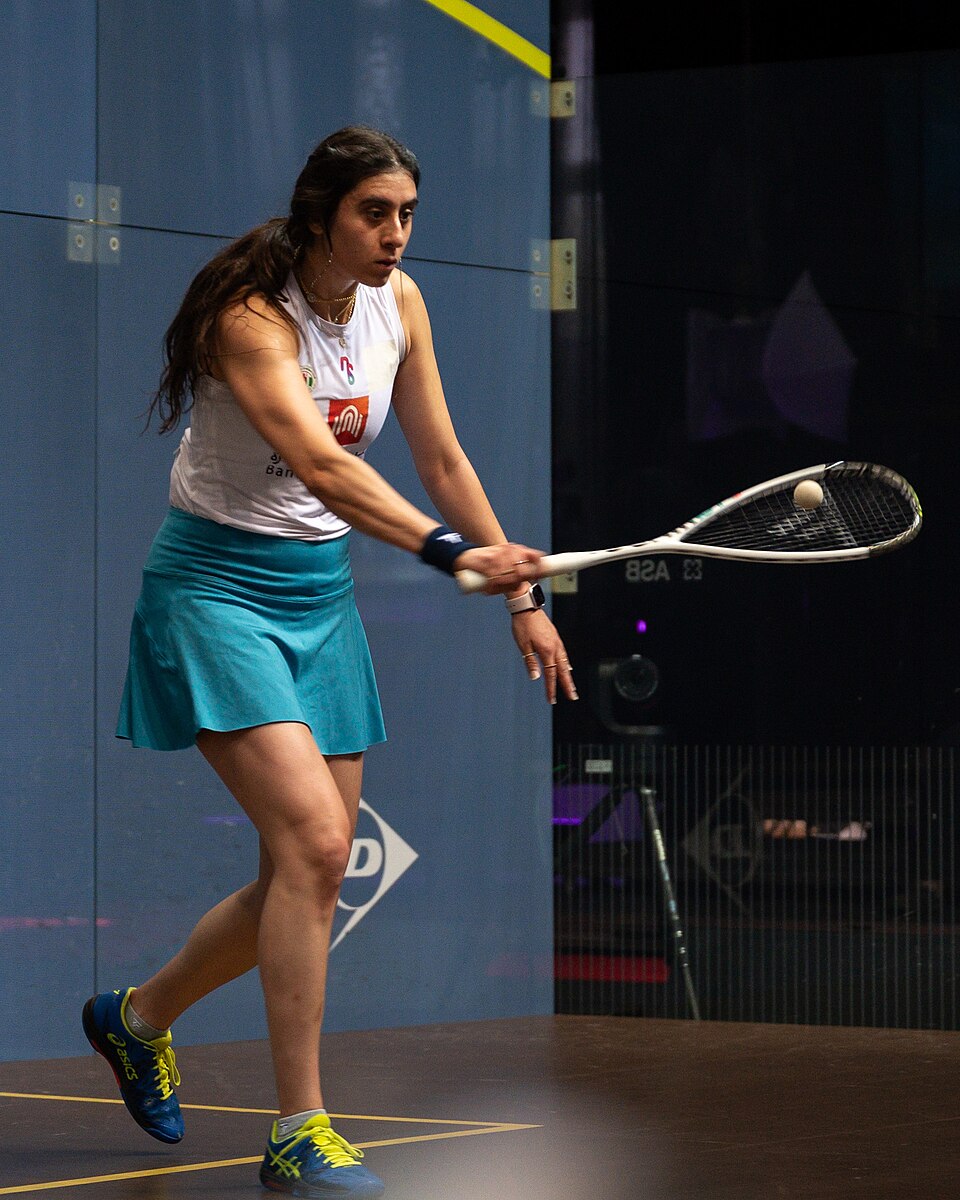
Nour El Sherbini
Sarah Fitz-Gerald
Stat by stat
Bars are scaled to the leader in this list.
The verdict
Nour El Sherbini leads 3 of 4 categories. Our all-time ranking places Nour El Sherbini at #8 and Sarah Fitz-Gerald at #11.
Head-to-head FAQ
Who leads more shared metrics?
How do the published ranks compare?
Are these live stats?
The case for Nour El Sherbini
The defining player of the Egyptian age and the youngest women's world champion in history, winning her first World Championship in 2016 at 20 after reaching the final at just 16 in 2012 — the youngest finalist ever. By the 2024-25 season she had assembled seven world titles, behind only Nicol David's record eight, plus multiple British Opens and long spells at world number one that have traded back and forth with her compatriots Raneem El Welily, Nouran Gohar and Hania El Hammamy. Her squash is the clearest statement of the modern Egyptian template: elite movement combined with holds, disguised drops and an ability to attack from positions where earlier generations would have played safe. She won world junior titles before she was 16 and has stayed at the top for more than a decade, an unusual longevity in a system that burns through prodigies, and she is the athlete most likely to carry Egypt's flag into the 2028 Olympic tournament.
The case for Sarah Fitz-Gerald
Five World Open titles — in 1996, 1997, 1998, 2001 and 2002 — put Fitz-Gerald behind only Nicol David and Nour El Sherbini in the history of the women's world championship, and she added a British Open crown to go with them. Her career divides in two: three straight world titles in the late 1990s, then a serious knee injury and a comeback that produced two more at an age when most players of the period had retired. She reached world number one in 1996 and returned to it after the injury, a rare double ascent. Fitz-Gerald was known for a compact, low-error game and exceptional composure in deciding games, and she was central to Australia's dominance of the World Team Championship through the 1990s. She later moved into coaching and administration and served on the World Squash Federation's board during the sport's Olympic campaign.