
Jahangir Khan
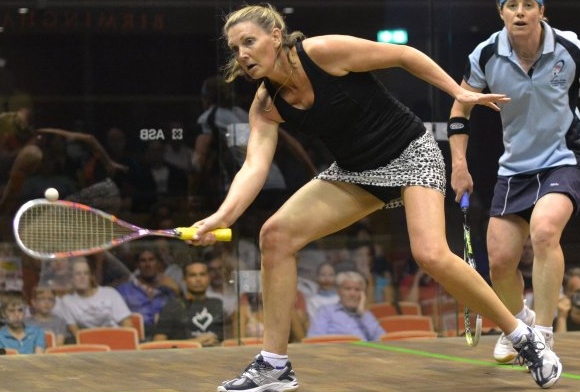
Michelle Martin
Stat by stat
Bars are scaled to the leader in this list.
The verdict
Jahangir Khan leads 3 of 4 categories. Our all-time ranking places Jahangir Khan at #1 and Michelle Martin at #10.
Head-to-head FAQ
Who leads more shared metrics?
How do the published ranks compare?
Are these live stats?
The case for Jahangir Khan
The holder of the longest winning streak in professional sport: 555 consecutive matches unbeaten over five years and eight months, from a British Open final loss to Geoff Hunt in November 1981 until Ross Norman beat him in the 1986 World Open final in Toulouse. He had already won the world amateur title at 15 and the World Open at 17 in 1981, still the youngest men's world champion. He finished with six World Opens and ten consecutive British Opens from 1982 to 1991, sixteen majors in all, built on a length game so accurate and a fitness base so deep that opponents described facing him as an interrogation rather than a match. His 1983 win over Gamal Awad lasted 2 hours 46 minutes, the longest recorded competitive squash match. Son of the great Roshan Khan and nephew of Hashim, he later served as president of the World Squash Federation. No one else in squash combines that peak with that duration.
The case for Michelle Martin
The most decorated member of the most remarkable family in squash. Martin won three consecutive World Opens in 1993, 1994 and 1995 and six consecutive British Opens from 1993 to 1998, nine majors in six years of near-total control of the women's game between the Devoy and Fitz-Gerald eras. Her brothers were both world-class professionals: Rodney Martin won the 1991 World Open in Adelaide by beating Jahangir Khan in the semifinal and Jansher Khan in the final, the only man to defeat both at their peak in a single tournament, while Brett Martin also reached the world top five. Michelle's game was orthodox, powerful and relentlessly accurate, built on Australian coaching orthodoxy of hard length and early volleying, and she led Australia to repeated World Team Championship success. She is a rare case of a player whose peak was total but whose reputation has faded simply because it sat between two more famous eras.