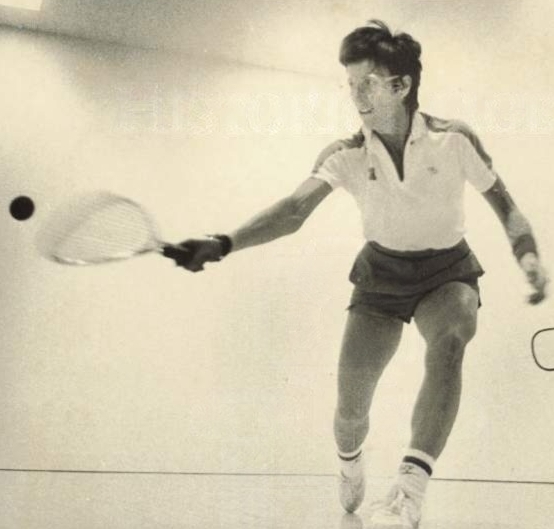
Heather McKay
Jonah Barrington
Stat by stat
Bars are scaled to the leader in this list.
The verdict
Heather McKay leads 4 of 4 categories. Our all-time ranking places Heather McKay at #2 and Jonah Barrington at #9.
Head-to-head FAQ
Who leads more shared metrics?
How do the published ranks compare?
Are these live stats?
The case for Heather McKay
The most complete domination in the history of any racket sport. McKay lost exactly two competitive matches in her entire career, both in 1962, and was never beaten again — a run of roughly nineteen unbeaten years. She won sixteen consecutive British Opens from 1962 to 1977, when the British Open was the sport's world championship in all but name, and then won the first two Women's World Opens in 1976 and 1979, giving her eighteen major titles. She also won the Australian championship fourteen times. Her superiority was so absolute that contemporaries struggled to describe her weaknesses, and when she retired she switched codes and won the women's world racquetball championship as well. The standard argument against her is field depth: women's squash in the 1960s was smaller and less professional than the men's game. The standard answer is that she never lost to anyone, for two decades, in any of it.
The case for Jonah Barrington
The least naturally gifted player on this list and one of the most influential. Barrington came to serious squash in his twenties, having been expelled from university, and concluded that he could not out-hit the Pakistanis so he would out-train the entire sport. The regime he built — road running, weights, court sprints, brutal solo drilling — had no precedent in any racket sport and effectively invented modern squash conditioning. He won six British Opens between 1967 and 1973, at a time when that title was the world championship, and represented both Ireland and Great Britain. His impact off court was larger still: articulate, evangelical and made for television, he turned squash into a mass participation boom in Britain through the 1970s, when hundreds of new courts were built to meet demand. Every player who now treats fitness as the primary competitive weapon, from Jansher Khan to Paul Coll, is working inside the template he set.